
How Much Is 1 Gram? Weight, Examples & Conversions
Pick up a single paperclip and rest it on your fingertip. That barely-there weight — the kind you’d forget was there — is, near enough, one gram. It’s one of the lightest units most people ever measure by hand, which is exactly why it trips so many of us up. A gram is too small to feel clearly, yet it matters enough that bakers, jewelers, and postal clerks weigh things down to it every day.
This page gives you a fast, honest picture of what a gram actually is: the numbers, a set of real objects that hit that weight, a trick for estimating one without any equipment, and the reason your eyes can never truly “see” a gram. No fluff — just the mental reference points that make this tiny unit click.
The Short Answer
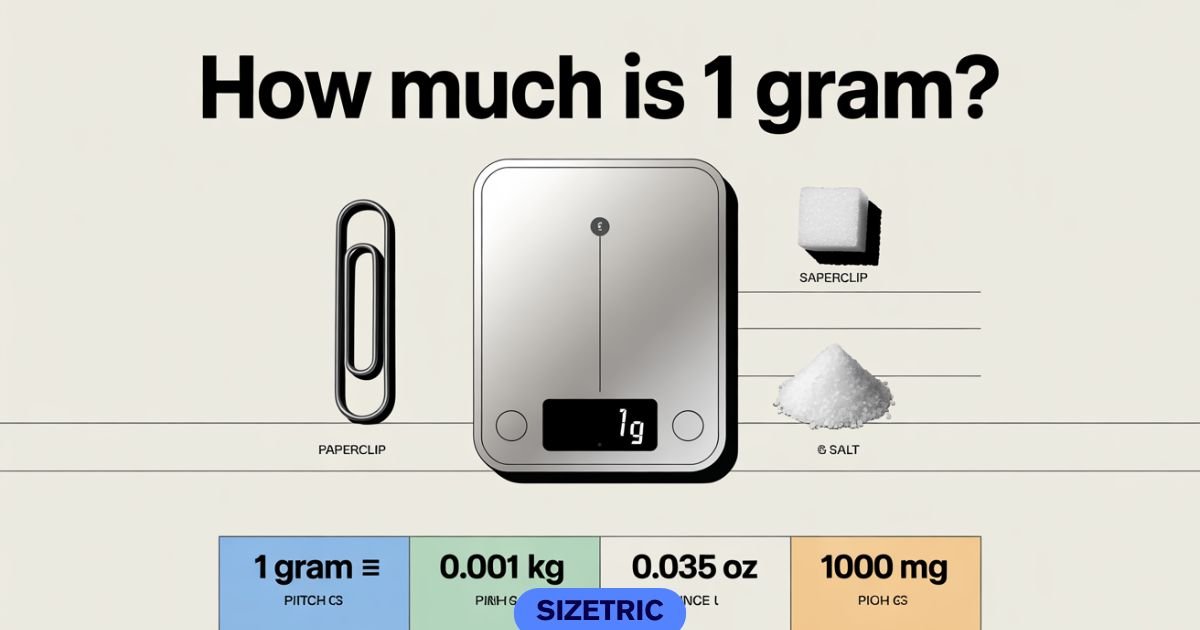
One gram is a very light unit of mass — roughly the weight of a US dollar bill, a small paperclip, or a single plain M&M. In plain numbers, 1 gram = 1,000 milligrams = 0.001 kilograms, which works out to about 0.035 ounces. There’s also a neat anchor built into the metric system: one gram is the mass of exactly 1 milliliter (one cubic centimeter) of water. That water definition is where the unit comes from, and it’s the cleanest way to picture a gram before you memorize any objects.
1 Gram in Other Units
Here’s the same weight expressed across the units you’re most likely to run into — metric, imperial, and a couple of specialist ones for jewelry and pharmacy.
| Unit | 1 gram equals |
| Milligrams (mg) | 1,000 mg |
| Kilograms (kg) | 0.001 kg |
| Ounces (oz) | ≈ 0.0353 oz |
| Pounds (lb) | ≈ 0.0022 lb |
| Carats (gemstones) | 5 carats |
| Grains | ≈ 15.43 grains |
| Water, by volume | 1 mL (1 cm³) |
Two conversions are worth committing to memory. First, there are 1,000 milligrams in a gram, which is why medicine doses jump straight to mg once amounts get tiny. Second, a full ounce is about 28.35 grams, so a gram is only a small slice of one — a little over a thirtieth.
What a Gram Actually Feels Like
Honestly? It barely feels like anything. Lay a dollar bill flat across your open palm and the sensation is closer to a warm breath than to real weight. Balance a paperclip on the back of your hand and you’ll struggle to tell it’s there with your eyes closed.
That near-nothingness is the whole point. A gram sits right at the edge of what human touch can register, so we’re bad at judging it by feel alone. This is why kitchen and jewelry scales exist, and why “eyeballing” a gram works only as a rough estimate. Once you accept that a gram is supposed to feel almost weightless, the reference objects below start to make a lot more sense.
Everyday Things That Weigh About 1 Gram
These are the reliable, easy-to-picture references. Where a real range exists, I’ve given it rather than pretending every item is a perfect gram.
A US Dollar Bill
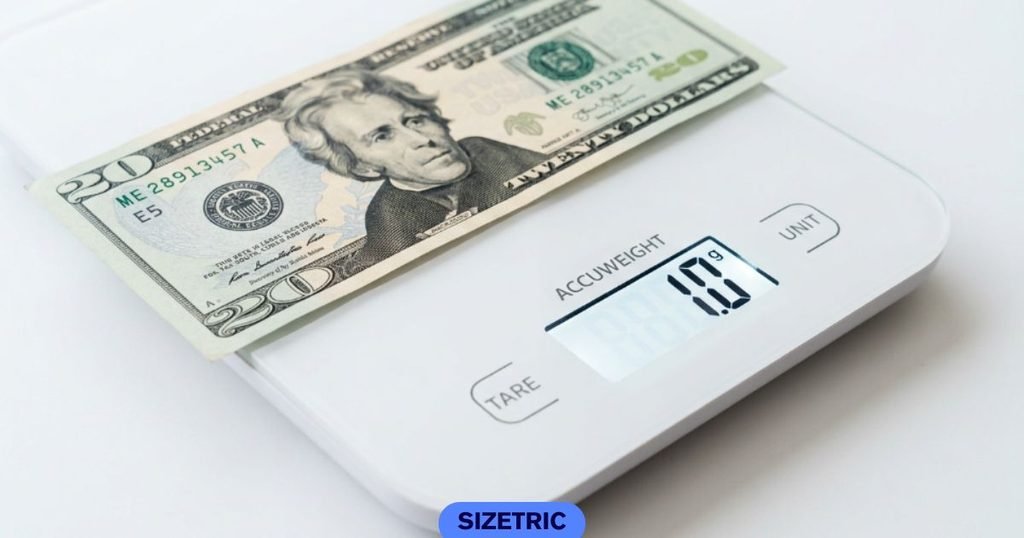
Every US banknote — $1, $20, $100, it makes no difference — weighs almost exactly 1 gram (about 0.98–1.0 g). The paper stock and size are standardized, so the denomination doesn’t change the mass. Slide a bill out of your wallet and you’re holding a physical, always-available gram. It’s the single best on-hand reference most people carry.
Read Also: 100 Grams: How Heavy It Is + What Weighs That Much
A Regular Paperclip
A standard metal paperclip lands right around 1 gram, though it depends on size: the small ones dip closer to 0.5 g, and jumbo clips push past 1.5 g. Grab a “regular” clip from a desk drawer and you’ve got a decent gram in your fingers. Because paperclips are everywhere in offices, this is a handy check when a proper scale isn’t nearby.
One Milliliter of Water
By definition, 1 mL of water weighs 1 gram at its densest (a cubic centimeter — a cube one centimeter on each side). This isn’t an approximation dreamed up for convenience; it’s how the gram was originally set. If you’ve got a measuring syringe or a marked medicine cup, drawing up exactly 1 mL of water gives you a gram you can trust to the decimal.
A Plain M&M
A single plain M&M weighs about 0.9 grams — just a hair under a gram. Peanut and other filled versions are heavier and vary more, so stick to the classic plain candy for this one. It’s a fun, tangible reference for teaching a kid what a gram is, since almost everyone has a rough sense of an M&M’s heft.
Two Tic Tacs
Each Tic Tac weighs roughly 0.5 gram, so a pair adds up to about 1 gram. Tap two into your palm and you’re holding a gram of breath mint. Because the little mints are so uniform, they double as a surprisingly consistent unit — one is half a gram, two is a gram, four is two.
A Quarter-Teaspoon of Sugar
Granulated sugar runs about 4.2 grams per level teaspoon, so a quarter-teaspoon is close to 1 gram (a touch over). Table salt behaves similarly by volume. This is the reference that actually earns its keep in the kitchen, where you’re rarely weighing a coin but often nudging a small amount of a dry ingredient.
A Plump Raisin
A single large, plump raisin weighs roughly 1 gram; smaller, drier ones come in under that at around 0.5 g. Raisins vary more than manufactured objects, so treat this as approximate rather than exact. Still, when you want a soft, organic example instead of metal or paper, a raisin does the job.
Around 30 to 50 Grains of Rice
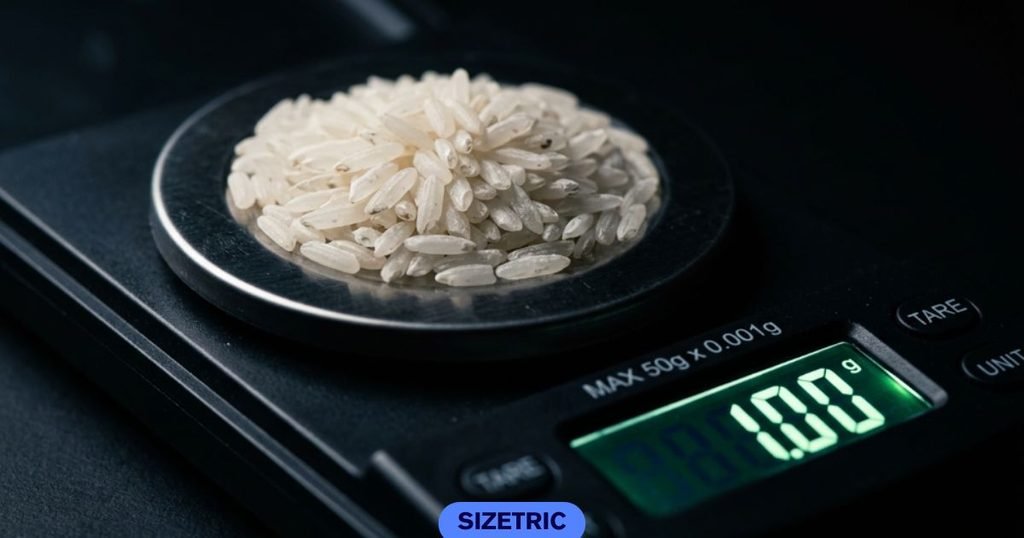
One dry grain of uncooked rice weighs only about 0.02–0.03 g, so it takes roughly 30 to 50 grains to reach a gram. Counting them out is a genuinely useful classroom demo — it turns an abstract unit into a small, visible pile. It also drives home just how little a gram is when it’s split into tiny pieces.
A few more that land close: a single jelly bean (~1.1 g), a standard business card (~1 g), and one almond (~1.0–1.3 g). None is exact, but all sit in the right neighborhood.
1-Gram Reference Objects at a Glance
| Object | Approx. weight | Exact or estimate? |
| US dollar bill | ~1.0 g | Very close, standardized |
| 1 mL of water | 1.0 g | Exact by definition |
| Regular paperclip | ~1.0 g | Estimate (size varies) |
| Two Tic Tacs | ~1.0 g | Estimate |
| Plain M&M | ~0.9 g | Estimate |
| Quarter-teaspoon of sugar | ~1.0 g | Estimate |
| Plump raisin | ~1.0 g | Estimate (varies) |
| ~30–50 grains of rice | ~1.0 g | Estimate |
No Scale? Estimate a Gram Like This
You can’t reliably feel a single gram, but you can borrow a known object. The trick is to start from something standardized and count.
Your best pocket references are a dollar bill (~1 g) and a paperclip (~1 g) — both are close enough that a couple of them stacked or clipped together gets you into the right range. Need roughly 5 grams? A US nickel weighs exactly 5 grams, so it’s the same as five paperclips. Want half a gram? A single Tic Tac gets you there.
For dry kitchen ingredients, lean on the spoon method instead: a level quarter-teaspoon of a fine powder like salt, sugar, or baking soda is about a gram. It won’t satisfy a jeweler, but it’s fine for cooking. The honest rule: use references for a ballpark, and use an actual scale the moment precision matters.
Just Under and Just Over a Gram
Knowing a gram’s neighbors makes it far easier to place. Slip below and you enter milligram territory — half a gram (0.5 g) is one Tic Tac, and a single grain of rice is only about 0.03 g (30 mg). Once you’re weighing individual grains, seeds, or crumbs, you’ve dropped well under a gram and should be thinking in milligrams.
Climb above and coins take over. A US penny is 2.5 grams, and a nickel is a clean 5 grams — five times a paperclip. So the quickest sanity check is this: if an object feels as heavy as a coin, it’s already several grams, not one. Anything that lands on your palm with a noticeable, unmistakable weight has left gram-scale behind.
Why You Can’t Judge a Gram by Its Size
Here’s the part that catches people out: weight and size are not the same thing, and a gram proves it better than almost any unit. Two objects that both weigh a gram can look wildly different, because volume depends on density.
Start with water: 1 gram fills exactly 1 cubic centimeter — a tidy little cube. Now swap the material. Gold is about 19 times denser than water, so a gram of gold occupies only around 0.05 cm³ — a fleck smaller than a match head. Go the other way to loose down feathers, which are mostly air, and a gram puffs up into a visible tuft you could see across the room.
Same gram, three completely different sizes. That’s why your eyes can never weigh anything past a rough guess — they’re reading volume, not mass. It’s the classic “gram of feathers versus gram of gold” puzzle, and the answer is that they weigh the same; they just refuse to look it.
Read Also: How Much Is 10 Grams? A Weight You Can Hold in Two Coins
Where Measuring to the Gram Really Counts
A gram sounds trivial until you land in a situation where it isn’t. A few where the single unit genuinely matters:
In the kitchen. Yeast, baking soda, salt, and spices all work in small amounts, and a gram off can shift a small bake or a shot of espresso. Baristas dose coffee to the gram for exactly this reason.
At the post office. Paper is light, but postage tiers aren’t forgiving — an extra sheet or a heavier envelope can tip a letter into the next rate. When you’re near a weight threshold, grams decide the price.
In jewelry and precious metals. Gold is bought and sold per gram, so one gram is a meaningful chunk of money, not a rounding error. Gemstones use carats, where 5 carats equal 1 gram — a stone’s whole value can hinge on a fraction of a gram.
On nutrition labels. Sugar, sodium, protein, and fiber are all listed in grams. One gram of sugar carries about 4 calories, and a typical sugar cube is roughly 4 grams — useful math when you’re reading the back of a package.
Questions People Actually Ask
What is 1 gram equal to?
One gram equals 1,000 milligrams, 0.001 kilograms, or about 0.035 ounces. It’s also the mass of exactly 1 milliliter of water.
What does 1 gram look like?
Picture a US dollar bill, a small paperclip, or a single plain M&M. Any one of those weighs right around a gram.
Is 1 gram equal to 1 teaspoon?
No — a teaspoon is a volume, a gram is a weight, so it depends on the ingredient. Sugar or salt run about 4–5 grams per teaspoon, so 1 gram is closer to a quarter-teaspoon.
Is 1 gram 1000 mg?
Yes — 1 gram is exactly 1,000 milligrams. That’s why tiny amounts get written in mg instead of fractions of a gram.
How much is 1 mg?
One milligram is one-thousandth of a gram — far too light to feel, roughly the weight of a single grain of salt.
The One-Line Takeaway
So now you know all about 1 gram. It is a very small weight. A dollar bill weighs about 1 gram. A paperclip weighs about 1 gram too. You cannot really feel it in your hand. That is normal, because a gram is one of the lightest weights we measure. One gram also equals 1,000 milligrams, and it matches the weight of 1 milliliter of water.
You can use easy objects to picture this weight anytime. Keep the dollar bill and paperclip in your mind as quick guides. When you cook, a quarter-teaspoon of sugar comes close to 1 gram. When you shop or study, this small unit still helps a lot. Bakers, jewelers, and shops all measure things down to the gram. Now you will spot this weight with ease.
Related Guides:
1: 500 Grams: How Heavy It Is & What Weighs That Much
2: Coke Can Dimensions: Height, Diameter & Every Size
3: Pokémon Card Dimensions: Exact Size in Inches, mm & cm
4: Gatorade Bottle Dimensions: Every Size, Measured
5: Red Bull Can Dimensions: All Sizes, Height & Diameter


2 Comments