
Coke Can Dimensions: Height, Diameter & Every Size
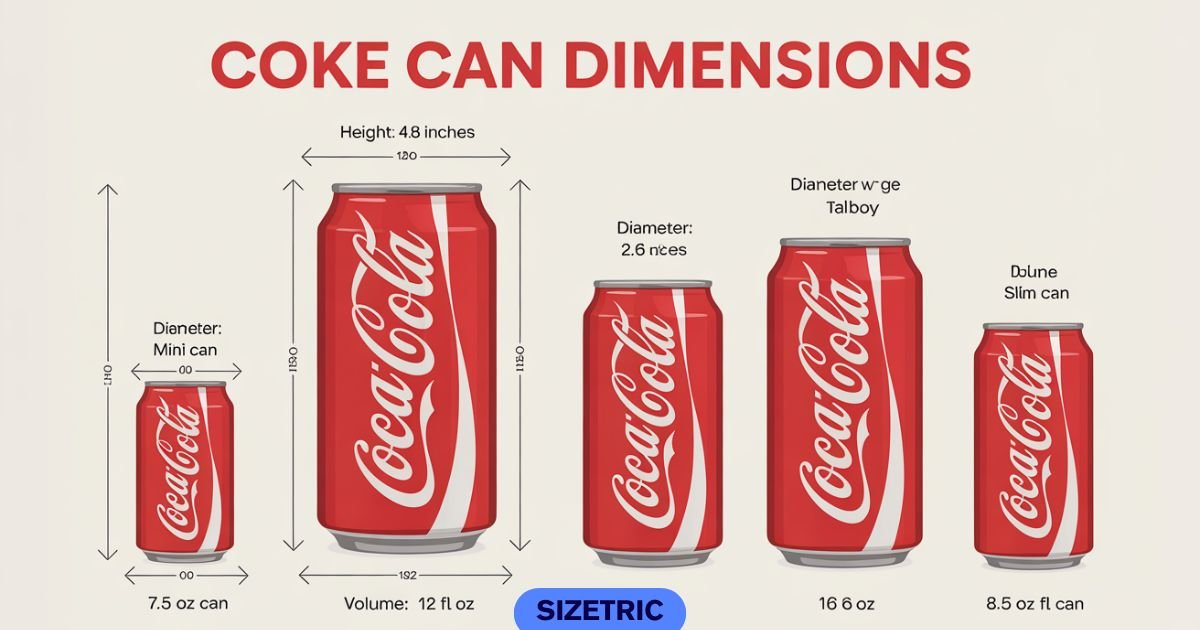
Pick up a Coke and you’re holding one of the most precisely standardized objects in your kitchen. A regular American can is 4.83 inches tall and 2.6 inches across — numbers that have barely moved since aluminium replaced steel in the 1960s. But “a can of Coke” isn’t one size. It’s a whole family, from a stubby 7.5 oz mini to a 16 oz tallboy, and the diameter stays fixed while the height stretches to hold more.
Below you’ll get the exact height, width, diameter, circumference and volume for every format Coke actually sells — in inches, centimetres and millimetres — plus a spec sheet, a side-by-side table, honest real-world comparisons, and the storage math that tells you how many will fit in your fridge.
A Standard Coke Can at a Glance
The one you buy from a vending machine in the US is the 12 fl oz (355 ml) can. It stands 4.83 in (12.3 cm / 122.7 mm) tall and measures 2.6 in (6.6 cm / 66 mm) in diameter at its widest point. The lid is smaller than the body — the top necks in to about 2.13 in (54 mm) — which is why a can looks slightly tapered near the tab.
Wrap a tape measure around the body and you’ll get a circumference of roughly 8.15 in (207 mm). Empty, the can weighs about 14 grams; full, it’s close to 13 ounces. That’s the whole answer in two lines — but the size you meet depends heavily on where you are in the world, so the variants are worth a proper look.
The Full Spec Sheet for a 12 oz Can
Here’s the standard American can broken down into every measurement people actually search for, with all three unit systems side by side.
| Measurement | Inches | Centimetres | Millimetres |
| Height | 4.83 in | 12.3 cm | 122.7 mm |
| Body diameter | 2.6 in | 6.6 cm | 66 mm |
| Lid diameter | 2.13 in | 5.4 cm | 54 mm |
| Circumference | 8.15 in | 20.7 cm | 207 mm |
| Volume | 12 fl oz | 355 ml | 355 cc |
Two quick notes on those figures. The diameter is the number that stays constant across nearly every Coke format — mini and slim cans aside — because keeping one body width lets the same filling lines, tooling and vending slots handle every drink. And the height above is measured to the top rim; the visible label panel is a touch shorter.
The Full Coke Can Lineup, Size by Size
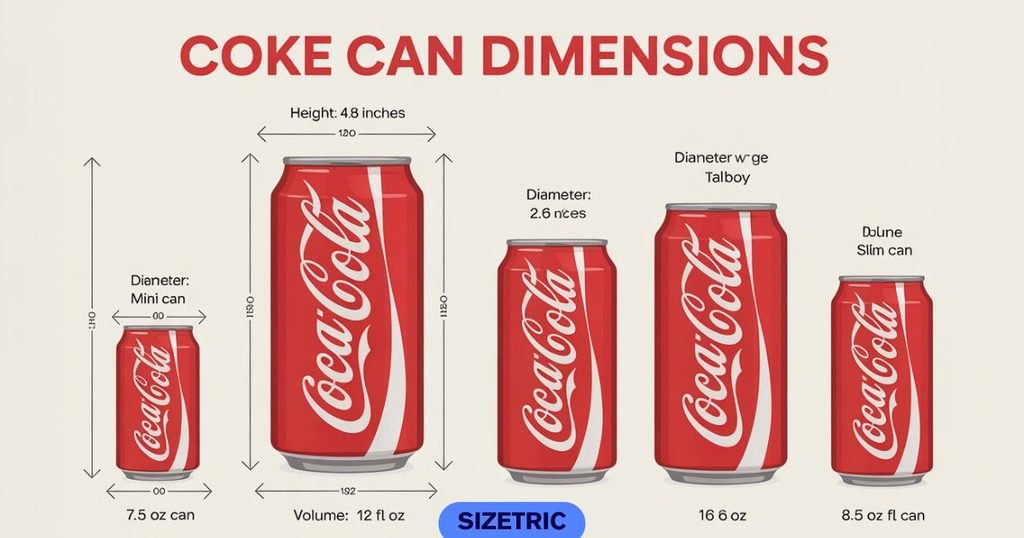
Coca-Cola sells more shapes than most people realise. Here’s each one with its real dimensions and where you’ll run into it.
The 7.5 oz Mini Can
The mini holds 7.5 fl oz (222 ml) and is the smallest can Coke makes for general sale. It’s both shorter and skinnier than a regular can, standing about 3.8 in (9.7 cm) tall with a narrowed diameter near 2.1 in (5.3 cm / 53 mm). Because it’s slimmer, its circumference drops to roughly 6.5 in — noticeably easier to close a small hand around.
This is the portion-control can, sold in multipacks and marketed for people who want a taste without a full serving. If you’re teaching a child what “small” looks like, the mini is a clean reference: it’s roughly the height of a stack of two golf balls and disappears into a coat pocket. Its skinnier body is the giveaway — set it beside a standard can and the diameter difference is obvious before the height is.
Read Also: Pokémon Card Dimensions: Exact Size in Inches, mm & cm
The 12 oz Slim Can
The slim (or “sleek”) can holds the same 355 ml as the standard, but redistributes it into a tall, narrow shape. It rises to about 6.57 in (16.7 cm) while the diameter drops to 2.28 in (58 mm), giving a circumference around 7.17 in (182 mm). Same drink, very different silhouette.
Brands reach for this format to signal a lighter, more modern, “premium” identity — you’ll see it on diet lines, flavoured sparkling drinks and energy variants far more than on classic red-label Coke. The practical catch: a slim can is too narrow for a standard foam koozie and too tall for some low fridge shelves, so it’s the one variant that quietly breaks your usual storage habits.
The 330 ml European Can
Cross the Atlantic and the default changes. The standard can across the UK and most of Europe holds 330 ml (11.2 fl oz) — a little less than the American 355 ml. It keeps the familiar 2.6 in (66 mm) body diameter but comes in shorter, at roughly 4.5 in (115 mm) tall.
That shared diameter is deliberate and clever: because the width matches the US can, the same manufacturing equipment and much of the same packaging carries over, and only the height changes to hit the smaller volume. If you’ve ever thought a European Coke looked slightly stubby, you were right — same waistline, less height.
The 12 oz American Standard
This is the reference point for everything else: 12 fl oz / 355 ml, 4.83 in (12.3 cm) tall, 2.6 in (66 mm) wide. It’s the format tuned to the American market — sized to drop cleanly into a car cup holder and to line up neatly in vending columns and fridge packs.
Every comparison in this article circles back to this can, so it’s worth committing its two headline numbers to memory: just under five inches tall, just over two-and-a-half inches wide. Get those two and you can eyeball almost any other Coke format by asking “taller or skinnier than the standard?”
The 375 ml Australian Can
Australia and New Zealand run on 375 ml (12.7 fl oz) as their standard single serve — slightly more than the US can. It holds that extra volume by growing taller, to about 5.1 in (130 mm), while sticking to the same 2.6 in (66 mm) diameter.
So three different “standard” cans — 330 ml in Europe, 355 ml in the US, 375 ml in Australia — all share one body width and differ only in height. It’s a neat illustration of how the industry standardises the hard-to-change dimension (diameter) and flexes the easy one (height) to suit local serving preferences.
The 16 oz Tallboy
The tallboy is the big single-serve you’ll see at ballparks and convenience stores: 16 fl oz (473 ml), standing about 6.2 in (157 mm) tall on the same 2.6 in (66 mm) base. Above it sits the less common 24 oz “king” can at roughly 7.4 in (188 mm) and 710 ml, for the same-diameter maximum.
What makes the tallboy handy is exactly that unchanged width — it grips like a normal can and slots into most cup holders, it’s just taller. If you’re planning cooler space, treat it as a standard can that eats about 30% more vertical room.
All Coke Can Sizes Side by Side
Every format at a glance, sorted from smallest to largest. Heights are to the top rim; slim and mini diameters differ, everything else shares the 66 mm body.
| Format | Volume | Height | Diameter | Where it’s common |
| Mini | 7.5 oz / 222 ml | 3.8 in (9.7 cm) | 2.1 in (53 mm) | US multipacks |
| Slim 12 oz | 12 oz / 355 ml | 6.57 in (16.7 cm) | 2.28 in (58 mm) | Diet / energy lines |
| European standard | 11.2 oz / 330 ml | 4.5 in (11.5 cm) | 2.6 in (66 mm) | UK & Europe |
| US standard | 12 oz / 355 ml | 4.83 in (12.3 cm) | 2.6 in (66 mm) | North America |
| Australian standard | 12.7 oz / 375 ml | 5.1 in (13.0 cm) | 2.6 in (66 mm) | Australia & NZ |
| Tallboy | 16 oz / 473 ml | 6.2 in (15.7 cm) | 2.6 in (66 mm) | US convenience |
| King | 24 oz / 710 ml | 7.4 in (18.8 cm) | 2.6 in (66 mm) | Large single-serve |
Why “Standard” Means Different Things in Different Places
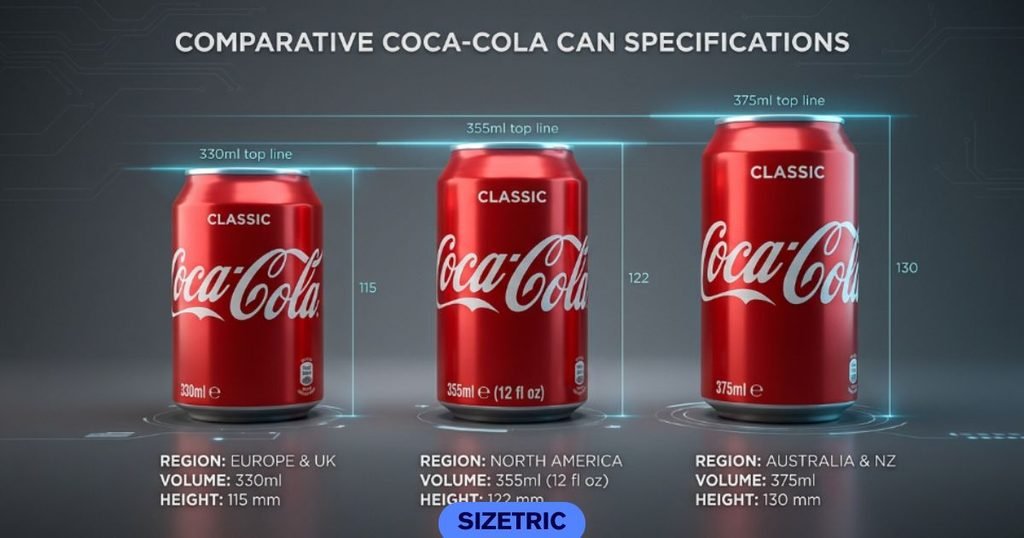
The single biggest source of confusion around Coke can dimensions is that there is no one global standard volume — there are three regional ones. The US settled on 355 ml, Europe on 330 ml, Australia on 375 ml, and each is genuinely “standard” in its own market. That’s why an imported European Coke feels short next to a domestic American one even though they look identical head-on.
The diameter, by contrast, really is near-universal. Almost every mainstream can shares the 66 mm body and a necked-in 54 mm lid, held to tolerances set by the Can Manufacturers Institute so that filling lines, seamers and vending gear stay interchangeable. Small production tolerances mean any individual can may sit a fraction of a millimetre off the nominal figure — which is why you’ll see the height quoted as anything from 122 to 123 mm depending on the source.
There’s one more reason numbers drift: the can itself has been engineered thinner over the decades. A modern wall is only around 0.1 mm of aluminium alloy, far slimmer than the cans of the 1970s, yet strong enough to hold the pressure of the carbonation inside. Lighter cans, same external dimensions.
What a Coke Can Is About the Same Size As
Because a standard can is round and pocket-sized, you can calibrate it against things you already own — useful when you don’t have a ruler handy.
The diameter is the standout match: a tennis ball is almost exactly the same width, about 2.6 in across, so a can and a tennis ball sit side by side at the same waistline. That 2.6 in also happens to land right in the range of an average adult palm width (2.5–3 in), which is part of why the can feels so natural to hold — grip one and it fills your hand without stretching your fingers.
For height, a US stick of butter (about 4.75 in long) is a close stand-in — lay one next to a can and they finish within a fraction of an inch of each other. A standard can also comes up just short of a modern smartphone stood on end, and roughly two-thirds the length of an adult hand from wrist to fingertip. On volume, 355 ml is close to 1.5 US cups of liquid — handy when a recipe calls for a rough measure and a can is the nearest thing on the counter.
No ruler at all? Make a “C” with your thumb and index finger: the gap that comfortably clears a tennis ball is the can’s diameter. Stack your reference mentally — just under three golf balls tall, one tennis ball wide — and you can gauge any Coke can within a few millimetres.
Read Also: Gatorade Bottle Dimensions: Every Size, Measured
Fitting Cans Into Fridges, Coolers and Cup Holders
The reason these dimensions get searched so often is packing. A standard 12-pack “fridge pack” is built around twelve of these 66 mm cans lying on their sides, which is why it slides onto a shelf a bit over 5 inches deep. If you’re stacking cans upright in a mini-fridge, budget about 4.83 in of clearance per can vertically and you’ll rarely misjudge a shelf.
For coolers and party planning, the width matters more than the height, because cans nest against each other by diameter. Roughly 66 mm per can means a 40-quart cooler swallows far more standard cans than tallboys — the tallboy’s extra height, not width, is what fills the space faster. And for koozies and can holders: they’re sized for the 66 mm standard body, so they grip a regular, tallboy or king can snugly but slip loosely on a mini and won’t reach around a slim can at all.
One buying tip worth knowing — if a product only lists volume, use the diameter to predict fit. Anything quoting the 66 mm body will behave like a normal can in your cup holder and fridge; a 53 mm mini or 58 mm slim will not.
Questions People Actually Ask
What is the dimension of a Coke can?
A standard Coke can is 4.83 in (12.3 cm) tall and 2.6 in (6.6 cm) in diameter, holding 12 fl oz (355 ml). The lid necks in to about 2.13 in (54 mm).
What are the dimensions of a 12-ounce soda can?
A 12 oz can measures 4.83 in (122.7 mm) tall and 2.6 in (66 mm) wide, with a circumference of roughly 8.15 in (207 mm). These specs are shared by Coke, Pepsi and most major brands.
How big is a 250ml Coke can?
A 250 ml can stands about 3.8 in (97 mm) tall with a slim 2.26 in (57 mm) diameter. That’s roughly 8.5 fl oz — common in Asian markets and European vending machines.
What is the size of a 330 ml can?
A 330 ml can is about 4.5 in (115 mm) tall with the standard 2.6 in (66 mm) diameter. It holds 11.2 fl oz — the default size across the UK and Europe.
How tall is a 330ml can of coke?
A 330 ml Coke can stands roughly 4.5 inches (115 mm, or 11.5 cm) tall — a little shorter than the US 12 oz can while keeping the same 66 mm width.
The One Line Worth Remembering
If you keep just one fact, keep this: a regular Coke can is 4.83 inches tall and 2.6 inches wide — a tennis ball’s width, a butter stick’s height. Every other size is that same body made taller or skinnier. Once the standard is fixed in your head, you can size up a mini, a slim or a tallboy at a glance, ruler or no ruler.
Related Guides:
1: Red Bull Can Dimensions: All Sizes, Height & Diameter
2: How Tall Is a Monster Can? Exact Height, Diameter, and Size Guide






3 Comments