
How Much Is 20 Grams? Weight, Conversions & Examples
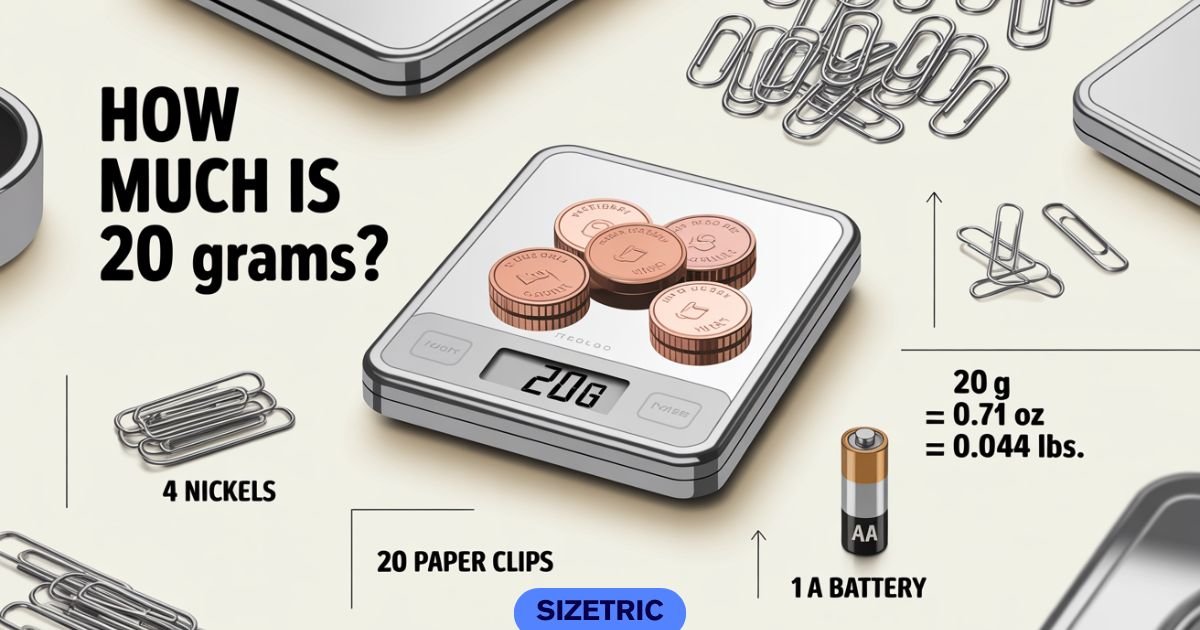
Twenty grams is a small unit of weight. It is a light amount you can hold in one hand. In simple terms, it equals four US nickels stacked together.
Have you ever wondered what 20 grams really looks like? It is not much, yet it hides in things you touch daily. Once you see it, you will spot it everywhere.
Twenty grams weighs about 0.71 ounces, or 0.02 kilograms. It matches a tablespoon of honey or four sheets of paper. This guide shows you exactly how heavy it feels.
The Short Answer
Twenty grams is a light, palm-sized weight — about 0.71 ounces, or a little under three-quarters of an ounce. The cleanest mental image is four US nickels stacked together, because each nickel weighs exactly 5 grams, so four of them land on 20 grams with no rounding at all. It’s roughly the heft of a tablespoon of honey or four sheets of printer paper resting in your hand.
In the units you’re most likely to need: 20 g = 20,000 milligrams, 0.02 kilograms, ≈ 0.71 oz, and ≈ 0.044 lb.
20 Grams in Every Unit You’ll Need
Grams sit on the metric side of the fence, so if you think in ounces and pounds, here’s the full translation in one place. I’ve added troy ounces at the bottom because anyone weighing gold or silver measures in those, not the everyday ounce.
| Unit | 20 grams equals |
| Milligrams (mg) | 20,000 mg |
| Grams (g) | 20 g |
| Kilograms (kg) | 0.02 kg |
| Ounces (oz, standard/avoirdupois) | ≈ 0.71 oz |
| Pounds (lb) | ≈ 0.044 lb |
| Troy ounces (precious metals) | ≈ 0.64 ozt |
A quick note on that last row: a troy ounce is heavier than a regular ounce (31.10 g versus 28.35 g), which is why the two figures don’t match. Kitchen and postal scales use the standard ounce; jewelers and bullion dealers use troy. Same 20 grams, two different “ounce” answers.
So, How Heavy Does 20 Grams Actually Feel?
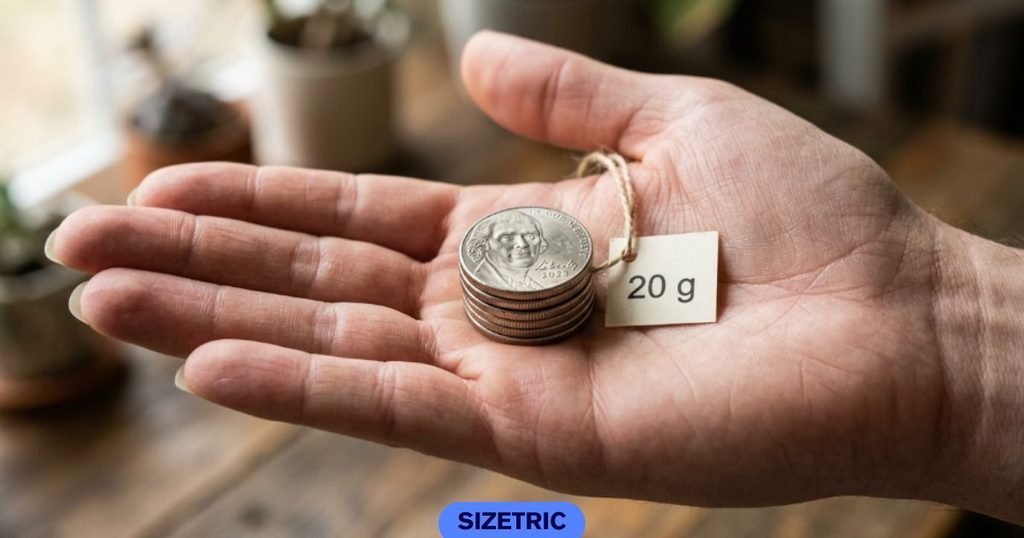
Set 20 grams in your open palm and most people barely register it — it’s the weight of a few coins, not enough to make your hand dip. It’s featherlight compared to a phone (around 170–200 g) yet clearly more substantial than a single sheet of paper or a paperclip.
The honest description is “present but easy to miss.” You’d feel it if someone dropped it into an empty envelope, but you wouldn’t feel it added to a full grocery bag. That’s the sweet spot 20 grams lives in: heavy enough to hold and notice, light enough that it never feels like much.
Everyday Objects That Land Right Around 20 Grams
These are the references I reach for when I want to show someone 20 grams instead of just saying the number. I’ve flagged which ones are near-exact and which are ballpark, because honesty beats fake precision.
Four US Nickels
A US nickel weighs exactly 5.00 grams — that’s a US Mint specification, not an estimate — so four of them come to a precise 20 grams. This is the single most reliable reference on the list. If you keep loose change around, you have a free, accurate 20-gram calibration weight sitting in a jar. Stack four, drop them in your palm, and that’s your baseline.
The nickel trick is genuinely useful for checking a cheap kitchen or jewelry scale. Place four on the pan; if it doesn’t read 20 g, the scale is off. No special calibration weight required.
Twenty One-Dollar Bills
A US banknote weighs almost exactly 1 gram, regardless of denomination, so a stack of twenty singles tips the scale at roughly 20 grams. It’s a fun party-fact reference and a genuinely handy one — currency is everywhere, and the weight barely varies with wear.
Because each bill is so close to a gram, this also scales cleanly: ten bills is about 10 g, forty bills about 40 g. Handy when you want a quick sense of a light, flat weight and there’s cash nearby.
Read Also: How Much Is 1 Gram? Weight, Examples & Conversions
Four Sheets of Printer Paper
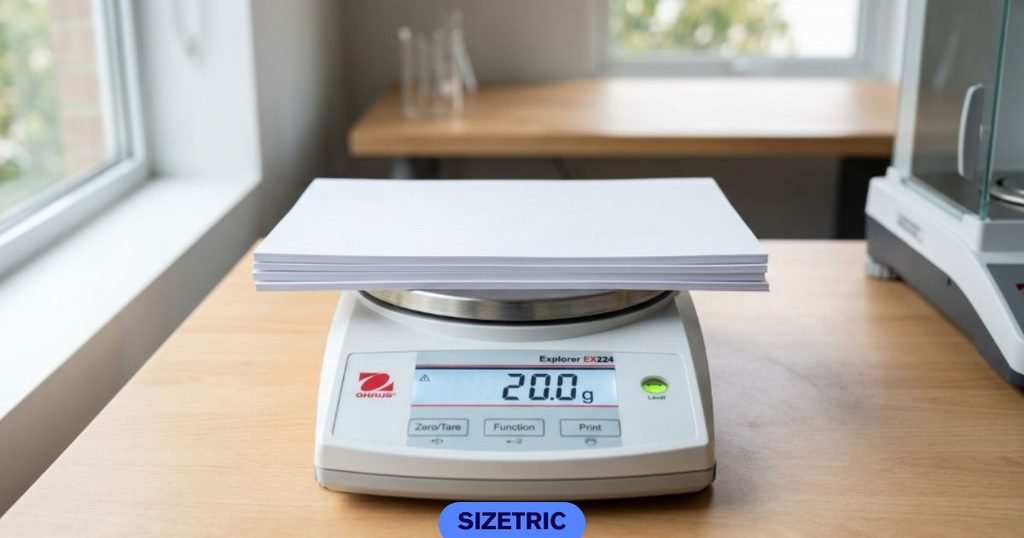
A standard sheet of A4 office paper (80 gsm) weighs 5 grams, so four sheets add up to 20 grams almost exactly. US Letter sheets run a touch lighter, closer to 4.5 g each, so you’d want about four-and-a-half of those. Either way, a small pinch of a paper stack is a solid stand-in.
This one’s great for a mailing gut-check. If you’re posting a few loose pages, four sheets plus a light envelope keeps you comfortably inside most first-class weight brackets.
A Tablespoon of Honey
One level tablespoon of honey weighs about 21 grams — just a hair over target, thanks to honey’s density. It’s the most kitchen-friendly reference here: if a recipe calls for 20 g of honey and you don’t want to dirty a scale, a slightly-under tablespoon gets you there.
Water, by contrast, is lighter per spoon (a tablespoon is about 15 g), so 20 grams of water is roughly four teaspoons, or a generous tablespoon and a bit. Density matters — the same spoon holds different grams depending on what’s in it.
A Single Slice of Processed Cheese
An individually wrapped slice of processed cheese usually weighs around 19–21 grams, landing right on 20 g for most brands. It’s an oddly precise everyday object, and one that’s easy to picture. Peel one out of the pack and you’re holding roughly 20 grams of food.
Real cheese slices vary far more, so stick to the standardized wrapped singles if you want the comparison to hold.
A Fun-Size Chocolate Bar
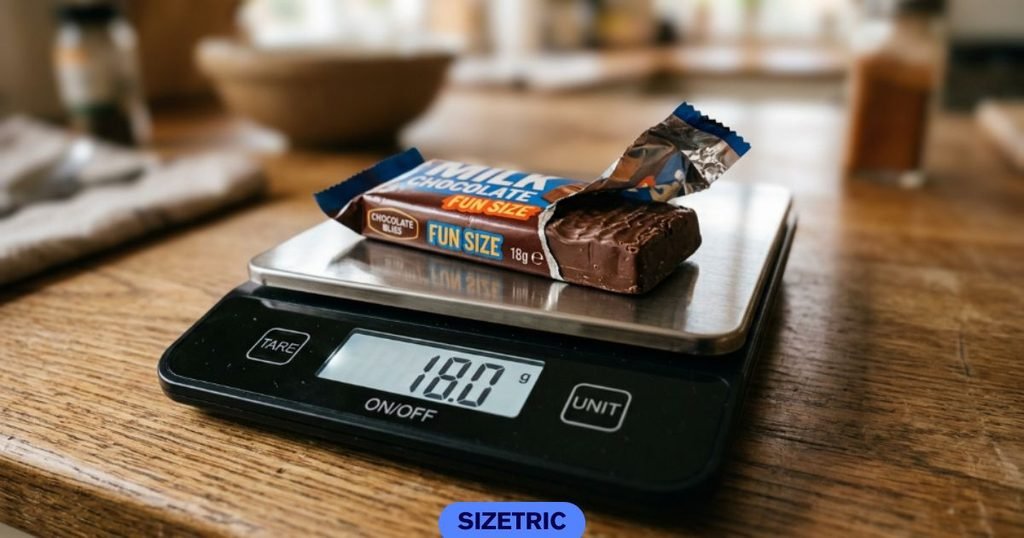
A “fun-size” or mini chocolate bar typically weighs 17–19 grams, a shade under 20 g. It won’t give you a laboratory-grade reading, but as a grab-and-hold sense of the weight, it’s spot-on — small, flat, and satisfyingly close.
Treat this as a “just under” marker. A full-size candy bar is far heavier (often 45–60 g), so don’t confuse the two.
Those References at a Glance
| Object | Approx. weight | How close to 20 g |
| Four US nickels | 20 g | Exact |
| Twenty $1 bills | ~20 g | Near-exact |
| Four sheets of A4 paper (80 gsm) | ~20 g | Near-exact |
| Single slice of processed cheese | ~19–21 g | Near-exact |
| One tablespoon of honey | ~21 g | Slightly over |
| Four teaspoons of water | ~20 g | Near-exact |
| Fun-size chocolate bar | ~17–19 g | Slightly under |
| ~20 standard paperclips | ~20 g | Approximate |
Guessing 20 Grams Without a Scale
You can’t measure weight with your fingers the way you’d measure an inch, but your hands are surprisingly good at comparing small weights when you give them a known anchor. Here’s how to fake a scale.
Use coins as a reference. Four US nickels (20 g) or eight US pennies (2.5 g each, so 20 g) make a pocket-sized standard. Hold the coins in one hand and your mystery item in the other, and you can often tell within a few grams whether it’s lighter or heavier.
Balance across two hands. Rest the known 20 g in your left palm and the item in your right. Small differences — 15 g versus 25 g — are easier to feel side by side than to judge in isolation. Your hands are comparators, not scales, so always give them something to compare against.
Anchor to a spoon in the kitchen. For food, memorize a couple of density facts: a level tablespoon of water is ~15 g, a tablespoon of honey ~21 g, a tablespoon of sugar ~12–13 g. From those, 20 grams of most ingredients is “a bit more than a tablespoon.”
None of this beats a $10 digital scale for accuracy, but it’ll get you close enough for cooking, portioning, or a quick sanity check.
10 g, 20 g, 30 g: Telling the Neighbors Apart
Twenty grams is easy to confuse with the weights right beside it, so here’s how the neighbors compare — coins make the cleanest yardstick.
10 grams is half of our target — think two nickels, two sheets of A4 paper, or a single AAA battery (about 11.5 g). In your palm it reads as “a couple of coins,” noticeably slighter than 20 g.
20 grams is our anchor: four nickels, four sheets of paper, a tablespoon of honey.
30 grams bumps up to six nickels and is right around one standard ounce plus a little (an ounce is 28.35 g). A typical slice of sandwich bread or a compact AA battery (roughly 23–30 g depending on type) lives near here. The jump from 20 to 30 g is the difference between four coins and six — small in absolute terms, but your hand can usually feel it.
The takeaway: count in nickels. Two, four, six — that ladder maps straight onto 10, 20, and 30 grams and gives you an instant frame of reference.
Where 20 Grams Shows Up in Real Life
This weight isn’t random — it turns up constantly once you know where to look. The audience for “how much is 20 grams” is usually solving one of these jobs.
Cooking and baking. Recipes lean on 20 g for small but meaningful amounts: about 1.5 tablespoons of granulated sugar, 4 teaspoons of water, a scant 1.5 tablespoons of butter, or 1 tablespoon of honey. Precise baking rewards weighing over measuring by volume, and 20 g is a common ingredient step.
Postage and shipping. A light letter — a few folded sheets in an envelope — often weighs about 20 g, comfortably inside the base first-class bracket in most postal systems. Knowing the weight helps you predict whether you’re paying the lowest tier or bumping into the next one.
Nutrition labels. Twenty grams is a headline number on food packaging: 20 g of sugar is roughly 5 teaspoons, and 20 g of protein is a solid single-serving hit (about three eggs’ worth). Seeing it as objects makes the label feel real instead of abstract.
Precious metals. Gold and silver are priced by the troy ounce, and 20 grams is about 0.64 troy ounces — just under two-thirds of an ounce. It’s a common size for small bullion bars and a chunky amount of gold jewelry. (Prices shift daily, so I won’t quote a figure, but the weight itself is fixed.)
Read Also: 100 Grams: How Heavy It Is + What Weighs That Much
Small Weight, Common Mix-Ups
A few misunderstandings trip people up with a weight this small.
Grams versus milligrams. Twenty grams is 20,000 milligrams — a thousandfold difference. This matters most with supplements and medicine doses, where a “20 mg” tablet and “20 g” of powder are worlds apart. Read the unit, not just the number.
Material doesn’t change the weight. Twenty grams of feathers and 20 grams of steel weigh the same — that’s the whole point of a fixed weight. What changes is volume: the feathers fill a bag while the steel fits in a bottle cap. Weight and size are separate questions.
The two “ounces.” As noted earlier, 20 g is ~0.71 standard ounces but ~0.64 troy ounces. Using the wrong one when valuing gold throws your math off by about 10%. Match the ounce to the context.
Weight versus mass. Strictly, grams measure mass; “weight” also depends on gravity. On Earth’s surface the distinction almost never matters for everyday purposes, so “how much does 20 grams weigh” is a perfectly fine question — just know the two aren’t technically identical.
Quick-Fire Q&A
Is 20 grams a tablespoon?
Not exactly — it depends on the ingredient. Honey is about 1 tablespoon at 20 g, while water is closer to 1.3 tablespoons.
What is an example of 20 grams?
Four US nickels weigh exactly 20 grams. A tablespoon of honey or four sheets of paper also match this weight.
How much is 20 grams to cups?
This varies by ingredient. Twenty grams of flour is about ⅙ cup, while 20 g of sugar is about ⅒ cup.
How much is 20g in teaspoons?
It depends on the substance. Twenty grams of water is about 4 teaspoons, and 20 g of sugar is about 5 teaspoons.
How to measure 20g with a spoon?
Use a tablespoon as your guide. Twenty grams equals roughly one full tablespoon of honey or about four teaspoons of water.
Locking 20 Grams Into Memory
Now you know exactly how much is 20 grams. It is a light weight that fits in your hand. Four US nickels weigh 20 grams, and so do about twenty dollar bills. A tablespoon of honey and four sheets of paper also match this weight. These simple objects give you a clear picture. You can use them any time you need to guess this weight. Keep the nickel trick in your mind, and you will always remember it.
Twenty grams equals about 0.71 ounces, or 0.02 kilograms. This small weight shows up in cooking, mail, and food labels every day. You can now measure it with confidence, even without a scale. Hold four coins in your palm, and you will feel it right away.
Related Guides:
1: How Much Is 10 Grams? A Weight You Can Hold in Two Coins
2: 500 Grams: How Heavy It Is & What Weighs That Much
3: Coke Can Dimensions: Height, Diameter & Every Size
4: Pokémon Card Dimensions: Exact Size in Inches, mm & cm
5: Gatorade Bottle Dimensions: Every Size, Measured

2 Comments