
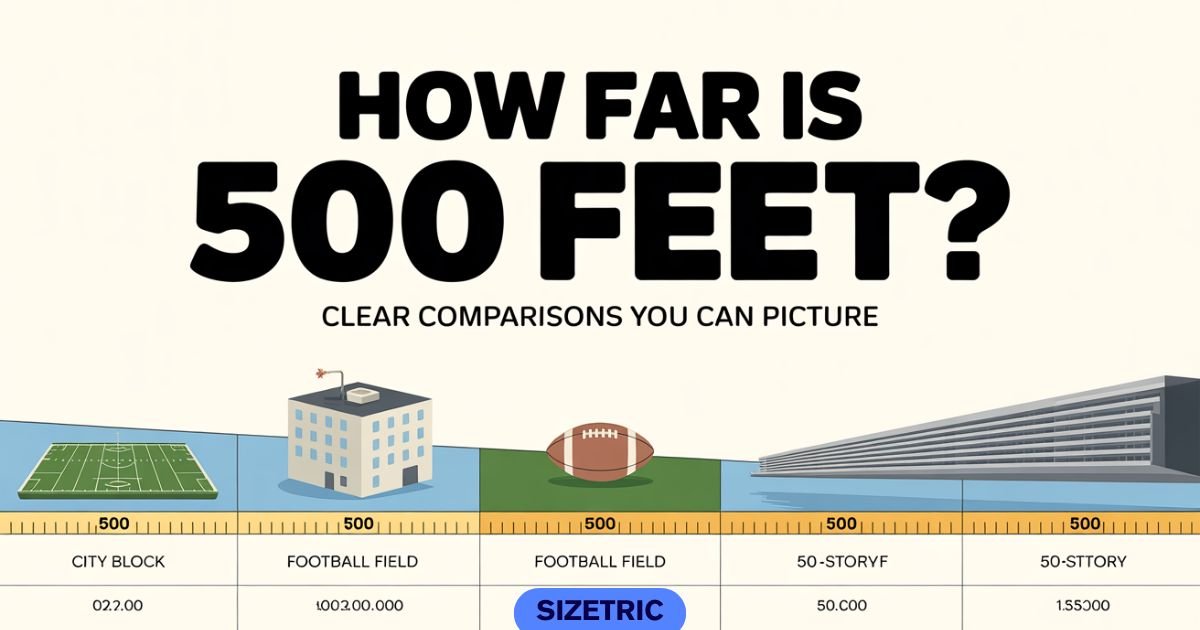
How Far Is 500 Feet? Clear Comparisons You Can Picture
Five hundred feet sounds precise until someone asks you to point to it — and suddenly the number floats loose, somewhere between “a long walk” and “not that far.” It’s the distance stamped on hunting laws, drone rules, zoning setbacks, and real estate listings, yet almost nobody can picture it on demand. Is it longer than a football field? Close to a mile? Taller than a building you’d recognize? Most people guess, and most people guess wrong.
This page fixes that. You’ll get the exact conversions up front (spoiler: 500 feet is 152.4 meters, just under a tenth of a mile), then ten real, correctly sized objects from two jumbo jets nose to tail to the Washington Monument that let you see the distance instead of just reading it. There’s a scannable comparison table, three ways to pace out 500 feet without any tools, and honest notes on where the figure actually matters. By the end, you’ll spot 500 feet instantly, no calculator required.
The Short Answer
500 feet is 152.4 meters — a little under a tenth of a mile, and roughly 1.4 American football fields laid end to end. If you’d rather picture it upright, it’s about 90% the height of the Washington Monument. Walk it at a normal pace and you’ll cover the ground in under two minutes.
Quick conversions: 500 ft = 152.4 m = 15,240 cm = 166.67 yards = 0.0947 miles.
That’s the headline. The rest of this page turns that number into something you can actually see — with named objects, honest figures, and a couple of ways to eyeball 500 feet when you don’t have a tape measure or a phone app handy.
500 Feet in Every Unit You’ll Need
Because a foot is defined as exactly 0.3048 meters, every conversion below is precise rather than rounded guesswork. Keep this table close if you’re translating a property line, a zoning setback, or a distance on a map into metric.
| Unit | 500 feet equals |
| Inches | 6,000 in |
| Millimeters | 152,400 mm |
| Centimeters | 15,240 cm |
| Meters | 152.4 m |
| Yards | 166.67 yd (166 yd 2 ft) |
| Kilometers | 0.1524 km |
| Miles | 0.0947 mi (about 1/10.6 of a mile) |
The two numbers most people actually need are the 152.4 meters and the 166⅔ yards. Notice that yardage: because a yard is three feet, 500 doesn’t divide evenly, which is exactly the kind of detail that trips people up. More on that below.
What 152 Meters Actually Feels Like
Numbers on a page don’t stick. What sticks is the sense of scale you build by anchoring 500 feet to things you already know.
Think of it as one and a half city blocks in a typical grid, or the length of a comfortable two-minute stroll. Stand at one goal line of a football field, look at the far end zone, then imagine that whole field plus another 40% tacked on — that’s your distance.
Vertically, 500 feet is genuinely tall: taller than the Great Pyramid of Giza ever stood, and roughly the height of a 45-story building. It’s the kind of distance where a person at the far end becomes hard to recognize by face. Hold that image, and the comparisons ahead will slot into place fast.
Real Objects That Measure Close to 500 Feet
Here are ten concrete references — a mix of things laid flat and things standing up. Where a figure is exact I say so; where it’s a close approximation, I say that too.
Two Boeing 747-8 Jets, Nose to Tail

The Boeing 747-8 — the stretched, modern jumbo — measures 250 feet (76.3 m) from nose cone to tail. Park two of them bumper to bumper and you land almost exactly on 500 feet. This is about as clean a one-to-one match as everyday objects get.
What makes the 747 useful isn’t just the round number; it’s that most people have a rough mental image of a jumbo jet’s bulk from airport terminals or television. Picture two of those fuselages nose-to-tail on a runway apron and you’ve got a surprisingly reliable yardstick. It’s the comparison I reach for first when someone needs to feel 500 feet rather than just read it.
Read Also: How Much Is 10 oz? Weight, Grams, Cups & Examples
A Football Field Plus Both End Zones — and Then Some

An American football field runs 360 feet (120 yards) including both end zones, or 300 feet of playing field between the goal lines. So 500 feet is about 1.4 full fields end to end — the whole gridiron plus roughly another 40 yards.
Nearly everyone carries a football field in their head, which is why it’s the go-to reference for outdoor distances. If you’re standing on the field, walk from one back line, cross the entire length, and keep going almost halfway into a second field. That overshoot is the part people forget: 500 feet is meaningfully longer than a single field, not equal to one.
Roughly Five Blue Whales in a Line
The blue whale, the largest animal ever known, reaches up to about 98 feet (30 m) for the biggest recorded individuals. Line up five of them head to tail and you’re at roughly 490 feet — a whisker short of the target, so call it five whales, give or take.
It’s an approximate reference by nature, since whale length varies, but it’s memorable precisely because the animal is so enormous. When you want to convey how substantial 500 feet really is to someone who thinks of it as “just a few car lengths,” five of the planet’s biggest creatures nose-to-tail does the job.
Three Olympic Pools End to End
A regulation Olympic swimming pool is 164 feet (50 m) long. Set three of them in a row and you cover about 492 feet — close enough that three pools is a dependable stand-in for 500 feet.
Swimmers and anyone who’s watched a big meet have a feel for that 50-meter length. Mentally chaining three of them together is easy, and the small 8-foot shortfall is negligible for casual estimating. This one shines when you’re picturing distance across a large indoor space or a long backyard.
Two and a Half NHL Hockey Rinks
An NHL hockey rink measures 200 feet (61 m) from end board to end board. Stack two and a half of them lengthwise and you hit 500 feet on the nose — another exact match.
The rink works well because it’s a fully enclosed, familiar rectangle; fans know its proportions instinctively. When you need to gauge a distance inside a venue or a large parking lot, “two rinks and a half” gives you a crisp, no-fuss picture.
The Washington Monument, Minus Its Top 55 Feet
Switching to height: the Washington Monument stands 555 feet (169 m) tall. That makes 500 feet about 90% of the way up — you’d stop just 55 feet shy of the peak.
This is my favorite vertical anchor because the monument is a slender, instantly recognizable obelisk, so it’s easy to visualize a mark near the top. Next time you need to sense 500 feet of elevation — a drone ceiling, a cliff, a tall building — imagine standing at the monument’s base and looking almost, but not quite, all the way up.
Slightly Taller Than the Great Pyramid Once Stood
When it was completed, the Great Pyramid of Giza rose to about 481 feet (146.6 m); erosion and the loss of its outer casing have since shaved it down to roughly 455 feet. So 500 feet is a touch taller than the pyramid at its original peak — by about 19 feet.
Few structures communicate sheer scale like the pyramids, and pinning 500 feet just above that ancient summit gives the number real gravity. It’s a great reach-for reference in any conversation about the height of large modern structures.
About a Block and a Half in Most Cities
A standard U.S. city block varies a lot — Manhattan’s short blocks run around 264 feet, while many grid-city blocks land closer to 300–330 feet. Using a typical ~330-foot block, 500 feet works out to roughly one and a half blocks.
Because block size is regional, treat this as a soft estimate rather than a fixed rule. Still, “a block and a half” is how most people naturally narrate walking distance, and for on-foot navigation it’s the phrase that tends to land. Just don’t assume every city’s blocks are the same length — they aren’t.
A Bit More Than Five NBA Courts
A regulation NBA basketball court is 94 feet (28.7 m) long, baseline to baseline. Laid end to end, a little over five courts — about 5.3 — spans 500 feet.
Court length is standardized and widely recognized, which makes it a tidy indoor reference. If you regularly see a full court, mentally chaining five-plus of them together gives you a solid read on 500 feet in a gym, warehouse, or long corridor.
Seven Semi-Trucks Bumper to Bumper

A typical tractor-trailer (18-wheeler) runs about 70–75 feet long, cab and trailer combined. Queue up seven of them nose to tail and you reach roughly 500 feet.
Anyone who’s sat behind a line of trucks at a loading dock or on the highway has a gut sense of that length. Seven rigs is easy to picture, and it’s a handy reference for estimating distances along a road, a fence line, or a large industrial lot.
Quick Comparison Table
At a glance, here’s how each reference stacks up against 500 feet.
| Reference object | Single length/height | How many for ~500 ft | Match quality |
| Boeing 747-8 jet | 250 ft | 2 | Exact |
| NHL hockey rink | 200 ft | 2.5 | Exact |
| Olympic swimming pool | 164 ft | 3 | Very close (~492 ft) |
| American football field | 360 ft | 1.4 | Approximate |
| Blue whale | 98 ft | ~5 | Approximate (~490 ft) |
| NBA basketball court | 94 ft | ~5.3 | Close |
| Semi-truck | ~72 ft | ~7 | Approximate |
| City block (typical) | ~330 ft | ~1.5 | Region-dependent |
| Washington Monument | 555 ft (tall) | 0.9 | Vertical reference |
| Great Pyramid (original) | 481 ft (tall) | ~1.04 | Vertical reference |
Pacing It Out: Estimating 500 Feet Without a Tape
No measuring tool? Your own body is a decent instrument once you know the numbers.
Count your steps. An average adult walking step covers about 2.5 feet, so 500 feet is roughly 200 steps. If you count full paces instead (left foot to left foot, about 5 feet each), aim for 100 paces.
Time your walk. At a relaxed pace of 3 mph you’re moving about 4.4 feet per second, so 500 feet takes just under two minutes. Pick it up to a brisk 4 mph and you’ll close the gap in about a minute and a half. Counting “one minute forty” in your head is a surprisingly good field estimate.
Use car lengths. A typical sedan is around 15 feet long, which makes 500 feet about 33 cars parked bumper to bumper. Glance down a full street of parallel-parked cars and you can roughly tally the distance.
For best accuracy, calibrate your stride once against a known 50-foot span, then trust your count. Bodies differ, so a quick personal check beats a textbook average.
Where 500 Feet Actually Comes Up
This isn’t a random number — it shows up in rules and real decisions more often than you’d expect.
In many U.S. jurisdictions, discharging a firearm within 500 feet of a dwelling is restricted, so hunters and rural landowners run into it constantly. Zoning and land-use codes lean on it too, using 500-foot buffers for setbacks, signage, and “sensitive use” boundaries near schools or parks.
Aviation offers another example: under FAA rules, aircraft generally must stay at least 500 feet from any person, vessel, vehicle, or structure when flying over non-congested areas. Real estate listings sometimes advertise a home as being “within 500 feet” of a school, a lake, or transit — a distance close enough to matter but far enough to feel private. And in emergency response, a 500-foot perimeter is a common first cordon around a hazard.
400 Feet vs 500 Feet vs 600 Feet
Neighboring distances help sharpen your sense of scale.
400 feet (121.9 m) is the FAA’s altitude ceiling for recreational drones, and it’s roughly the length of a football field plus its end zones. It’s a common threshold precisely because it’s easy to reference.
500 feet (152.4 m) — our number — sits a full football field’s worth beyond that, at about 1.4 fields, and edges just past the Great Pyramid’s original height.
600 feet (182.9 m) pushes to almost two football fields and is a hair taller than the Washington Monument. The jump from 500 to 600 is only 100 feet, but against a fixed landmark like the monument it’s the difference between “just below the top” and “clearing it entirely.”
Read Also: What Is 20 kg? Weight, Conversions & 6 Real Examples
Where People Trip Up on This Distance
A few honest mistakes come up again and again with 500 feet — worth flagging so you sidestep them.
Confusing feet with yards
500 feet is not 500 yards. Five hundred yards is three times longer — 1,500 feet, or about 457 meters. Swapping the units inflates your distance dramatically, which matters a lot for property lines and shooting distances.
Assuming it’s close to a mile
A mile is 5,280 feet, so 500 feet is under a tenth of a mile — about 1/10.6 of one. People often overestimate here, picturing a much longer walk than the roughly 90-second stroll it actually is.
Treating a “block” as a fixed length
City blocks are not standardized. A block in Portland (~200 ft) is very different from a long Manhattan avenue block (up to ~900 ft). Using “blocks” is fine for a rough feel, but never for a precise figure.
Fast Answers
How far is a 500 ft walk?
About a minute and a half to two minutes at a normal pace — roughly 200 average walking steps. It covers around one and a half city blocks.
What is 500 feet compared to?
It’s about 1.4 American football fields, two Boeing 747-8 jets nose to tail, or 90% of the Washington Monument’s height. In metric, that’s 152.4 meters.
How many football fields are 500 feet?
About 1.4 fields, counting the full 360-foot length including both end zones. That’s one whole field plus roughly another 40 yards.
How many cars is 500 feet?
Around 33 cars parked bumper to bumper, using a typical 15-foot sedan. Larger SUVs would bring that closer to 28–30.
How long is 500 feet visually?
Picture a football field and a half, or two jumbo jets in a line. Standing upright, it’s a bit taller than the Great Pyramid once stood.
How long is 500 feet in cars?
Roughly 33 average cars end to end at about 15 feet each. Count a full block of parallel-parked cars and you’re near the mark.
Locking This Size Into Memory
If you remember just one thing, make it this: 500 feet is 152.4 meters — about a football field and a half, or two jumbo jets nose to tail. Everything else is detail you can rebuild from that single anchor.
Next time the number comes up — a setback line, a drone rule, a “how far did I park” moment — you won’t reach for a calculator. You’ll picture the field, add a little, and know exactly what 500 feet looks like.
Related Guides:
1: How Long Is 25 Feet Visually? 6 Ways to Picture It
2: How Long Is 30 Meters? Feet, Yards & Real Examples
3: How Long Is 30 Meters? Feet, Yards & Real Examples
4: How Long Is 30 Feet? Visualize It With Real Objects
5: How Far Is 500 Meters? 6 Real-World Ways to Picture It




2 Comments