
500 Grams: How Heavy It Is & What Weighs That Much
Half a kilo sounds abstract until you’re holding it. You’ll meet 500 grams at the grocery scale, on a shipping label, in a recipe, and every time you calibrate a kitchen scale — usually without naming it. This page pins the number down: the exact conversions, a plain-language sense of the heft, a set of everyday objects that genuinely land near 500 g (with honest figures, not rounded-up guesses), the weights sitting just above and below it, and a way to estimate it with nothing but your hand. By the end you’ll recognise half a kilo on sight.
How Much Is 500 Grams? The Short Answer
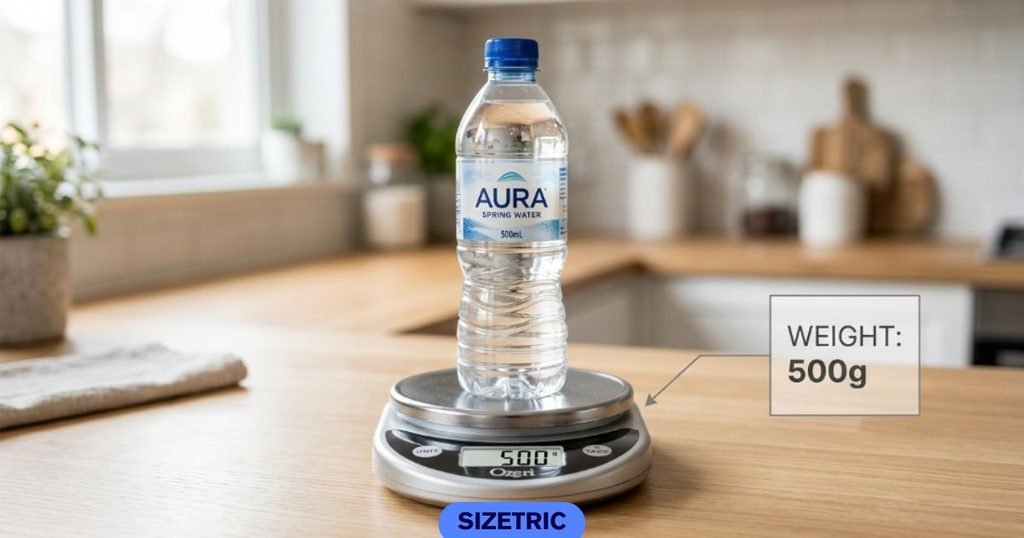
500 grams is exactly half a kilogram — and that’s the cleanest way to hold it in your head. In imperial units it works out to roughly 1.1 pounds (precisely 1.102 lb, or 1 lb 1.6 oz) and 17.64 ounces. It is not half a pound; it’s a little over a whole pound. Picture a full single-serve water bottle or four medium bananas and you’ve already got it in your hands.
500 Grams in Every Unit You’ll Need
Here’s the full conversion set, so whatever system a recipe, courier, or lab sheet uses, you’re covered.
| Unit | 500 grams equals |
| Kilograms | 0.5 kg |
| Milligrams | 500,000 mg |
| Ounces (avoirdupois) | 17.64 oz |
| Pounds | 1.10 lb (1 lb 1.6 oz) |
| Metric tonnes | 0.0005 t |
One number to memorise: 1 pound = 453.6 grams, so 500 g sits about 46 grams above a pound — roughly 10% heavier. That single fact clears up most of the confusion people have with this weight.
What Half a Kilo Feels Like in Your Hand
Weight doesn’t announce itself the way length does — you can’t lay it against a ruler — so the fastest way to know 500 g is to feel a reference and remember it.
Fill a 500 ml water bottle to the top and rest it on your open palm. That downward pull is 500 g almost exactly, because water weighs 1 gram per millilitre. It’s a weight you can carry all day without noticing, yet heavy enough that you’d feel it vanish if someone lifted it away.
Two more anchors round out the intuition. A standard block of butter (250 g in most metric countries) is half of it, so two blocks stacked equal the target. And a full-size tablet — an iPad, say — lands just under, so if 500 g feels like “a tablet plus a little,” your instinct is calibrated. It’s a moderate, one-handed weight: more than a smartphone, less than a full one-litre bottle.
Everyday Things That Weigh About 500 Grams
These are the objects I’d actually reach for to picture half a kilo. I’ve flagged which are exact and which are close, because a reference is only useful if the number behind it is honest.
A Full 500 ml Water Bottle
The contents of a 500 ml bottle weigh 500 g on the nose — water’s density is 1 g per ml at room temperature, so the volume and the mass line up perfectly. The plastic bottle itself adds only about 15 g, bringing a full one to roughly 515 g total. This is the single most reliable everyday reference for the weight, which is exactly why it doubles as a scale-calibration trick.
100 US Nickels
Every US nickel is struck to weigh exactly 5.00 grams, a spec the US Mint holds tight. Count out 100 of them and you have precisely 500 g — no rounding, no estimate. Coins barely wear enough to matter, so a stack of nickels gives you laboratory-grade accuracy for checking a cheap kitchen scale. It’s the most precise DIY 500 g weight in an average home.
Read Also: Coke Can Dimensions: Height, Diameter & Every Size
A Sealed Pack of Pasta or Coffee
In metric-labelled countries, dried pasta and ground coffee are commonly sold in 500 g packs — the number is printed right on the bag, so it’s exact by definition. In the US the same shelf item often shows 454 g (1 lb) instead, so check the label before you trust it. When it says 500 g, that unopened pack is a ready-made half-kilo reference sitting in your pantry.
A Full-Size Tablet
Most full-size iPads land around 460–480 g, putting a tablet just shy of 500 g. It’s a great intuition-builder because so many people hold one daily: if half a kilo feels like “my iPad and a bit more,” you’ve internalised it. Handy when you’re mailing a device and eyeballing the postage tier before it hits the scale.
Roughly Four Medium Bananas
A medium banana weighs about 120–150 g with the peel, so four of them come to roughly 500 g. Fruit varies with ripeness and size, so treat this as a close approximation rather than a fixed figure. It’s a useful produce-aisle gut check — and more accurate than the “two apples” claim you’ll see elsewhere, since a medium apple is only ~180–200 g, meaning you’d actually need closer to three.
A Regulation Soccer Ball
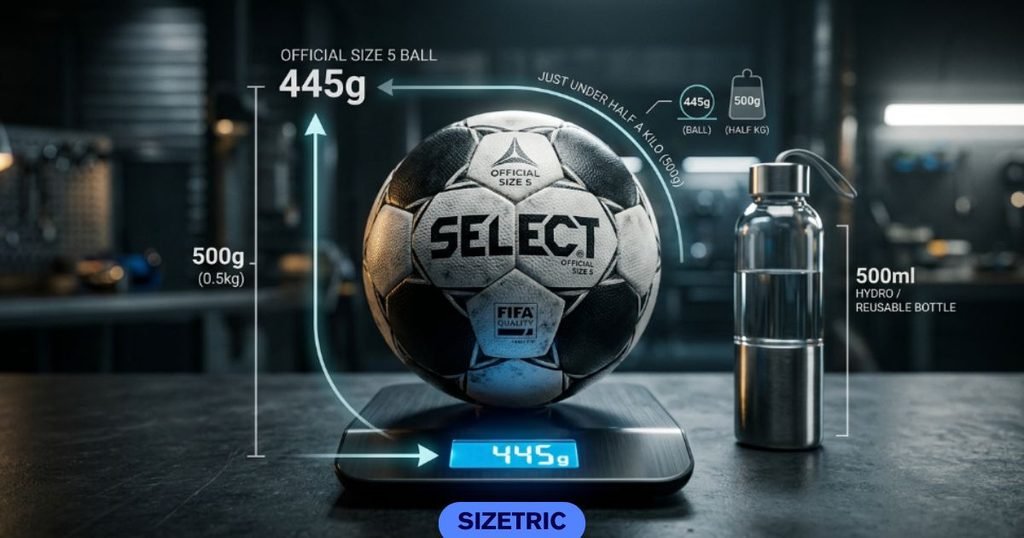
A size-5 match ball is built to weigh 410–450 g under the laws of the game, landing a touch under half a kilo. It reads as “almost 500 g” in the hand — a familiar object for anyone who’s kicked one around. Good for teaching the weight to a kid: hand them the ball, then add a phone on top to close the gap.
An Empty Glass Wine Bottle
A standard 750 ml wine bottle, emptied, weighs about 400–550 g depending on how thick the glass is. The heavier the punt and walls, the closer it creeps to 500 g. It’s a surprisingly good reference because the glass alone — before a drop of wine — is already in half-kilo territory, which is worth remembering when you’re weighing packages for recycling or shipping.
An Adult Gray Squirrel
An adult eastern gray squirrel typically weighs 400–600 g, centring right around 500 g. Wildlife is an approximate reference, obviously, but it’s a memorable one: half a kilo is “about one squirrel.” Useful the next time you want a living, breathing sense of the weight rather than a grocery item.
A Pound Block of Butter (Nearly)
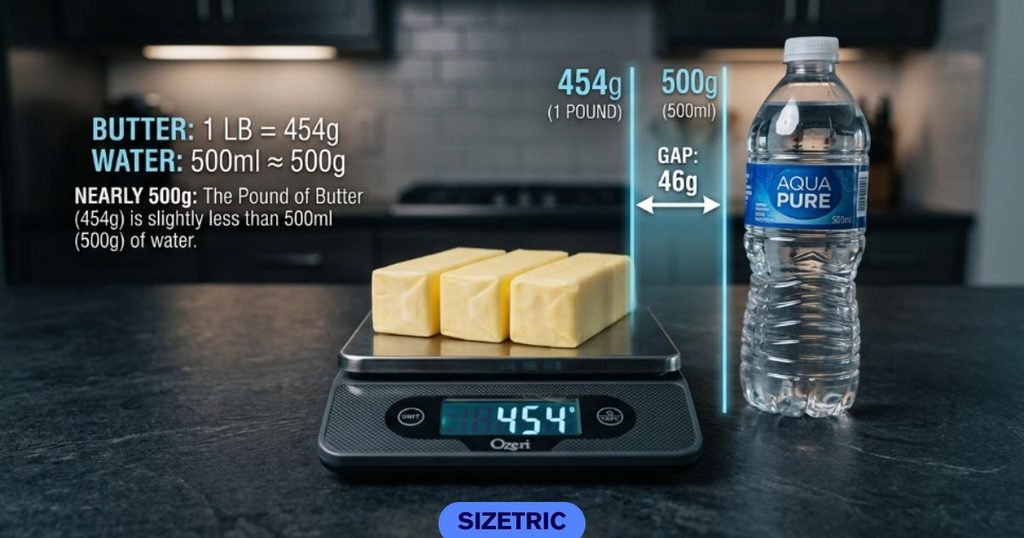
A US pound of butter — four sticks — weighs 454 g, which sits just under 500 g by that same ~46 g gap. In metric regions, two 250 g blocks make an exact 500 g. Butter is a strong kitchen anchor because it’s dense and compact, so the heft in your hand maps cleanly to the number.
Weight References at a Glance
| Object | Typical weight | Relative to 500 g |
| 500 ml water (contents only) | 500 g | Exact |
| 100 US nickels | 500 g | Exact |
| 500 g pasta / coffee pack | 500 g | Exact (labelled) |
| Full-size tablet (iPad) | ~460–480 g | Just under |
| Four medium bananas | ~500 g | About right |
| Regulation soccer ball | 410–450 g | Just under |
| Empty glass wine bottle | ~400–550 g | About right |
| Adult gray squirrel | 400–600 g | About right |
| US pound of butter | 454 g | Just under |
No Scale? Judge 500 Grams by Feel
You can estimate this weight surprisingly well once you’ve trained your hand, because 500 g falls squarely in the range where human “muscle memory” for heft is reliable.
Start by building a reference. Hold a full 500 ml bottle in one palm for a few seconds and pay attention to the pull — that sensation is your baseline. Now lift the object you’re unsure about in the other hand and compare. Your body is far better at telling “the same as” and “heavier/lighter than” than it is at guessing a raw number, so always estimate against a known weight rather than in the abstract.
For food, lean on volume when you can, since it’s steadier than eyeballing. About two and a bit cups of water weigh 500 g. Roughly four cups of all-purpose flour come to about 500 g (flour is light and fluffy). Around two and a half cups of granulated sugar land near the same mark (sugar packs denser than flour). These aren’t lab-exact, but they get you well within a useful margin for cooking.
One more trick: use coins. Ten US quarters weigh about 57 g, and a stack of 100 nickels is exactly 500 g — so a jar of loose change is a genuine, checkable half-kilo weight hiding in plain sight.
The Weights on Either Side of 500 g
Half a kilo makes the most sense sandwiched between its neighbours.
Just below it sits 250 g — exactly half — which looks like a single 250 g butter block, 50 nickels, or a large apple. And a hair under 500 g is the pound (454 g), close enough that people constantly mix the two up, though that 46 g gap is real.
Just above it is 1 kilogram (1,000 g) — double 500 g, equal to 2.2 lb, and the weight of a full one-litre water bottle or a standard bag of sugar or flour. If 500 g is a comfortable one-handed carry, 1 kg is when your wrist starts to notice.
| Weight | What it maps to | Relation to 500 g |
| 250 g | One butter block / large apple | Half |
| 454 g (1 lb) | A pound of butter | Slightly under |
| 500 g | Full 500 ml bottle | The target |
| 1,000 g (1 kg) | One-litre bottle / sugar bag | Double |
Where 500 Grams Actually Comes Up
This isn’t a trivia number — it shows up in a handful of everyday jobs, and knowing it saves real time.
In the kitchen, metric recipes lean on it constantly: 500 g of flour, 500 g of minced meat, 500 g of pasta. A 500 g pack of mince is a classic base for a family bolognese, and many baking recipes are built around the 500 g flour bag. For shipping and postage, half a kilo is a common cutoff between rate tiers for letters and small parcels, so a reliable mental estimate tells you whether a padded envelope will sneak under the next price band before you queue at the counter.
For fitness and nutrition, food portions are often weighed in grams — a 500 g tray of chicken breast is usually three to four servings — and light dumbbells and wrist weights are sold in half-kilo steps. And for anyone with a cheap digital scale, a known 500 g weight (that water bottle or those 100 nickels) is the fastest way to check it hasn’t drifted. A dedicated 500 g calibration weight exists for exactly this reason.
Read Also: Pokémon Card Dimensions: Exact Size in Inches, mm & cm
Where People Get 500 Grams Wrong
Two mix-ups cause almost all the confusion around this number.
The first: assuming 500 g equals half a pound. It doesn’t — half a pound is only 227 g. Five hundred grams is more than a full pound (about 1.1 lb). The word “half” is doing the damage, because 500 g really is half of something — half a kilogram, not half a pound.
The second: treating 500 g and 500 ml as interchangeable. They match only for water and water-like liquids, where density is 1 g/ml. For oil, 500 ml weighs about 460 g; for flour, 500 ml weighs far less than 500 g because it’s full of air; for honey, 500 ml weighs closer to 700 g. Volume and weight are different measurements — the number lines up for water and drifts for everything else.
Quick-Fire Q&A
Is 500 g equal to 1 kg?
No. 500 g is only half of 1 kg — you need 1,000 g to make a full kilogram.
Is 500 grams equal to 1 pound?
No. A pound is 453.6 g, so 500 g is about 46 g heavier — roughly 1.1 lb.
What is 500 grams equal to in cups?
It depends on the ingredient: about 4 cups of flour, 2½ cups of sugar, or a bit over 2 cups of water.
Is 500 grams half a kg?
Yes. 500 g is exactly half a kilogram (0.5 kg) — an exact conversion, not a rounded one.
How many grams is 1 kg?
1 kilogram is exactly 1,000 grams, which makes 500 g precisely half of it.
Locking Half a Kilo Into Memory
Keep one anchor and you’ll never lose this weight: a full 500 ml water bottle is 500 grams — half a kilo, about 1.1 pounds, 17.64 ounces, and just over a pound. Feel that bottle once, remember it’s not half a pound but a touch more than a whole one, and you’ll gauge half a kilo by hand for good.
Related Guides:
1: Gatorade Bottle Dimensions: Every Size, Measured
2: Red Bull Can Dimensions: All Sizes, Height & Diameter
3: How Tall Is a Monster Can? Exact Height, Diameter, and Size Guide

3 Comments