
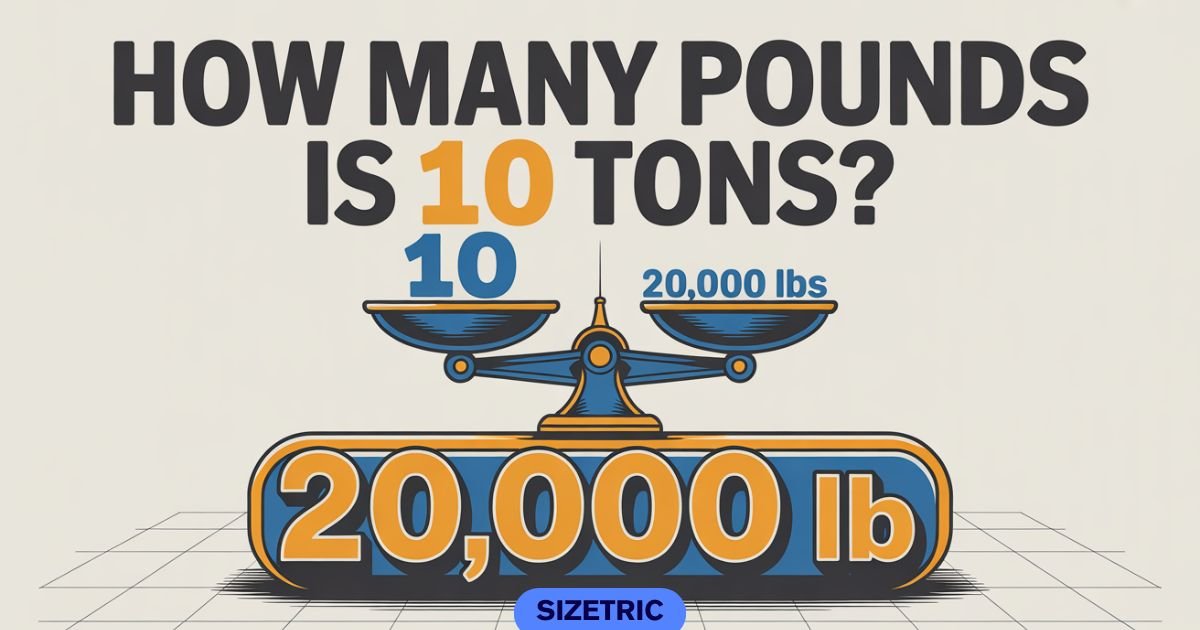
How Many Pounds Is 10 Tons? (20,000 lb Answer)
Ten tons is a way to measure very heavy weight. In the United States, one ton means 2,000 pounds. So 10 tons is equal to 20,000 pounds in all.
Have you ever wondered how heavy 10 tons really is? It is far more than any person can lift. Picture six family cars sitting side by side.
Not every “ton” is the same size around the world. A metric tonne makes about 22,046 pounds instead. A British long ton comes to 22,400 pounds total.
The Short Answer
10 tons is 20,000 pounds when you mean the US short ton — the one used by default across the United States. That’s the figure most people are after.
If you’re working in metric, 10 metric tonnes is 22,046 pounds (exactly 10,000 kg). And in the older British long ton, 10 tons is 22,400 pounds. Same word, three answers, a 2,400-pound spread between the lowest and highest.
For everyday US use, lock in this: 10 tons = 20,000 lb = 9,072 kg.
10 Tons in Every Common Unit
Here’s 10 tons expressed across the units people actually convert into, for all three definitions side by side.
| Unit | 10 short tons (US) | 10 long tons (UK) | 10 metric tonnes |
| Pounds (lb) | 20,000 | 22,400 | 22,046 |
| Ounces (oz) | 320,000 | 358,400 | 352,740 |
| Kilograms (kg) | 9,072 | 10,160 | 10,000 |
| Metric tonnes (t) | 9.07 | 10.16 | 10 |
| Stone (UK) | 1,428.6 | 1,600 | 1,574.7 |
[IMAGE: a scale reading 20,000 lb with the three “ton” labels — short, long, metric — branching off it]
One conversion factor sits under all of this: 1 pound = 0.45359237 kg, fixed by international agreement. Every number above traces back to it, so nothing here contradicts anything else.
What 20,000 Pounds Actually Amounts To
Twenty thousand pounds is the weight class where objects stop being things you lift and become things you drive, tow, or crane. It’s an order of magnitude past a car and comfortably into freight territory.
Picture a legal highway load limit. A single axle in the US is generally capped around 20,000 lb — so 10 short tons is, almost poetically, about the most one axle is allowed to carry on an interstate. That’s not a coincidence you need to memorize, but it’s a handy peg: 10 tons is roughly one loaded truck axle’s worth of weight.
Split it into people and it’s easier to feel. At an average adult weight of about 150 lb, 10 tons is roughly 133 grown adults — a packed commuter-train car, standing room and all.
Real Things That Weigh Right Around 10 Tons
Numbers land better when they have a shape. Here are six things that sit close to 20,000 pounds. Where a figure is a ballpark, I’ve said so plainly.
Six mid-size sedans
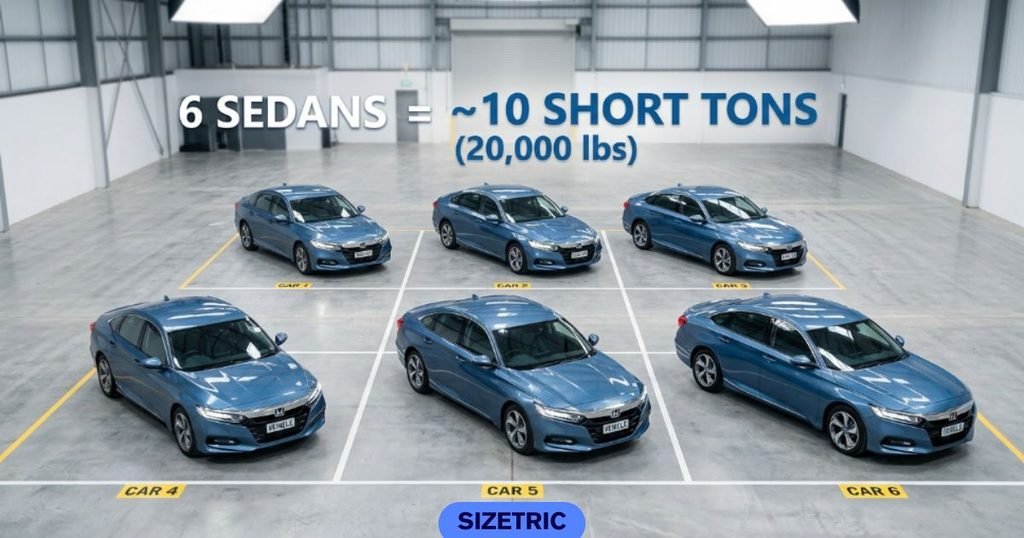
A typical mid-size sedan — think a Toyota Camry or Honda Accord — weighs around 3,300 lb. Stack six of them and you’re at roughly 19,800 lb, a hair under 10 short tons. It’s the cleanest mental image on this list: a small parking row of ordinary cars is almost exactly 10 tons.
Read Also: 80 Feet: How Long It Really Is, With Real Comparisons
A full-size school bus, empty
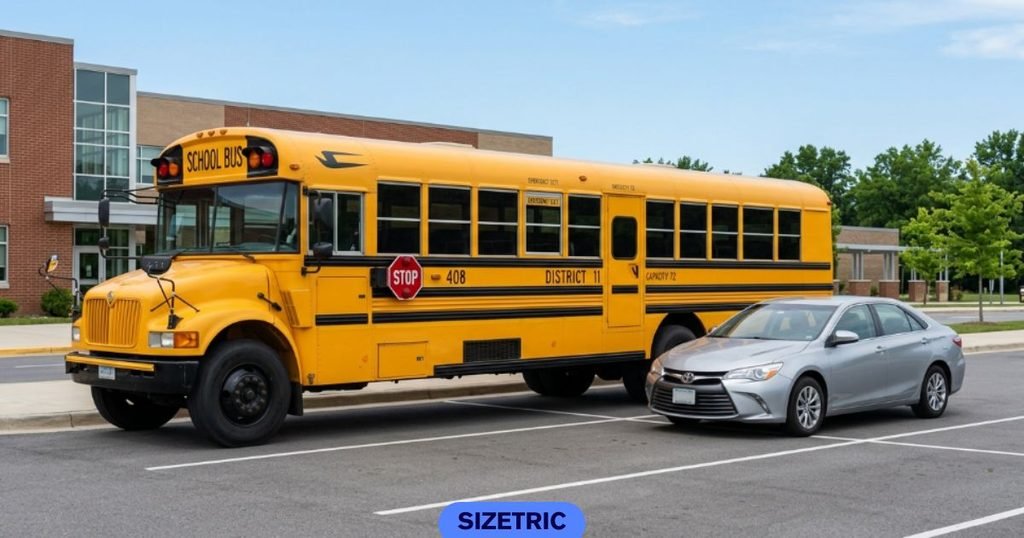
A conventional full-size yellow school bus has a curb weight in the neighborhood of 20,000 lb before a single kid climbs aboard. That makes the empty bus itself a near-perfect stand-in for 10 tons. Add passengers and fuel and it climbs past that, which is why these buses carry hefty gross-weight ratings.
Nearly two adult bull elephants
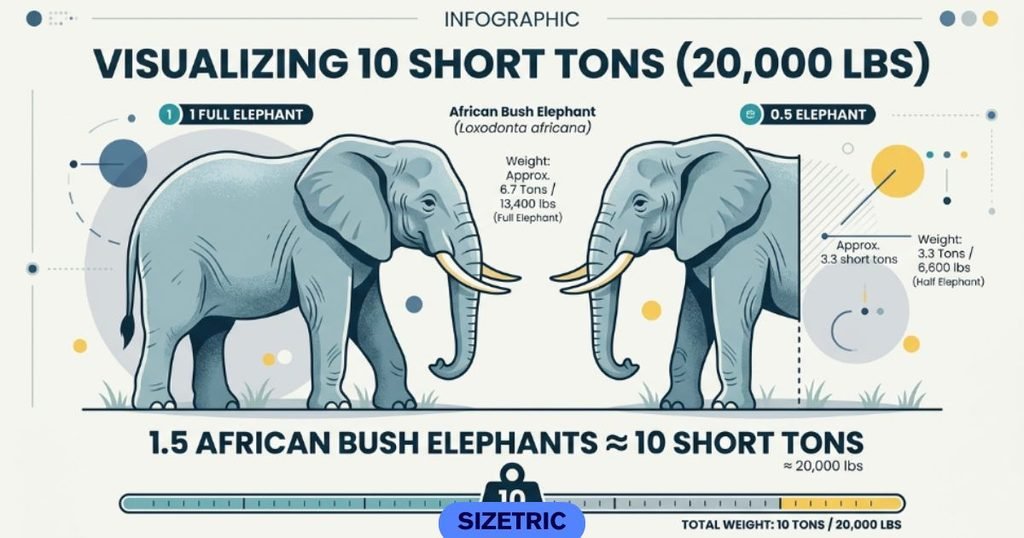
A full-grown male African bush elephant runs about 12,000 lb (6 short tons). So 10 tons is close to one and a half to two bulls — not quite a matched pair, but in that range. It’s the biggest land-animal yardstick most people can picture, and it makes clear you’re now weighing things measured in tons, not pounds.
Four full-size pickup trucks
A full-size pickup like a Ford F-150 tips the scales around 5,000 lb depending on trim and cab. Line up four of them and you land right on 20,000 lb. Heavy-duty three-quarter and one-ton pickups weigh more, so you’d need only about three of those to reach the same mark.
A moderately loaded 20-foot shipping container
An empty 20-foot steel shipping container weighs roughly 5,000 lb on its own; fill it with general cargo and a common working gross weight lands somewhere around 18,000–24,000 lb. A container packed to a middling load is a solid real-world 10-ton reference — and it’s exactly the kind of unit where “how many pounds is 10 tons” gets asked for real.
An empty rear-loader garbage truck
Strip a rear-loading refuse truck of its trash and the chassis-plus-body alone weighs on the order of 20,000–25,000 lb. Empty, it hovers right around 10 tons; fully packed, it can more than double that, which is why these trucks are built like tanks.
Weight Comparison at a Glance
| Reference object | Approx. weight | How it maps to 10 short tons |
| Mid-size sedan | ~3,300 lb | About 6 of them |
| Full-size pickup truck | ~5,000 lb | About 4 of them |
| Adult bull African elephant | ~12,000 lb | Roughly 1.5–2 |
| Full-size school bus (empty) | ~20,000 lb | ≈ one bus |
| Loaded 20-ft shipping container | ~18,000–24,000 lb | ≈ one container |
| Average adult person | ~150 lb | About 133 people |
[INTERNAL LINK: how many pounds is 1 ton]
Short Ton, Long Ton, or Metric Tonne?
This is the part that trips people up, so it’s worth slowing down. The 2,400-pound gap between definitions is enough to matter on any real invoice or load sheet.
The US short ton — 2,000 lb
When an American says “ton,” this is almost always it: 2,000 pounds. It’s the default in US trucking, construction, agriculture, and air-conditioning capacity. Ten of them makes the headline 20,000 lb. If you saw “tons” written with no other clue and you’re in the US, assume short tons.
The metric tonne — 1,000 kg
The metric tonne is defined cleanly as 1,000 kilograms, which works out to about 2,204.6 lb. Ten tonnes is therefore 10,000 kg, or 22,046 lb. This is the standard for international shipping, science, and most of the world outside the US. Watch the spelling cue: “tonne” almost always signals metric.
The long ton — 2,240 lb
The imperial long ton, also called the gross ton, equals 2,240 lb. It’s the old British standard, now mostly seen in shipping displacement, bulk commodities, and historical figures. Ten long tons is 22,400 lb — the heaviest of the three answers, and only 354 lb more than 10 metric tonnes.
Why the differences exist: the long ton was built to equal 20 hundredweight of 112 lb each (a system rooted in old English trade), the short ton simplified that to a round 2,000 lb, and the metric tonne was defined from the kilogram entirely separately. Three histories, three numbers, one overloaded word.
The Weights on Either Side of 10 Tons
If you’re eyeballing tonnage, it helps to know the neighbors and how far apart they are. These use the US short ton.
| Weight | In pounds | In kilograms |
| 5 tons | 10,000 lb | 4,536 kg |
| 10 tons | 20,000 lb | 9,072 kg |
| 15 tons | 30,000 lb | 13,608 kg |
| 20 tons | 40,000 lb | 18,144 kg |
The pattern is worth internalizing: each additional short ton adds exactly 2,000 lb. So doubling from 10 to 20 tons doesn’t nudge the figure — it jumps a full 20,000 lb, from one loaded axle to a whole loaded semi-trailer’s cargo. Telling 10 tons from 15 tons by sight is nearly impossible; the only reliable way to separate them is to weigh, because a 30,000-lb load and a 20,000-lb load can look identical stacked on the same flatbed.
Read Also: Dollar Bill Dimensions: Exact Size, Thickness & Weight
Where This Conversion Actually Comes Up
Most people don’t convert 10 tons to pounds for fun. It shows up in freight and shipping, where carriers quote cargo in tons but scales and weigh stations read in pounds. It appears in construction and hauling, where a “10-ton” load of gravel or steel has to fit under an axle or truck rating measured in pounds. Students hit it in physics and chemistry homework, where the metric tonne is assumed. And it turns up any time a US spec (short tons) meets an international one (metric tonnes) and someone has to reconcile the two — a 10% difference that’s easy to miss and expensive to get wrong.
Quick-Fire Q&A
Is 10 tons 20,000 pounds?
Yes, 10 US short tons equals exactly 20,000 pounds. This is true only for the American short ton, where 1 ton is 2,000 pounds.
What is 1 ton equal in pounds?
One US short ton equals 2,000 pounds. A metric tonne is about 2,205 pounds, and a British long ton is 2,240 pounds.
Does 1000 pounds equal 1 ton?
No, 1,000 pounds is only half of a US ton. A full short ton is 2,000 pounds, so 1,000 pounds equals half a ton.
What does 10 tons equal?
Ten US short tons equal 20,000 pounds, or about 9,072 kilograms. In metric, 10 tonnes equal 22,046 pounds, or exactly 10,000 kilograms.
What weighs 10 tons?
An empty full-size school bus weighs close to 10 tons. Six mid-size cars or nearly two adult bull elephants also weigh about that much.
The Takeaway in One Line
So now you know the answer to how many pounds is 10 tons. In the United States, 10 tons equals 20,000 pounds. People use this weight for big trucks, heavy cargo, and building work. Always remember the simple rule. Just multiply the number of tons by 2,000. This gives you the right answer in pounds every time. Ten tons is a very heavy load, much more than a person can lift.
You must also watch for the word “ton” itself. A metric tonne makes about 22,046 pounds instead. A British long ton makes 22,400 pounds. Because of this, you should always check which ton someone means. This small step keeps your numbers correct and clear. With this simple guide, you can now measure heavy weights with full confidence.
Related Guides:
1: Jerry Can Dimensions: Every Size, Weight and Variant Explained
2: Miles to Steps Calculator: How Many Steps in a Mile?
3: Celsius Can Dimensions: Exact Size, Height & Diameter
4: 300 Grams: 12 Everyday Things That Weigh This Much
5: How Much Is 20 Grams? Weight, Conversions & Examples

2 Comments