
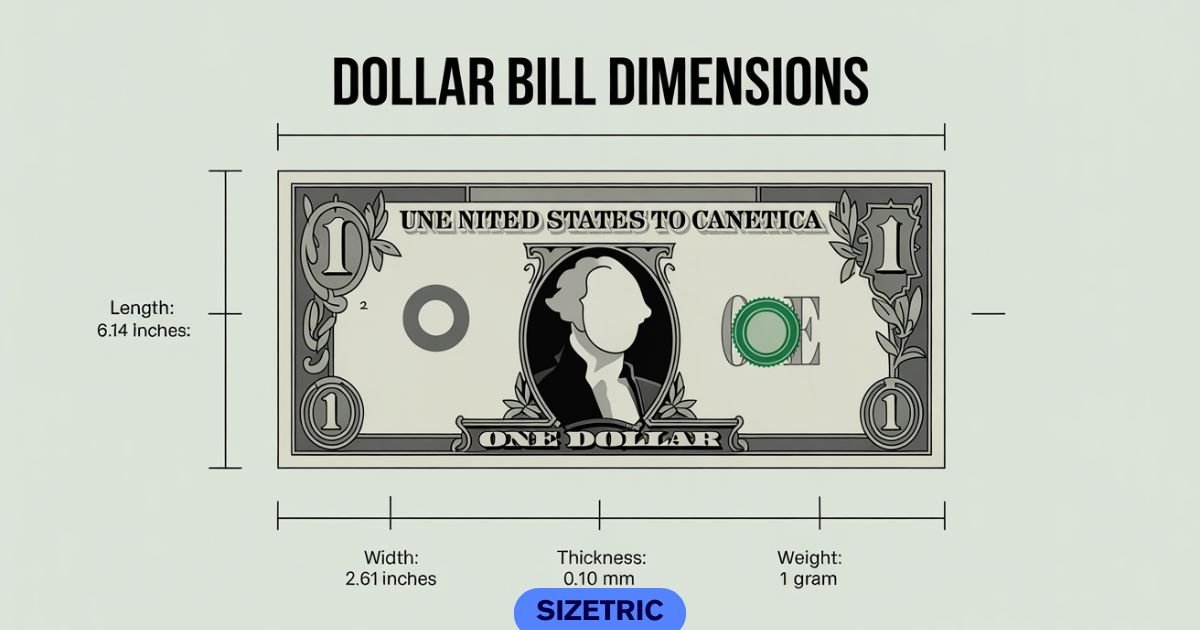
Dollar Bill Dimensions: Exact Size, Thickness & Weight
Pull a bill out of your wallet and you’re holding one of the most precisely standardized objects you own. Every U.S. note — a single, a five, a hundred — is cut to the exact same rectangle, and that size hasn’t budged since 1929. This page gives you the exact dollar bill dimensions in every unit you’d ever need, breaks down what each measurement means, shows how the note stacks up against everyday objects, and turns that piece of paper into a genuinely useful pocket ruler.
The Short Answer
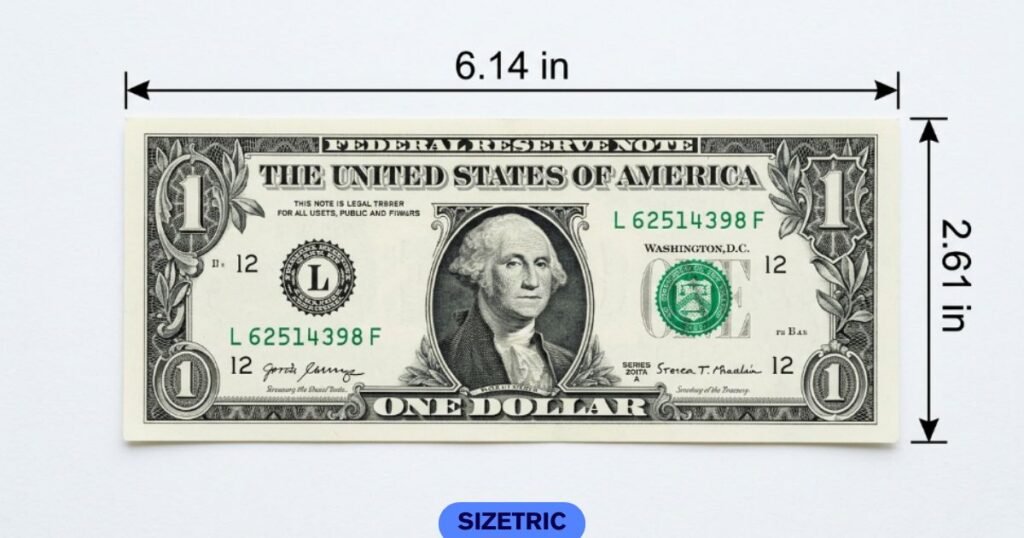
A U.S. dollar bill measures 6.14 inches long by 2.61 inches wide, is 0.0043 inches thick, and weighs about 1 gram. In metric, that’s 156 mm × 66.3 mm, with a thickness near 0.11 mm. Every denomination of U.S. paper currency shares those exact figures — the only differences between a $1 and a $100 are the portrait, the ink, and the security features, never the size.
If you remember one thing: the long side is just past the 6-inch mark, and the short side is a shade over 2.6 inches. That single fact is enough to eyeball most quick measurements.
Dollar Bill Dimensions at a Glance
Here’s the full spec sheet with every conversion lined up, so you can grab whichever unit your project uses.
| Measurement | Inches | Millimeters | Centimeters | Feet / Meters |
| Length (long edge) | 6.14 in | 156 mm | 15.6 cm | 0.51 ft / 0.156 m |
| Width (short edge) | 2.61 in | 66.3 mm | 6.63 cm | 0.22 ft / 0.066 m |
| Thickness | 0.0043 in | 0.11 mm | 0.011 cm | — |
| Diagonal (corner to corner) | 6.67 in | 169 mm | 16.9 cm | 0.56 ft |
| Weight | 0.035 oz | — | — | ~1 gram |
Two numbers there tend to surprise people. The diagonal — corner to corner — comes out to about 6.67 inches, longer than the long edge itself, which makes a bill handy for marking a slightly bigger span than 6 inches. And the thickness is so slight that it takes a whole strap of bills before you can measure the stack in fractions of an inch.
Every Measurement, Broken Down
A rectangle is only four numbers, but each one carries a bit of history and a practical use. Here’s what each dimension actually gives you.
The Long Edge — 6.14 Inches
The long side of every Federal Reserve Note runs 6.14 inches, or 156 mm / 15.6 cm. On a ruler it lands just past the 6-inch line — close enough that people casually call a bill “about six inches,” though the extra 0.14 inch matters if you’re being precise. The Bureau of Engraving and Printing holds this figure tight across every sheet it prints, which is exactly why it works as a reference at all.
Because that length never changes, you can lean on it. Lay two bills end to end and you’ve spanned roughly 12.3 inches — a hair over a standard school ruler. Line up about six of them and you’ve marked out close to a yard (36.84 inches versus 36). When you need a rough foot or yard and there’s no tape measure in sight, the cash in your pocket is calibrated.
Read Also: Jerry Can Dimensions: Every Size, Weight and Variant Explained
The Short Edge — 2.61 Inches
The short side measures 2.61 inches, which converts to 66.3 mm / 6.63 cm. Depending on how you hold the note, people call this the width or the height — on a flat rectangular bill both words point to the same shorter edge, so don’t let the terminology trip you up. It’s taller than the short side of a credit card (2.125 inches) and just under the diameter of a hockey puck (3 inches).
This dimension quietly shapes the objects around it. A standard bi-fold wallet is built a little taller than 2.61 inches so bills sit with a sliver of room above the leather. Cash registers, ATM cartridges, and bill counters across the U.S. are all engineered around this exact height, which is part of why a single design keeps the whole cash economy running smoothly.
Thickness — 0.0043 Inches
A single note is 0.0043 inches thick, or about 0.11 mm — roughly the thickness of one sheet of standard printer paper. It doesn’t feel like much because it isn’t, but that thinness is deliberate: bills are made from a 75% cotton, 25% linen blend rather than wood-pulp paper, which is why a note can survive something like 4,000 double folds before it tears.
Thickness only becomes measurable in a stack. One hundred bills — a standard bank strap — pile up to about 0.43 inches, less than half an inch. A thousand notes reach roughly 4.3 inches, about the height of a coffee mug. It’s a useful mental trick: if a stack of singles looks about half an inch tall, you’re looking at close to a hundred bills.
Weight — About 1 Gram
Each note tips the scale at roughly 1 gram, or 0.035 ounces — about the same as a large paperclip or a plump raisin. Hold one flat on your palm and it registers as almost nothing.
That featherweight comes from the same cotton-linen fabric that makes bills durable, and it scales in ways that are fun to picture. A million dollars in singles weighs about a metric ton (a million grams), while the same value in hundreds weighs only around 10 kilograms — light enough to carry, which is one practical reason large sums move in high denominations.
Do All U.S. Bills Share the Same Size?
Yes — and it’s one of the things that makes American money unusual. Since the 1929 redesign, every denomination from $1 to $100 has been printed at 6.14 × 2.61 inches. A dollar and a hundred are physically interchangeable in size; you tell them apart by design, not by feel. That uniformity is what lets a single vending machine, ATM, or counting machine handle any note without recalibrating.
Most of the world does it the other way around. Euro notes grow with value, so a €500 note is noticeably larger than a €5. British pound notes and many other currencies also step up in size as the denomination climbs. The U.S. is the outlier in using one fixed rectangle for everything.
The Bigger Bills of the Past
Before 1929, U.S. currency was distinctly larger. Those older “large-size” notes measured roughly 7.4 × 3.1 inches (about 187 × 79 mm) — wide enough that collectors nickname them “horse blankets.” The switch to today’s smaller format was a cost-cutting and standardization move by the Bureau of Engraving and Printing, and the compact size has stayed frozen ever since. So if you ever handle a note that feels oversized and old, it likely predates the current standard.
Size Comparison Across Currencies and Eras
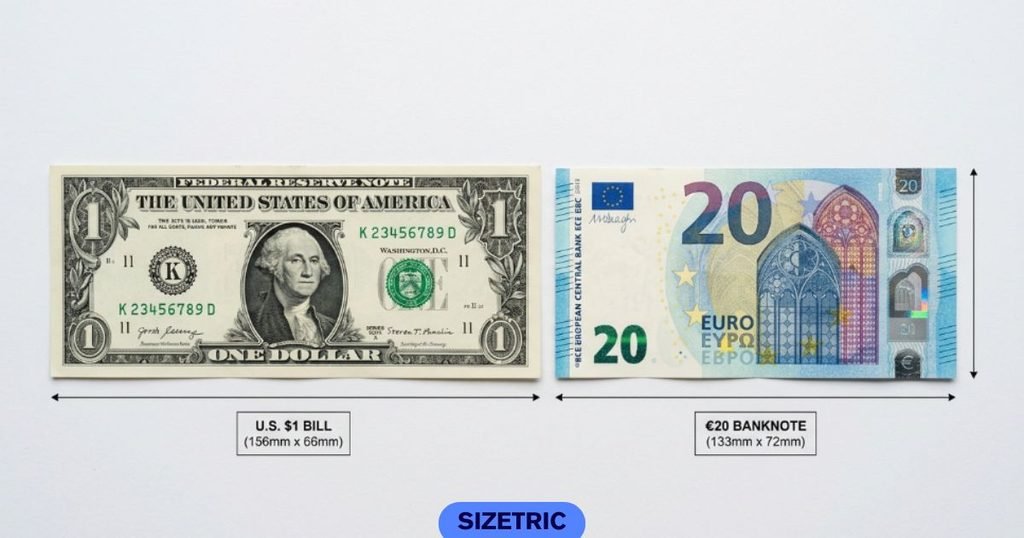
Here’s how the modern note lines up against its predecessor and a couple of foreign bills. Foreign figures are approximate and, for currencies that scale by denomination, reflect a common mid-range note.
| Note | Length | Width | Notes |
| Modern U.S. bill (all denominations) | 6.14 in / 156 mm | 2.61 in / 66.3 mm | Fixed since 1929 |
| Pre-1929 U.S. large note | ~7.4 in / 187 mm | ~3.1 in / 79 mm | Approx.; “horse blanket” |
| Canadian note | ~6.0 in / 152 mm | ~2.75 in / 70 mm | Approx.; polymer |
| Euro / British pound | Varies | Varies | Grows with denomination |
The takeaway: the U.S. note is comparatively long and narrow, and it’s the same in your hand whether it’s worth one dollar or a hundred.
What a Dollar Bill’s Size Feels Like in Real Life
Numbers are precise, but comparisons are what make a size stick. Here’s where a bill lands next to things you already know.
- Its long edge (6.14 in) is a touch longer than a modern smartphone stood upright — an iPhone is roughly 5.8 inches tall, so the bill edges past it.
- Laid flat, a bill is just under two credit cards placed end to end (a card’s long side is 3.375 inches, so two make 6.75 inches).
- The short edge (2.61 in) sits between the two dimensions of a business card (3.5 × 2 inches) — taller than the card’s short side, shorter than its long side.
- Its thickness matches roughly one sheet of printer paper, which is why a fresh bill feels crisp but almost weightless.
- At about a gram, a single note weighs close to one large paperclip.
None of these are exact, but they’re close enough to gauge a bill’s size — or to work backward and estimate an object’s size using a bill you’re already holding.
Turn a Dollar Bill Into a Pocket Ruler
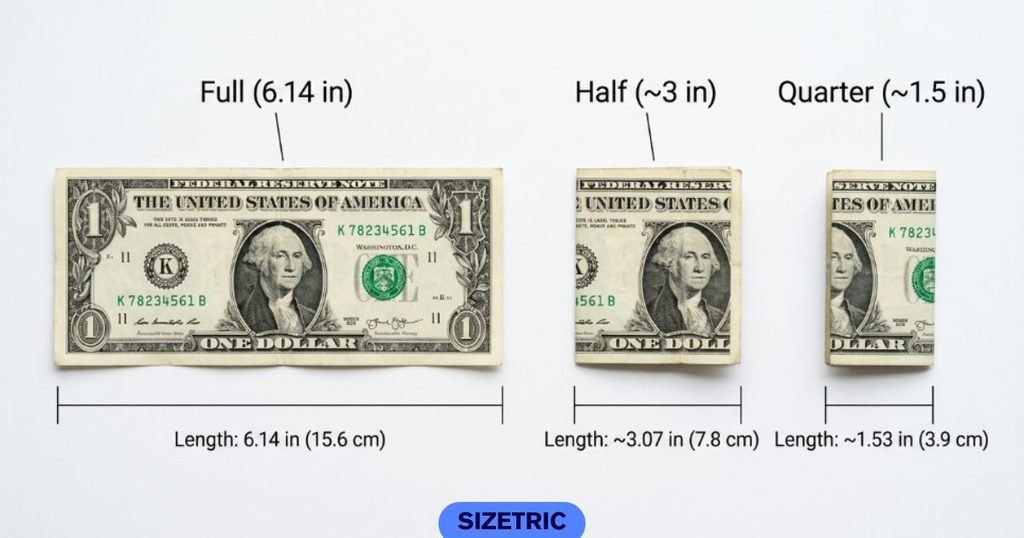
This is where the fixed dimensions earn their keep. Because the size never varies, a bill is a surprisingly accurate measuring tool when you’re caught without a tape measure. A few reference points worth memorizing:
- Full length ≈ 6.14 in (just past 6 inches / 15.6 cm)
- Full width ≈ 2.61 in (about 6.6 cm)
- Folded in half lengthwise ≈ 3.07 in (about 3 inches)
- Folded in quarters ≈ 1.5 in
- Two bills end to end ≈ 12.3 in (about one foot)
- Six bills end to end ≈ 37 in (about one yard)
- Corner to corner (diagonal) ≈ 6.67 in, for a span a little longer than the edge
Say you’re at a flea market and want to check whether a shelf will fit a slot at home, or you’re hanging a frame and need to space two nails a foot apart. Fold and lay the bill against the object, count the lengths, and you’ll land within a fraction of an inch. It won’t replace a real ruler for fine work, but for a quick, no-tool estimate of everyday objects, the money in your wallet is already calibrated to the standard set in a government print shop.
Read Also: Miles to Steps Calculator: How Many Steps in a Mile?
Money Myths Worth Busting
A few widely repeated ideas about bill size don’t hold up.
“Bigger bills are bigger notes.” Not for U.S. currency. A $100 is identical in length, width, and thickness to a $1 — the value lives in the design and security features, not the paper size.
“It’s paper, so it’s fragile.” Bills aren’t paper at all. The cotton-linen blend is closer to fabric, which is why a note tolerates thousands of folds, survives the wash, and outlasts anything printed on ordinary stock.
“Height and width are different measurements.” On a flat rectangular note they refer to the same short edge — 2.61 inches. The label just depends on which way you’re holding the bill.
Fast Answers
What is the dimension ratio of a US dollar bill?
A dollar bill’s length-to-width ratio is about 2.35 to 1 (6.14 inches ÷ 2.61 inches). Every U.S. note shares this same proportion.
What is the exact size of a $100 bill?
A $100 bill measures 6.14 inches long by 2.61 inches wide (156 × 66.3 mm). It matches every other U.S. denomination.
Is a dollar bill 8 inches long?
No. A dollar bill is 6.14 inches long, not 8 inches. That is just over 6 inches, or about 156 mm.
How wide is a $20 bill?
A $20 bill is 2.61 inches wide (66.3 mm), the same short-edge width as every U.S. note.
How long is a $2 bill?
A $2 bill is 6.14 inches long (156 mm), identical in length to all current U.S. currency.
Locking This Size Into Memory
Now you know the Dollar Bill Dimensions by heart. Every U.S. note measures 6.14 inches long and 2.61 inches wide. That is about 156 mm by 66 mm. Each bill is very thin at 0.0043 inches, and it weighs close to one gram. Best of all, every bill shares this same size. A one-dollar note and a hundred-dollar note match exactly. Only the design and colours change.
This makes a dollar bill a handy tool. You can fold it to mark 3 inches or 1.5 inches. Two bills end to end reach about one foot. Six bills reach close to one yard. So keep these numbers in mind. The next time you need a quick measure, the money in your pocket will help you out.
Related Guides:
1: Celsius Can Dimensions: Exact Size, Height & Diameter
2: 300 Grams: 12 Everyday Things That Weigh This Much
3: How Much Is 20 Grams? Weight, Conversions & Examples
4: How Much Is 1 Gram? Weight, Examples & Conversions
5: 100 Grams: How Heavy It Is + What Weighs That Much





2 Comments