
Miles to Steps Calculator: How Many Steps in a Mile?
You laced up, walked three miles, and now your app says one number while your friend’s says another. So which is right? Both, probably — because a mile isn’t a fixed pile of steps. It’s a distance your legs cross in however many strides your body takes.
This page gives you a working miles to steps calculator, a clean conversion table you can trust, and the plain-English reason two people can walk the same route and log wildly different step counts. By the end you’ll be able to convert any distance in your head, dial in a number that fits your own stride, and stop second-guessing your tracker.
[CALCULATOR EMBED: miles → steps, with an optional stride-length or height input]
The Quick Answer: Miles to Steps at a Glance
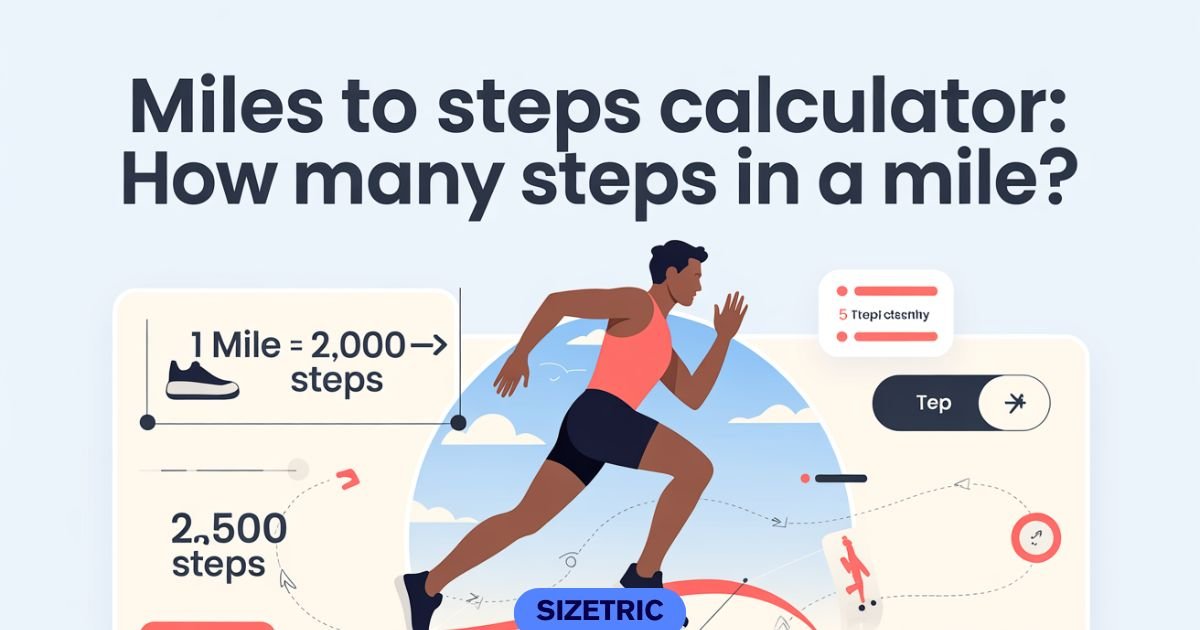
Roughly 2,000 steps make up one mile. That’s the rule of thumb worth memorizing. Walk at a normal, unhurried pace and most adults land somewhere between 2,000 and 2,500 steps per mile, with about 2,250 a solid midpoint.
- 1 mile ≈ 2,000–2,500 steps (walking), ~2,250 typical
- 1 mile ≈ 1,400–1,700 steps (running), ~1,600 typical
- 1 mile = 5,280 feet = 1.609 km
- 10,000 steps ≈ 5 miles ≈ 8 km (the famous daily target)
Running eats fewer steps per mile than walking, because you stretch each stride longer and add a bit of airborne float between footfalls. More on that below.
Miles to Steps Conversion Table
The number of steps in a mile isn’t one figure — it’s a small range that depends on your stride. Rather than force a single value, this table shows three honest columns: a short-stride estimate, a typical average, and a rule-of-thumb round number. Read across the row that matches how you move.
| Distance | ~2,000 steps/mi (rule of thumb) | ~2,250 steps/mi (typical) | ~2,500 steps/mi (shorter stride) |
| 0.25 mile | 500 | 563 | 625 |
| 0.5 mile | 1,000 | 1,125 | 1,250 |
| 1 mile | 2,000 | 2,250 | 2,500 |
| 2 miles | 4,000 | 4,500 | 5,000 |
| 3 miles | 6,000 | 6,750 | 7,500 |
| 5 miles | 10,000 | 11,250 | 12,500 |
| 10 miles | 20,000 | 22,500 | 25,000 |
How to read it: taller walkers and brisk pacers sit near the left column; shorter strides and casual strolls drift right. If you have no idea which you are, the middle column is your safest bet.
What “2,000 Steps a Mile” Actually Feels Like
A number on a screen is abstract until you attach it to something. So picture this: a single mile is about 20 minutes of easy walking for most people, or roughly 15 minutes at a brisk clip. Across that stretch, your feet strike the ground around two thousand times — a little over 100 steps a minute at a relaxed pace, closer to 130 when you push.
Hold that image and the math stops feeling clinical. Every time you rack up 2,000 on your tracker, you’ve covered about the length of 35 football fields laid end to end, or four laps of a standard outdoor track. It’s less than it sounds while you’re doing it and more than it looks on a map.
Everyday Ways to Picture a Mile in Steps
Sometimes the fastest way to trust a number is to peg it to a place you already know. Here are five reference points that turn “a mile in steps” into something you can actually see.
Four Laps of a Running Track

A standard outdoor running track measures 400 meters per lap, so four laps clocks in just under a mile (1,600 m vs. 1,609 m). At a walk, those four laps run you roughly 2,200–2,300 steps. Runners doing the same loop will finish nearer 1,600 steps. It’s the cleanest real-world mile most people have access to.
Twenty City Blocks
In a gridded U.S. city, 20 north–south blocks roughly equal one mile — the classic Manhattan yardstick. Walking that distance at a normal pace puts you around 2,250 steps, give or take your stride. It’s a handy check when you’re pacing off a route on foot instead of a treadmill.
Read Also: Celsius Can Dimensions: Exact Size, Height & Diameter
Half Your Daily 10,000
If your goal is the well-known 10,000 steps a day, then a single mile chips away about a fifth of it. Five miles gets you the whole target. That framing makes a lunchtime mile feel worth it: one loop and you’ve banked 2,000 of the day’s steps before you’re back at your desk.
One Treadmill Mile
A treadmill reads distance straight off the belt, so a “1.00 mile” display is genuinely a mile — but the machine has no idea how many steps you took. That’s why your wrist tracker and the console rarely agree. Trust the belt for distance and your own estimate (~2,250 walking) for steps.
A Long Airport Terminal Walk
Big-airport concourses often stretch half a mile to a full mile gate to gate. If you’ve ever hustled from a distant gate and felt like you walked forever, you probably did log 1,500–2,500 steps doing it — a real-life mile hiding in plain sight.
Quick Reference: Common Distances in Steps

For the numbers people look up most, here’s the fast version at a typical walking cadence (~2,250 steps/mile) and a brisk running cadence (~1,600 steps/mile).
| Distance | Walking (~2,250/mi) | Running (~1,600/mi) |
| 1 mile | ~2,250 | ~1,600 |
| 5K (3.1 mi) | ~7,000 | ~5,000 |
| 5 miles | ~11,250 | ~8,000 |
| 10K (6.2 mi) | ~14,000 | ~9,900 |
| Half marathon (13.1 mi) | ~29,500 | ~21,000 |
| Marathon (26.2 mi) | ~59,000 | ~42,000 |
These are estimates — a marathoner’s stride at mile 25 isn’t the stride at mile 1 — but they’re close enough to plan around.
What Changes Your Steps-Per-Mile
If one figure could settle this, calculators wouldn’t need a stride field. Four things move your number, and understanding them lets you pick a column with confidence instead of guessing.
Your Height and Stride Length
Taller bodies take longer steps, so they cover a mile in fewer of them. A rough estimate for step length is about 41–42% of your height. Run that through the math and the pattern is clear:
| Height | Estimated steps per mile (walking) |
| 5’0″ | ~2,550 |
| 5’4″ | ~2,390 |
| 5’8″ | ~2,250 |
| 6’0″ | ~2,120 |
| 6’4″ | ~2,010 |
A four-inch difference in height shifts your per-mile count by well over a hundred steps. Over a 5-mile day, that’s a 500-step gap between two people walking side by side — neither tracker is broken.
Walking Versus Running
Speed lengthens your stride. At a walk, an average adult step covers roughly 2.1–2.5 feet (about 26–30 inches). Break into a run and that stretches past 3 feet, plus you spend a fraction of a second airborne with no foot down at all. The result: running burns through a mile in 1,400–1,700 steps instead of 2,000-plus. Same distance, fewer footfalls.
Pace and Terrain
Even without running, a brisk power-walk lengthens each stride and trims your count, while an ambling stroll shortens it and pads the total. Terrain matters too — you take shorter, choppier steps climbing a steep trail or picking through a crowded sidewalk, so those miles cost you more steps than a smooth, flat path.
Find Your Own Steps-Per-Mile Without a Pedometer
You don’t need a fancy tracker to personalize this. Two low-tech methods get you a number that beats any average.
The known-distance method (most accurate). Find a measured stretch — a 400-meter track works perfectly. Walk one full lap at your normal pace and count every step (or let any free step counter do it). Multiply your lap count by 4.02 to get your steps per mile. Walk it, count 560 steps, and your personal figure is about 2,250 per mile. Done once, it’s yours forever.
The stride-length method (quick). Mark a start line, take ten natural walking steps, and measure from your start to the heel of your final step. Divide that distance by ten for your average step length. Say ten steps cover 25 feet — that’s 2.5 feet per step, which works out to 5,280 ÷ 2.5 ≈ 2,112 steps per mile. Fast, and close enough for daily use.
Both beat plugging in a generic average, because they’re measuring the one thing calculators can only guess: how you actually move.
Going Metric: Kilometers to Steps
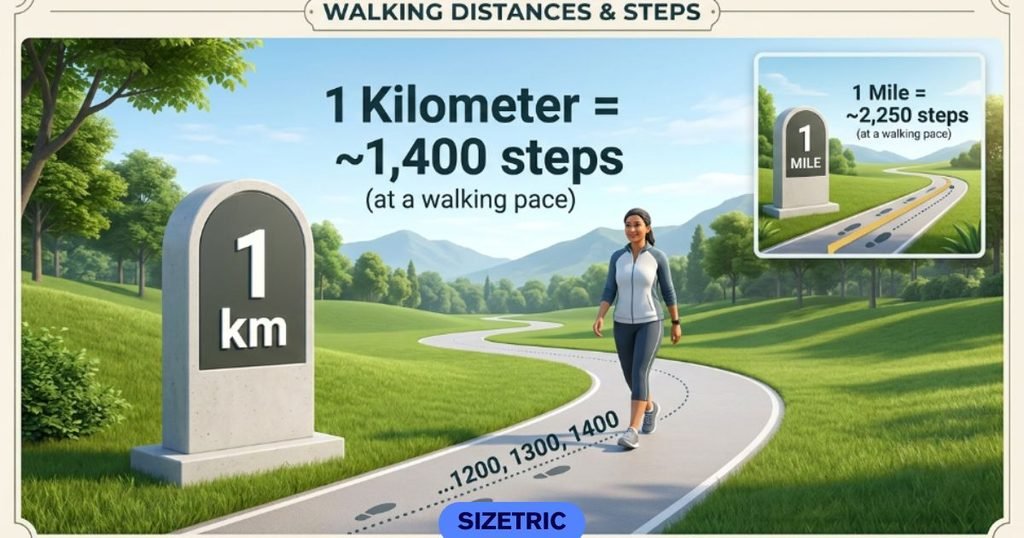
Outside the U.S., the same logic runs in kilometers. Since a kilometer is 0.621 of a mile, it packs fewer steps than a full mile does.
- 1 km ≈ 1,250–1,550 steps (walking), ~1,400 typical
- 5 km ≈ 7,000 steps
- 10 km ≈ 14,000 steps
- 10,000 steps ≈ 8 km
If your app is set to metric, convert with the same personal figure: take your steps-per-mile number and divide by 1.609 to get steps-per-kilometer. A 2,250-per-mile walker is doing about 1,400 steps per km.
Where This Conversion Actually Matters
Beyond curiosity, converting miles to steps has real jobs to do. Fitness goal-setting is the big one — if your target is a step count but your route is measured in miles, you need the bridge between them. Treadmill and outdoor logging lines up too: knowing your per-mile step rate lets you reconcile a treadmill’s distance readout with a wrist tracker that only counts strides.
It also helps with pacing a walking plan for weight management or recovery, where a doctor or coach might prescribe “two miles a day” and you’d rather track it in the steps your phone already shows. And for anyone chasing that 10,000-step badge, knowing a mile buys you 2,000-odd steps turns a vague goal into a concrete route.
Read Also: 300 Grams: 12 Everyday Things That Weigh This Much
Myths About Steps and Miles
“2,000 steps is exactly a mile.” It’s a rule of thumb, not a law. The real number swings from about 1,600 to 2,500-plus depending on your stride, pace, and whether you’re walking or running.
“10,000 steps a day is a scientifically required target.” The figure traces back to a 1960s Japanese pedometer marketing campaign, not a lab. It’s a fine, motivating goal — recent research even suggests real health benefits kick in well below it — but there’s nothing magic about the round number.
“My tracker is wrong because it disagrees with the treadmill.” They’re measuring different things. The treadmill measures belt distance; your tracker measures arm swing and footfalls. Different inputs, different totals — both can be right.
Fast Answers
How many steps is 1 mile?
About 2,000–2,500 steps for most walkers, with ~2,250 a good average. Taller strides land near 2,000; shorter ones near 2,500.
How many miles is 10,000 steps of walking?
Roughly 5 miles (about 8 km) for a typical adult. Longer strides stretch it toward 5.5 miles; shorter ones sit closer to 4.
Is 2 miles 5,000 steps?
Close — 2 miles is about 4,500–5,000 steps at an average walking pace. So 5,000 steps is a fair estimate, slightly on the high side.
Is 5,000 steps 1 mile?
No — 5,000 steps is roughly 2 to 2.5 miles, not one. A single mile is only about 2,000–2,500 steps.
Can I lose weight walking 5,000 steps a day?
Possibly, but only paired with a calorie deficit — 5,000 steps burns roughly 150–250 calories. It helps, though more steps or diet changes speed results.
The One-Line Takeaway
Now you know the simple truth about miles and steps. One mile equals about 2,000 to 2,500 steps for most people. Your height and your walking speed change this number a little. Taller people take longer steps, so they need fewer of them. A Miles to Steps Calculator makes this easy. You type in your miles, and it shows your steps right away. This tool saves time and gives you a clear answer every day.
Start with the round number of 2,000 steps per mile. Then measure your own stride one time for a better result. This small step turns a guess into a real figure that fits your body. Track your walks, set clear goals, and watch your daily steps grow with steady effort.
Related Guides:
1: How Much Is 20 Grams? Weight, Conversions & Examples
2: How Much Is 1 Gram? Weight, Examples & Conversions
3: 100 Grams: How Heavy It Is + What Weighs That Much
4: How Much Is 10 Grams? A Weight You Can Hold in Two Coins
5: 500 Grams: How Heavy It Is & What Weighs That Much







2 Comments