
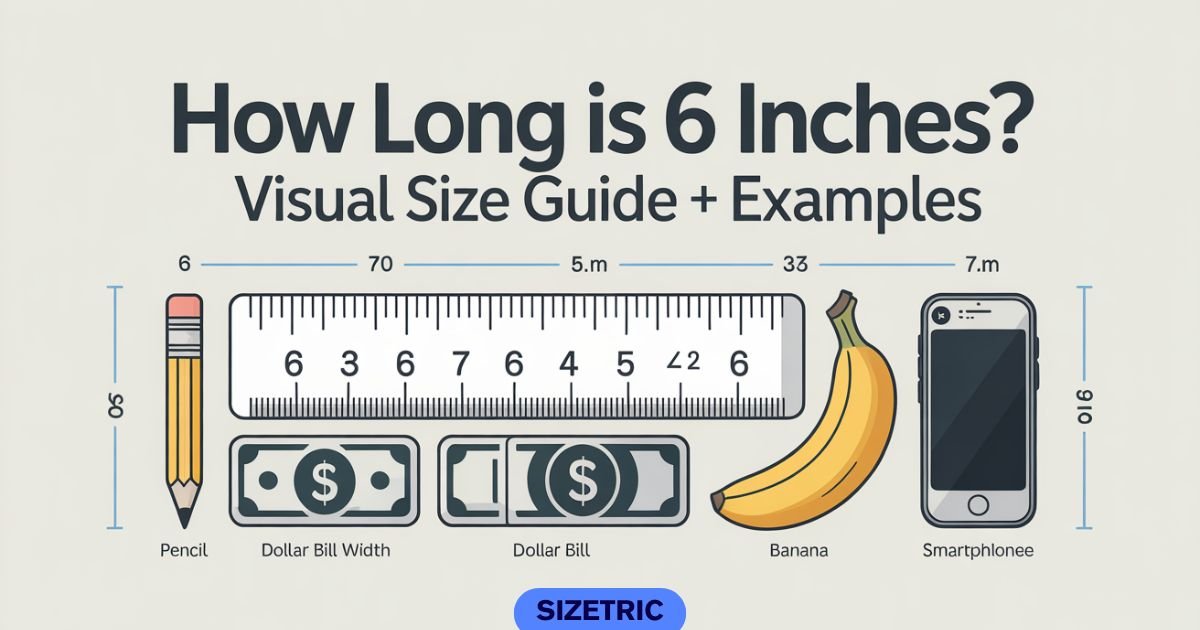
How Long Is 6 Inches? Visual Size Guide + Examples
Most of us can rattle off that 6 inches is “half a foot,” but freeze if someone asks us to hold our hands apart and show it. That’s the gap this guide closes. A number on its own is abstract; it only becomes useful once you can attach it to something real — a dollar bill, a pen, the phone in your pocket. Six inches sits in a sweet spot of everyday life: big enough to matter when you’re cutting, packing, or shopping online, small enough that you can gauge it with your bare hands once you know the tricks.
So instead of just quoting a conversion and moving on, we’ll build the picture from a few angles. You’ll get the exact figures in centimeters, millimeters, and feet, a set of household objects that match 6 inches almost to the millimeter, and a handful of no-ruler methods for the times you’re stuck without a tape measure. By the end, “6 inches” won’t be a vague half-foot in your head — it’ll be a length you can recognize on sight and reproduce with your fingers.
The Short Answer: How Long Is 6 Inches?
Six inches is exactly half a foot, or 15.24 centimeters (152.4 mm). It’s a mid-range length — longer than a credit card, shorter than a standard sheet of printer paper. The easiest way to picture it: a US dollar bill is about 6.14 inches long, so 6 inches is just a hair shorter than a bill laid flat.
6 Inches in Every Unit (Conversion Table)
| Unit | 6 Inches Equals |
| Centimeters | 15.24 cm |
| Millimeters | 152.4 mm |
| Feet | 0.5 ft |
| Yards | 0.167 yd |
| Meters | 0.1524 m |
Round numbers to know: 6 inches ≈ 15 cm (technically 15.24), and it’s exactly half of a 12-inch ruler.
Is 6 Inches Long or Short?
For a handheld object, 6 inches is on the larger side; for a room, tool, or piece of furniture, it’s tiny. It’s the length of a big smartphone stood upright, the width of a small dinner plate, or the reach across an adult palm plus a couple of fingers. In practical terms it’s a length you can wrap your hand around comfortably but not hide inside your fist.
Here’s the fastest mental anchor: 6 inches is half a foot. If you can picture a one-foot ruler, just cut it in the middle.
What Everyday Object Is About 6 Inches?
These are the references I reach for most, with their real measurements so you’re not guessing.
A US dollar bill (~6.14 in)
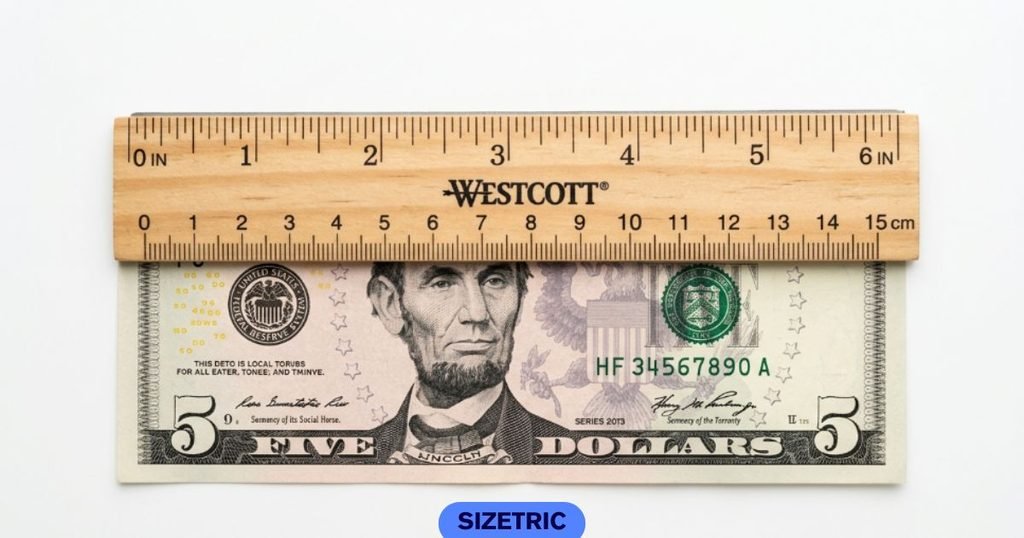
Every US banknote — the $1, $5, $20, right up to the $100 — measures exactly 6.14 inches (156 mm) long, because the Treasury holds every denomination to the same dimensions. Lay one flat against a ruler and it overshoots the 6-inch mark by only about an eighth of an inch, close enough that most people will never notice the difference in daily use.
That fixed, unchanging size is what makes a bill the most reliable “pocket ruler” you can carry, and unlike a hand or a finger, it needs no calibrating. If you want a true 6 inches rather than 6.14, just line up the edge of the bill and stop a sliver before the far end — that tiny fold is your correction, and you’ve marked an accurate half-foot with something already in your wallet.
Read Also: How Big Is 4 Inches? Real-World Size Examples & Chart
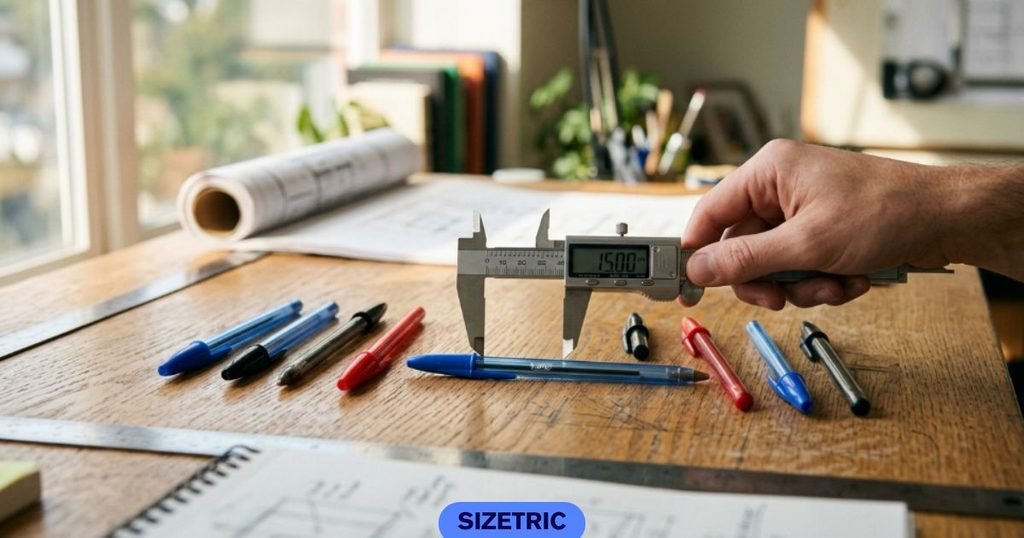
A ballpoint pen (~5.9 in)
A standard Bic Cristal–style pen runs about 5.9 inches (15 cm) from tip to cap, landing just a whisker under the 6-inch mark. Pens vary a little by brand and whether the cap is on, but the classic disposable ballpoint is remarkably consistent and sits within a few millimeters of the target every time.
Because a pen turns up in almost every bag, drawer, and cup on a desk, it’s one of the most convenient quick gauges around. When you need to rough out 6 inches on a box or a shelf and there’s no tape measure in sight, grabbing the nearest full-length pen will get you within a fraction of an inch — plenty close for packing, sketching a cut line, or checking whether something will fit.
A large smartphone (~6.3 in tall)
Big “Pro Max”– and “Ultra”–class phones stand roughly 6.2–6.5 inches tall, with most models clustering right around 6.3 inches from the bottom edge to the top. That’s a touch more than 6 inches, so held upright a large phone slightly overshoots a true half-foot rather than matching it exactly.
The advantage here is availability — your phone is almost always within arm’s reach, which makes it a genuinely practical reference once you’ve committed its height to memory. Measure your specific model against a ruler a single time, remember where the 6-inch line lands on it, and from then on the phone in your hand doubles as a rough ruler you never have to go looking for.
A standard hot dog (~6 in)
A regular-length hot dog nestled in its bun runs about 6 inches end to end, which is precisely why sandwich shops built their menus around the “6-inch” sub. As real-world matches go, it’s a good one — the number people already associate with these foods happens to be genuinely accurate.
The catch is that these are nominal, marketed sizes rather than precision-cut measurements, so any given hot dog might land anywhere from about 5.5 to 6.5 inches. That makes it a great tool for picturing the length in your head, but a poor one for real accuracy — reach for it when you want an instant mental image, not when you’re marking a cut.
Half a 12-inch ruler (exactly 6 in)
The cleanest reference of them all is simply half of a standard 12-inch ruler. Split that ruler at its midpoint and you get a flawless 6 inches with no rounding, no conversion, and no approximation — the 6-inch mark is printed right there for you.
Nothing else on this list can claim to be exactly right, which is what makes the ruler the benchmark every other object gets compared against. If one happens to be within reach, skip the stand-ins entirely; when it isn’t, the dollar bill and the pen are your next-best options for landing on a true half-foot.
Quick Comparison Table
| Object | Real length | Compared to 6 in |
| Half a 12-inch ruler | 6.0 in / 15.24 cm | Exact |
| Standard hot dog | ~6 in / ~15 cm | About equal |
| Ballpoint pen (Bic) | 5.9 in / 15 cm | Slightly shorter |
| US dollar bill | 6.14 in / 15.6 cm | Slightly longer |
| Large smartphone (Pro Max) | ~6.3 in / ~16 cm | Slightly longer |
| Credit card | 3.37 in / 8.56 cm | 6 in ≈ 1.8 cards |
No Ruler? Here’s How to Nail 6 Inches
When there’s no tape measure in reach, use something standardized rather than trusting your eye.
- Use a banknote. Any US bill is 6.14 inches long. Line up what you’re measuring with the edge of the bill and stop a sliver before its far end — that’s 6 inches.
- Use two index fingers. An average adult index finger is roughly 3 inches, so two finger-lengths end to end land near 6.
- Measure your own hand once. Hand sizes vary a lot, so hold your spread hand against a ruler a single time and remember where 6 inches falls (for many adults it’s close to the span from thumb tip to pinky tip). After that, your hand becomes a rough built-in ruler.
- Fold a sheet of paper. US letter paper is 8.5 × 11 inches. Fold the long edge so a bit over half is showing and you’re in the 6-inch neighborhood — good enough for quick DIY marking.
Of these, the dollar bill is the most trustworthy because its dimensions never change.
6 Inches or 15 cm — Which Is Bigger?
Six inches is slightly longer than 15 cm. The exact conversion is 15.24 cm, so 6 inches beats a flat 15 cm by about 2.4 millimeters. It’s a small gap, but worth knowing if you’re following a metric pattern, cut list, or recipe where a couple of millimeters matter.
The Sizes Right Next Door
Knowing what sits just above and below 6 inches makes it easier to place.
| Length | In cm | Easy reference |
| 5 inches | 12.7 cm | A large playing card and a half; many older phone screens |
| 6 inches | 15.24 cm | Half a foot; a dollar bill |
| 7 inches | 17.78 cm | A small tablet’s short side; a slim paperback height |
The tell between them: 6 inches is exactly half a ruler, 5 inches falls an inch short of that midpoint, and 7 inches pushes an inch past it. An unsharpened pencil (about 7.5 in) is a handy marker for “clearly more than 6.”
Where 6 Inches Shows Up in Real Life
This length turns up constantly once you start noticing it. In the kitchen it’s the reach of a small paring knife blade and the diameter of a personal-size cake pan. For DIY, a 6-inch clearance is a common gap for shelving brackets and pipe cutoffs. Shopping online, it’s the height of many decorative planters and the width of a compact tablet — so a 6-inch reference in the description tells you it’ll sit in one hand.
Read Also: How Big Is 7 Inches? A Visual Size Guide With Examples
One Thing People Get Wrong
The biggest mix-up: assuming “6 inches” and “15 cm” are identical. They’re close but not equal — 6 inches is 15.24 cm, a couple of millimeters longer. The second trap is trusting product labels as exact. A “6-inch” sub or a “6-inch” phone is a rounded marketing figure; the real object can land anywhere from about 5.8 to 6.4 inches. When precision counts, measure it yourself.
Fast Answers
Is 6 inches big or small?
It’s a medium, hand-sized length — exactly half a foot. That’s larger than a credit card or a soda can’s width but smaller than a standard sheet of paper’s long side.
How many cm is 6 inches?
Six inches equals 15.24 centimeters (152.4 mm). Multiply any inch value by 2.54 to convert to centimeters.
What is exactly 6 inches long?
Half of a standard 12-inch ruler is exactly 6 inches. A US dollar bill is the closest everyday match at 6.14 inches — barely longer.
Is 6 inches the same as 15 cm?
No. Six inches is 15.24 cm, which is about 2.4 mm longer than a flat 15 cm. Close for casual use, but not identical.
How can I measure 6 inches without a ruler?
Use a US banknote (6.14 in long) and stop just short of its end, or line up a standard ballpoint pen (about 5.9 in). Both get you within a fraction of a true 6 inches.
How many inches is half a foot?
Exactly 6 inches. A foot is 12 inches, so half of it is 6.
The Takeaway in One Line
Six inches turns out to be one of the friendliest measurements to memorize, precisely because so many familiar objects land right on it. It’s exactly half a foot, a shade over 15 centimeters, and just a hair shorter than the dollar bill folded in your wallet. Lock onto any one of those anchors — the bill, a ballpoint pen, the top half of a 12-inch ruler — and you’ve got a reference you carry with you everywhere, no measuring tape required.
The only real pitfalls are the two we flagged: don’t treat 6 inches and 15 cm as identical (that missing 2.4 mm can matter in a cut list), and don’t trust “6-inch” product labels as gospel, since they’re usually rounded. Beyond that, the length is yours. Next time you’re eyeballing shelf clearance, sizing up a package, or checking whether something will fit in one hand, you won’t reach for a ruler — you’ll already know what 6 inches looks like.
Related guides: [INTERNAL LINK: How Far Is 10 Miles?] · [INTERNAL LINK: 8 Inches Long?] · [INTERNAL LINK: How Far Is 50 Miles?] · [INTERNAL LINK: How Far Is 500 Feet?]


One Comment