
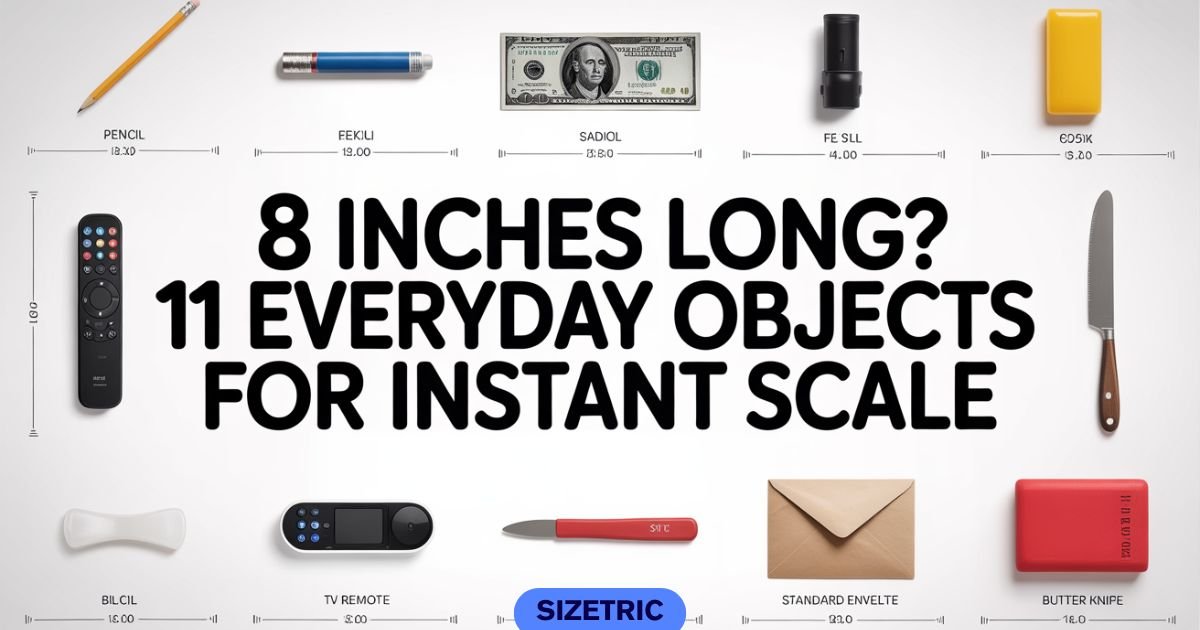
8 Inches Long? 11 Everyday Objects for Instant Scale
Say “8 inches” and most people freeze for a second. Is that hand-sized? Plate-sized? Bigger than a phone? The number is easy — the picture is the hard part.
This page fixes that. You’ll get eleven real objects that sit right at 8 inches, clean conversions to centimeters and feet, a no-ruler trick for measuring with just your hands, and the small traps that fool people. By the end you’ll spot 8 inches on sight.
The Short Answer
Eight inches is exactly 20.32 cm, 203.2 mm, or two-thirds of a foot. For a fast mental image: it’s the blade of a standard kitchen chef’s knife, the short edge of an 8×10 photo, or one adult hand spread wide. Bigger than any phone, a hair shorter than a sheet of letter paper is wide.
8 Inches Across the Measuring Systems
If you’re converting for a project, a package, or a school worksheet, here are the numbers you’ll actually reach for. [INTERNAL LINK: 20 cm to inches]
| Unit | 8 inches equals |
| Centimeters | 20.32 cm |
| Millimeters | 203.2 mm |
| Feet | 0.667 ft (8⁄12) |
| Yards | 0.222 yd |
| Meters | 0.2032 m |
A quick note worth banking: 8 inches is not a round 20 cm. It’s 20.32 cm, and going the other way, a flat 20 cm works out to about 7.87 inches. The gap is small, but if you claim they’re identical you’ll be off by a few millimeters — enough to matter for a tight-fitting part.
Getting a Feel for the Length
Eight inches is the “in-between” size — too long to call small, too short to call big. It clears the height of nearly every smartphone made, yet stops well short of a standard 12-inch ruler. Think two-thirds of a ruler’s run.
Held vertically, it reaches roughly from the tip of your middle finger to a couple of inches past your wrist on an average adult arm. Laid flat on a table, it’s about the span you’d cover if you opened your hand as wide as it goes. It’s a length you can hold — which is exactly why the objects below make such good yardsticks.
11 Real Objects That Land at 8 Inches
Each item here is something you’ve likely touched this week. Where a size is fixed by design, I’ve said so; where it varies, I’ve given the honest range.
An 8-Inch Chef’s Knife
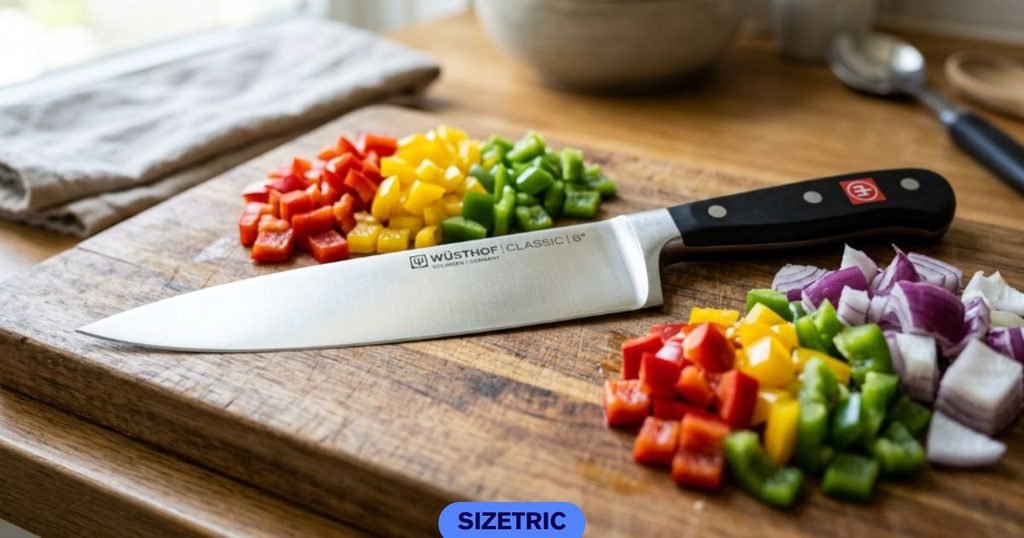
The all-purpose chef’s knife is the workhorse of home kitchens, and when it’s sold as “8-inch,” that number refers to the blade — measured tip to heel, not counting the handle. So the steel alone is a true 8 inches (20.3 cm). Add the handle and the whole tool runs closer to 13 inches, which is where people get tripped up.
Because almost every kitchen owns one, this is a reference you can literally pull from a drawer. Lay the blade flat against whatever you’re sizing up and you’re comparing against a precise 8 inches. I reach for it constantly when eyeing whether a new cutting board or drawer insert will actually fit the space.
Read Also: How Far Is 50 Miles? Travel Time, Distance & Real Examples
A Round 8-Inch Cake Pan
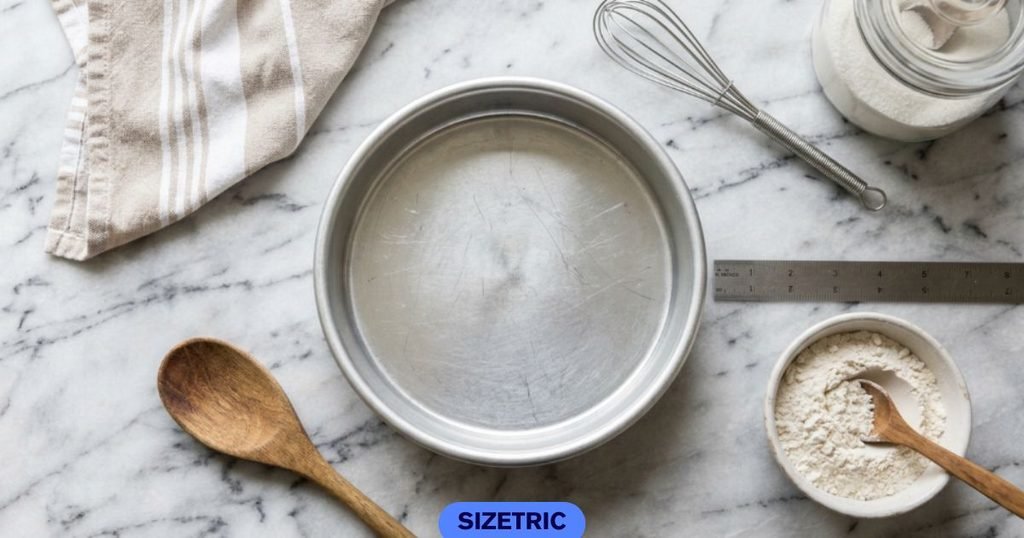
A standard round cake pan labelled “8-inch” measures 8 inches straight across the top opening (20.3 cm) — that’s the diameter, not the height. It’s one of the most common bakeware sizes on the planet, so the figure is dependable and fixed.
Set one on the counter and the mouth of the pan spans a clean, unbroken 8 inches. That makes it my go-to when I need to guess the diameter of a round lid, a small tray, or a bowl I’m eyeing at a shop. A circle is harder to judge than a line, and this gives you a physical one.
A Fajita-Size Flour Tortilla
The 8-inch flour tortilla — the “fajita” or soft-taco size — is a supermarket standard, roughly 8 inches across when it’s lying flat. Call it approximate: a tortilla flexes and puffs, so you’re within a quarter-inch either way rather than dead-on.
Pull one from the pack and you’re holding a soft 8-inch disc you can compare against almost anything on a counter. It’s a surprisingly good stand-in for picturing the footprint of a saucer or a small side plate before you buy one.
The Short Side of an 8×10 Photo
An 8×10 print is a classic frame and photo size, and its short edge is exactly 8 inches (20.3 cm). If you’ve ever framed a portrait or hung a certificate, you’ve handled this dimension without thinking about it.
A photo’s edge is a dead-straight line, which beats curved objects like bananas for judging length precisely. Prop a framed 8×10 next to a shelf or a wall gap and you’ve got an instant, reliable 8-inch check.
A Standard US Brick (Its Length)
Here’s one that rewards a careful eye. A common US modular brick is designed around an 8-inch length — but the brick itself measures 7 5⁄8 inches (7.625 in, or 19.4 cm). The missing 3⁄8 inch is the mortar joint. Add brick plus joint and the building module lands on a round 8 inches, which is how bricklayers count.
So the brick is a touch under 8; the unit-with-mortar is bang on. Outdoors, with no ruler in sight, a wall is a handy giant ruler: every brick length plus its joint steps off 8 inches, and four of them run right about 32 inches.
A Ripe Banana
A medium supermarket banana runs about 7 to 8 inches along its curve with the stem attached, and a large one clears 8 easily. This is an approximate reference — bananas grow, they don’t get manufactured.
Because it’s curved, treat it as a ballpark rather than a straightedge. Its real value is availability: everyone can summon a banana in their mind’s eye, which makes it a friendly “about 8 inches” when you’re mid-recipe and empty-handed.
A Dessert or Salad Plate
The everyday salad or dessert plate spans roughly 7.5 to 8.5 inches across, with the most common size sitting right around 8 inches (about 20 cm). Ranges exist because plate styles vary, so I’d call this a solid typical rather than a fixed spec.
Stack one on top of a dinner plate — those run 10 to 11 inches — and the size difference jumps out. It’s my favourite prompt for imagining an 8-inch circle in the wild: the top of a small lampshade, a round wall mirror, a cake.
A Pair of 8-Inch Kitchen Scissors
Kitchen shears and sewing scissors are sold by their overall length, and the 8-inch pair measures 8 inches from the blade tips to the far edge of the finger rings. It’s among the most common sizes, so the label is reliable to within a hair.
Closed, they form a straight 8-inch line you can lay flat against a seam, a strip of fabric, or a box flap. Cooks and sewers both keep a pair within arm’s reach, which quietly makes it one of the handiest 8-inch references in the house.
Your Own Hand Span
Spread your hand as wide as it goes — thumb tip to little-finger tip. For a lot of adults that hand span falls between 7.5 and 8.5 inches, with many men landing right around 8.5 and many women nearer 7.5. In other words, one spread hand is a rough 8 inches for a huge share of people.
This is the ruler you can never leave at home. Measure your own span once against a tape, memorise the number, and from then on you can gauge 8 inches against a shelf, a parcel, or a gap in the wall wherever you happen to be standing.
A Compact Tablet (iPad mini Class)
A small tablet such as the iPad mini measures about 7.7 inches down its long edge (195 mm) and carries an 8.3-inch diagonal screen. So the body height sits just under 8 inches, while the screen measured corner-to-corner slightly clears it — a good reminder that “8.3-inch screen” and “8-inch device” describe different lines.
If you own one, you carry a near-8-inch rectangle in your bag every day. Turn it to portrait and the long side becomes a quick, dependable stand-in for “about 8 inches” — closer than a phone, which tops out around 6.5.
A 5×8 Trade Paperback (Its Height)

The popular 5-by-8-inch trade paperback trim is exactly 8 inches tall. Not every book uses it — publishers pick from several trim sizes — but this one is common enough to be a genuine reference on any bookshelf.
Slide one out and the spine height reads a clean 8 inches top to bottom. When a photo frame or knife isn’t handy, the nearest paperback of this size is a tidy indoor yardstick that’s always sitting right there in plain view.
Every Comparison, Side by Side
| Object | Measurement | How exact |
| 8-inch chef’s knife (blade) | 8.0 in / 20.3 cm | Exact by design |
| 8-inch round cake pan (diameter) | 8.0 in / 20.3 cm | Exact by design |
| 8×10 photo (short edge) | 8.0 in / 20.3 cm | Exact |
| 5×8 trade paperback (height) | 8.0 in / 20.3 cm | Exact for this trim |
| 8-inch kitchen scissors (overall) | 8.0 in / 20.3 cm | Nominal size |
| Fajita-size flour tortilla | ~8 in / ~20 cm | Approximate |
| US brick (building module) | 8 in nominal / 7.625 in actual | Nominal vs actual |
| Dessert / salad plate | 7.5–8.5 in, ~8 typical | Range |
| Ripe banana (with stem) | 7–8 in / 18–20 cm | Approximate |
| Compact tablet (long edge) | ~7.7 in / ~19.5 cm | Just under 8 |
| Adult hand span | ~7.5–8.5 in | Varies by person |
No Tape Measure? Use Your Body
You can build 8 inches out of things you always have on you. The cleanest is your hand span, described above — one spread adult hand is close for most people.
If your hands run small, chain a couple of everyday cards instead. A standard credit card is 3.37 inches long, so about 2.4 of them laid end to end reaches 8 inches. A playing card stands 3.5 inches tall — a little over two and a quarter of those does the same job. Prefer paper money? A US dollar bill is 6.14 inches long, so a bill plus roughly a thumb’s width past it gets you there.
None of these is millimeter-perfect, and that’s fine. For hanging a picture, spacing plants, or checking a shelf, “within half an inch” is usually all you need — and any of these beats guessing blind.
Where This Measurement Earns Its Keep
Eight inches shows up more than you’d expect once you start noticing it. In the kitchen, it’s the default size for chef’s knives, round cake pans, and mid-size tortillas, so recipes and gear quietly revolve around it. In printing and framing, 8×10 is a staple, which is why frames and mats in that size fill every craft aisle.
For shipping and packing, knowing that an object is 8 inches on a side tells you fast whether it’ll drop into a small mailing box or need the next size up. In tech, the compact tablet and large e-reader class clusters right here, distinct from phones below and full-size tablets above. And in construction, the 8-inch module is baked into brickwork and standard concrete blocks, so builders think in these steps all day. [INTERNAL LINK: how big is 12 inches]
8 Inches Between Its Neighbours: 7 and 9
Sizing something is easier when you know what sits on either side. Drop an inch to 7 inches (17.78 cm) and you’re roughly at the height of a large smartphone or a small paperback — noticeably more pocket-friendly than 8.
Add an inch to 9 inches (22.86 cm) and you land near a luncheon plate or a modest dinner plate. The most useful near-neighbour, though, is paper: a sheet of US letter paper is 8.5 inches wide, just half an inch past our target. Hold an 8-inch object against the short side of a printed page and the small overhang tells you instantly you’re looking at eight-and-a-bit, not nine.
Read Also: How Far Is 500 Feet? Clear Comparisons You Can Picture
Where People Go Wrong With 8 Inches
A few honest mistakes come up again and again:
- Reading a product label as the object’s full length. An “8-inch” knife means the blade; an “8-inch” pan means the diameter; an “8.3-inch” tablet means the screen diagonal, not the body. Always check which line the number describes.
- Assuming nominal equals actual. A brick built to the 8-inch module actually measures 7.625 inches, and an “8-inch” concrete block is likewise a little shy of a true 8. The round number is the design unit, not a caliper reading.
- Mixing up inches and centimeters. Eight inches (20.32 cm) and 8 cm (about 3.15 in) are wildly different lengths — a costly slip when ordering parts online.
- Trusting a curved object as a straightedge. A banana or a cucumber gives you a rough feel, never a precise 8 inches. Reach for a flat edge when accuracy counts.
- Calling 8 inches a clean 20 cm. It’s fine for a rough estimate, but it’s really 20.32 cm — don’t present the rounded figure as exact.
Quick-Fire Q&A
How many centimeters is 8 inches?
Exactly 20.32 cm, which is the same as 203.2 mm. It comes from the fixed rate of 2.54 cm per inch.
Is 8 inches the same as 20 cm?
Almost, but not quite. Eight inches is 20.32 cm, and a flat 20 cm is about 7.87 inches. Close enough for a rough guess, off by a few millimeters for precise work.
What everyday object is exactly 8 inches?
The blade of a standard chef’s knife and the short edge of an 8×10 photo both measure a true 8 inches. An 8-inch round cake pan is exactly 8 inches across, too.
How do I measure 8 inches without a ruler?
Spread one adult hand wide — the span is close to 8 inches for many people. If your hands are small, line up about 2.4 credit cards end to end.
Is 8 inches long for a phone?
Yes. Most phones stand 6 to 6.7 inches tall, so 8 inches is taller than nearly any phone and closer to a compact tablet or a large e-reader.
What is 8 inches in feet?
Two-thirds of a foot, or 0.667 ft. Since a foot is 12 inches, 8 inches is 8⁄12 of it.
Conclusion
Eight inches stops being an abstract number the moment you tie it to something real. It’s a chef’s knife blade, the short edge of an 8×10 photo, or an 8-inch cake pan across the top — all exact — with a banana, a salad plate, or your own spread hand close behind for a fast gut check.
Keep two things straight and you’ll rarely be off: 8 inches is 20.32 cm, not a flat 20, and a “size” on a label often names one specific line — a blade, a diameter, a screen — not the whole object. Anchor the length to one reference you already own and you can measure it anywhere, tape or no tape.
Related Guides:
1: How Much Is 10 oz? Weight, Grams, Cups & Examples
2: What Is 20 kg? Weight, Conversions & 6 Real Examples
3: How Long Is 25 Feet Visually? 6 Ways to Picture It
4: How Long Is 30 Feet? Visualize It With Real Objects
5:How Long Is 30 Meters? Feet, Yards & Real Examples



2 Comments