
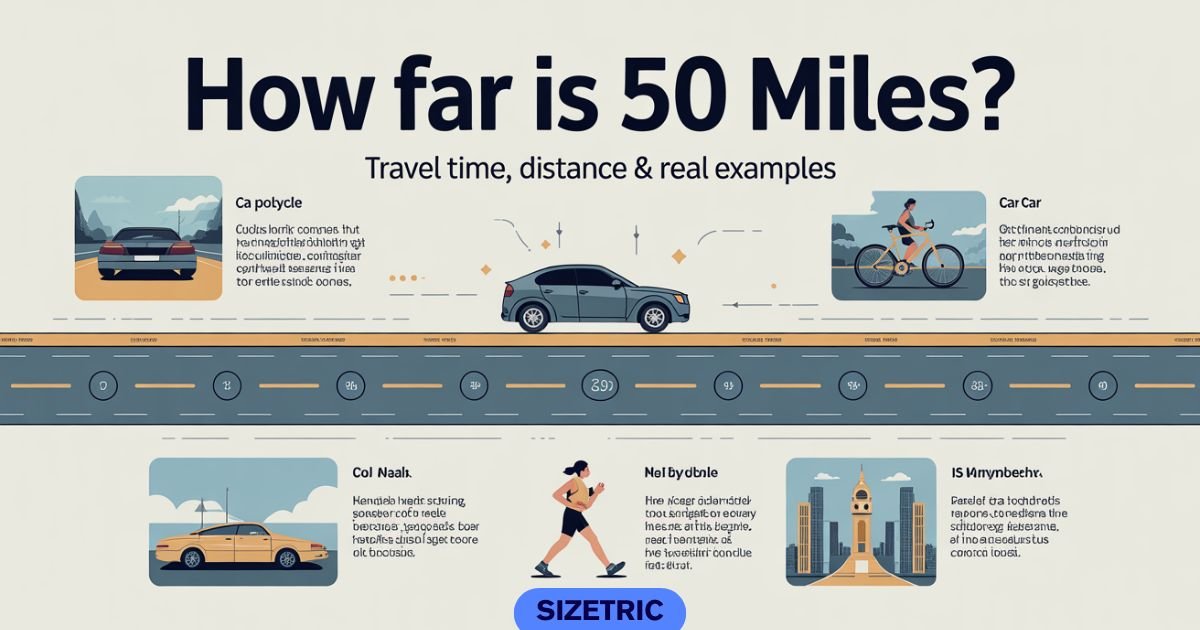
How Far Is 50 Miles? Travel Time, Distance & Real Examples
Fifty miles is one of those distances that sounds concrete until you try to picture it. It’s too far to walk on a whim, short enough to drive before lunch, and just long enough to make you double-check the gas gauge. Most people know the number without really feeling the distance behind it.
This guide pins it down from every angle: the exact conversions, how long 50 miles takes on foot, by bike, and behind the wheel, plus a stack of real-world distances you already know that add up to almost exactly 50 miles. By the end you’ll be able to feel the distance, not just read the number.
The Short Answer
Fifty miles equals 80.47 kilometers (about 80 km). In a car on the highway, that’s roughly a 45-minute drive. On foot at a normal walking pace, it’s around 16 to 17 hours of nonstop walking. And measured against races, 50 miles falls just short of two back-to-back marathons.
Everything below unpacks those numbers and adds the landmarks, conversions, and comparisons that make the distance stick.
50 Miles Converted Into Every Useful Unit
Miles are an imperial measurement, so anyone working in metric needs the conversion fast. The math is fixed: one mile is exactly 1.609344 kilometers, which makes 50 miles a clean 80.4672 km.
| Unit | 50 miles equals |
| Kilometers | 80.47 km (≈80.5) |
| Meters | 80,467 m |
| Feet | 264,000 ft |
| Yards | 88,000 yd |
| Nautical miles | 43.45 nm |
A few notes so nothing looks off. Feet come straight from the 5,280-feet-per-mile rule (5,280 × 50 = 264,000). Yards are one-third of that (88,000). Nautical miles run longer than statute miles, so the count drops to about 43.45. Centimeters and millimeters technically exist here too — 50 miles is 8,046,720 cm — but nobody measures highway distance in centimeters, so I’ve left the impractical units off the table.
How Long Does It Take to Cover 50 Miles?
Distance means nothing without a speed attached to it. The same 50 miles can be a quick errand or a two-day trek depending on how you’re moving. Here’s the honest spread across common modes.
| How you travel | Typical speed | Time for 50 miles |
| Highway driving | 65–70 mph | ~45 minutes |
| City driving with stops | 25–30 mph | ~1 hr 40 min–2 hr |
| Road cycling (fit rider) | 15–18 mph | ~3 hours |
| Casual cycling | 10–12 mph | ~4.5 hours |
| Running (ultra distance) | varies widely | ~5–13 hours |
| Walking | ~3 mph | ~16–17 hours |
| Commercial jet at cruise | ~550 mph | ~5.5 minutes |
The driving figures assume steady motion. Add a single traffic jam or a string of red lights and a “45-minute” trip stretches past an hour fast. The walking number is continuous, no rest — in reality, 50 miles on foot is a multi-day hike for most people, not a single push.
The running range is wide on purpose. Fifty miles is a recognized ultramarathon distance; elite ultrarunners finish in roughly five to six hours, while a first-time recreational runner might need ten to thirteen hours across the full day.
What 50 Miles Actually Looks Like
Numbers are easier to trust when they line up against distances you’ve already experienced. Each reference below is measured, and I’ve flagged where it’s exact versus a close approximation.
Nearly Two Marathons, Back to Back

A marathon is 26.2 miles. Run two of them without stopping and you’d cover 52.4 miles — so 50 miles lands just 2.4 miles short of a double marathon. Put another way, 50 miles is about 1.9 marathons, or roughly 3.8 half-marathons (a half is 13.1 miles).
This is my favorite anchor because so many people have either run or watched a marathon. The distance stops being abstract the moment you imagine doing the whole thing, then turning around and doing almost all of it again. If someone tells you they’re driving 50 miles, they’re covering ground it would take a world-class marathoner nearly two full races to run.
Read Also: How Far Is 500 Feet? Clear Comparisons You Can Picture
One Full 50-Mile Ultramarathon

The 50-mile ultra isn’t a comparison to 50 miles — it is 50 miles, and that makes it a perfect intuition check. It’s a standard step up from the marathon in the ultrarunning world, sitting below the famous 100 K and 100-mile events.
I mention it because the finish times reveal how much distance this really is. Even trained athletes spend the better part of a working day on their feet to complete one. When a race organizer draws a 50-mile course, they’re mapping out something that can take a mid-pack runner from sunrise well past lunch — a vivid reminder that 50 miles is a serious span, not a stroll.
More Than Twice Across the English Channel
At its narrowest point, the English Channel — the Strait of Dover between England and France — is about 21 miles wide. Fifty miles is roughly 2.4 times that crossing. This is an approximate anchor, since the Channel’s width varies along its length, but the narrowest point is the figure swimmers and ferry routes use.
It’s a useful reference because the Channel crossing is legendary for its difficulty; swimmers train for years to manage 21 miles of open water. Stack the distance up two and a half times and you have 50 miles. Next time you see a Dover-to-Calais map, remember you’d need to lay two of those crossings side by side and then add a bit more.
Manhattan End to End, Almost Four Times
The island of Manhattan runs about 13.4 miles from its southern tip up to its northern end. Line four Manhattans nose to tail and you’d travel 53.6 miles — so 50 miles is very close to 3.7 Manhattans in a row.
New York’s geography is familiar to a global audience through film and television, which is what makes this one land. If you’ve ever ridden the length of the island, you know it feels like a real journey. Repeat it not quite four times and you’ve hit 50 miles — a scale that helps city dwellers picture what would otherwise feel like open-country distance.
A Short Hop Between Neighboring Cities

Fifty miles is the sweet spot for city-to-city distances that feel connected but distinct. San Francisco to San Jose is roughly 48 miles by road, and Boston to Providence is about 50 miles down I-95. These are approximate driving distances — actual mileage shifts with the route you take — but both are close enough to serve as living examples.
I like real city pairs because they carry a built-in sense of time and effort. People who’ve made either drive know it’s a commit-to-it trip, not a quick pop across town, yet it’s routine enough that thousands do it daily. That’s exactly the character of 50 miles: substantial, but well within a day’s ordinary reach.
Roughly Four-Fifths of the Way to Space
Point the distance straight up instead of along the ground and something surprising happens. The Kármán line — the conventional boundary of outer space — sits at 62 miles (100 km) above sea level. Fifty miles up would put you at about 80% of that height, deep in the mesosphere and well above 99.9% of the atmosphere’s mass.
This vertical flip is the one that reliably makes people pause. Horizontally, 50 miles is a modest drive. Vertically, it’s most of the way to space — higher than any airliner, higher than weather balloons, into the layer where meteors burn up. Same distance, wildly different feeling, which is exactly why it’s worth including.
A Quick-Scan Comparison Table
Here’s everything above condensed for a fast visual gut-check.
| Reference | Its distance | 50 miles compared to it |
| Marathon | 26.2 mi | just under 2× (≈1.9) |
| Half marathon | 13.1 mi | about 3.8× |
| English Channel (narrowest) | ~21 mi | about 2.4× |
| Manhattan (full length) | ~13.4 mi | about 3.7× |
| Lap of a 400 m track | ~0.25 mi | about 201 laps |
| Edge of space (Kármán line) | 62 mi | about 80% of the way up |
That last row is worth a second look: if you ran a standard 400-meter track the whole way, you’d need to circle it just over 201 times to log 50 miles.
Judging 50 Miles Without a Map or Odometer
You won’t eyeball 50 miles the way you’d eyeball a table’s width — it’s simply too big to take in at once. But you can estimate it with a few reliable mental shortcuts.
Lean on time. If you’re driving a clear highway at a steady 60 mph, 50 miles is 50 minutes — one minute per mile, an easy ratio to hold in your head. Cut the speed to 30 mph on surface streets and the same trip roughly doubles to 100 minutes.
Lean on landmarks you know. Pick a familiar drive of known length — say, your regular 25-mile trip to a relative’s house — and simply double it. Anchoring an unknown distance to a route you’ve driven dozens of times beats guessing from scratch every time.
Lean on the map scale. On a paper map or a screen, find the scale bar, note how much real distance one inch or one centimeter represents, and count it out along your route. For rough planning, this gets you within a few miles with no tool but your eyes.
Where 50 Miles Actually Comes Up
This isn’t a trivia number — it appears in plenty of everyday decisions, which is part of why people search for it.
Electric-vehicle planning. Fifty miles sits inside the daily range of essentially every modern EV and comfortably covers a typical round-trip commute, which is why range anxiety rarely kicks in until distances climb well past it.
Delivery and service radius. Businesses often define a service area as a 50-mile radius from a hub. That’s not a small zone: a 50-mile radius covers a circle nearly 100 miles across, enclosing roughly 7,850 square miles of territory.
Commuting limits. A 50-mile one-way commute is on the long end of what people tolerate daily — a solid highway hour each way in good conditions, and the point where many workers start weighing relocation or remote work.
Emergency and jurisdictional zones. Evacuation planning, residency requirements, and event-security perimeters frequently use mileage thresholds, and 50 miles is a common round figure for “close enough to matter, far enough to be separate.”
50 Miles vs. the Distances Right Next to It
Context sharpens when you set 50 miles beside its neighbors.
Drop down to 40 miles and you shave about eight minutes off a highway drive — call it a 37-minute trip at 65 mph versus roughly 45 minutes for 50. In metric, 40 miles is 64.4 km against 50 miles’ 80.5 km. It’s a noticeable step, but the two feel like the same category of trip.
Climb to 60 miles and the character shifts more. That’s 96.6 km, close to an hour of highway driving, and it nudges past the double-marathon mark (52.4 miles) into clearly-more-than-two-marathons territory. Sixty miles also lands right around the Kármán line if you measure straight up.
The takeaway: 50 miles is the comfortable middle of the “an hour or less by car” band — long enough to plan for, short enough not to dread.
Read Also: How Much Is 10 oz? Weight, Grams, Cups & Examples
Where People Get 50 Miles Wrong
A few misconceptions trip searchers up repeatedly, so here they are, corrected.
Confusing it with 50 kilometers. These are not interchangeable. Fifty miles is 80.47 km, while 50 km is only about 31 miles. Mixing them up on a road trip means underestimating your drive by nearly 20 miles — a real problem when fuel or timing is tight.
Assuming 50 miles is always about an hour. Only on an open highway. In stop-and-go city traffic, 50 miles can easily eat 90 minutes to two hours, and a bad commute can push it further. Speed, not distance alone, sets the clock.
Treating it as “walkable in a day.” At 3 mph it’s 16-plus hours of continuous walking — physically possible for elite endurance athletes, but not a realistic single-day walk for most people. Treat 50 miles on foot as a multi-day undertaking.
Fast Answers
How long is a drive of 50 miles?
On the highway at 65–70 mph, about 45 minutes. In city traffic with stops, expect closer to 1.5–2 hours.
How many minutes is 50 miles?
At a steady 60 mph, it’s a clean 50 minutes (one minute per mile). Faster highway speeds trim it to around 45.
How long will it take to travel 50 miles?
By car, roughly 45 minutes to 2 hours depending on traffic. By bike it’s about 3–4.5 hours, and on foot around 16–17 hours nonstop.
How far away is a 50 mile drive?
Think Boston to Providence or San Francisco to San Jose — a real trip between neighboring cities, about 80 km apart.
Is 50 miles 1 hour?
Only on an open highway at around 50 mph. At 65–70 mph it’s under an hour; in city traffic it can stretch well past it.
Is 50 miles a long way?
Not by car — it’s a comfortable under-an-hour drive. On foot or running, though, it’s a serious distance: nearly two marathons.
Locking This Distance Into Memory
Here’s the one-line version to keep: 50 miles is 80 kilometers, a 45-minute highway drive, or almost two marathons — modest by car, mighty on foot, and most of the way to space if you point it at the sky. Hold those three anchors and you’ll never have to guess what 50 miles feels like again.
Related Guides:
1: What Is 20 kg? Weight, Conversions & 6 Real Examples
2: How Long Is 25 Feet Visually? 6 Ways to Picture It
3: How Long Is 30 Meters? Feet, Yards & Real Examples
4: How Long Is 30 Feet? Visualize It With Real Objects
5: How Far Is 500 Meters? 6 Real-World Ways to Picture It




One Comment