
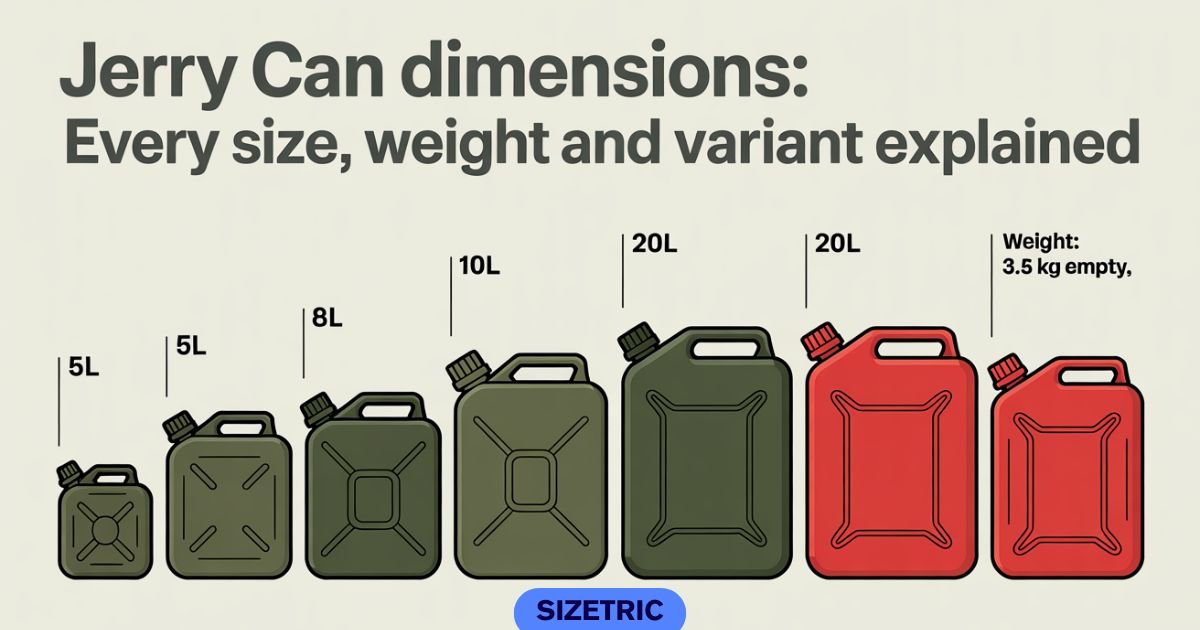
Jerry Can Dimensions: Every Size, Weight and Variant Explained
You reach for a jerry can expecting one standard shape — then discover the holder you bought is 5 mm too tight, or the “5-gallon” can you ordered online turns out to be a squat American gas jug instead of the flat, three-handled classic you had in mind. The word covers more sizes than most people realise.
This guide pins down the real numbers. You’ll get the exact dimensions of the standard 20-litre can in millimetres, centimetres and inches, the honest ranges for 10L and 5L versions, empty-versus-full weights, the difference between steel and plastic, and how to know whether one will actually fit your rack. No vague “about so big” — named specs you can measure against.
The Short Answer, Before Anything Else
The one most people mean by “jerry can” is the 20-litre NATO-pattern can, and it measures roughly 470 mm tall × 350 mm wide × 165 mm deep — that’s 47 × 35 × 16.5 cm, or 18.5 × 13.8 × 6.5 inches.
Twenty litres works out to about 5.3 US gallons or 4.4 imperial gallons. Empty, a steel one weighs around 4 kg (8.8 lb); filled with petrol it lands near 18–19 kg (≈41 lb), and filled with water closer to 24 kg (53 lb). Those five numbers cover the vast majority of real-world use.
[IMAGE: 20-litre steel jerry can with labelled height, width and depth arrows]
Full Spec Sheet for the Standard 20-Litre Can
Here’s the complete dimensional picture for the classic steel can, with every conversion in one place so you never have to reach for a calculator.
| Measurement | Metric | Imperial |
| Height | 470 mm / 47 cm | 18.5 in |
| Width (broad face) | 350 mm / 35 cm | 13.8 in |
| Depth (narrow side) | 165 mm / 16.5 cm | 6.5 in |
| Capacity | 20 litres | 5.3 US gal / 4.4 imp gal |
| Empty weight (steel) | ~4 kg | ~8.8 lb |
| Full — petrol | ~18.5 kg | ~41 lb |
| Full — diesel | ~21 kg | ~46 lb |
| Full — water | ~24 kg | ~53 lb |
The flat, slab-sided profile is deliberate. The original German Wehrmacht-Einheitskanister was designed in 1937 so cans stood shoulder to shoulder without wasted space, and the pressed X on each face lets the metal flex as fuel expands and contracts. That geometry is why the depth is a slim 165 mm while the face is broad — it stacks and packs like a book on a shelf, not a bucket.
The Sizes You’ll Actually Come Across
“Jerry can” is a family, not a single object. Below are the variants you’re most likely to buy, mount or trip over — each with the spec that matters and what sets it apart.
The 20-Litre Steel Can — The One Everyone Pictures
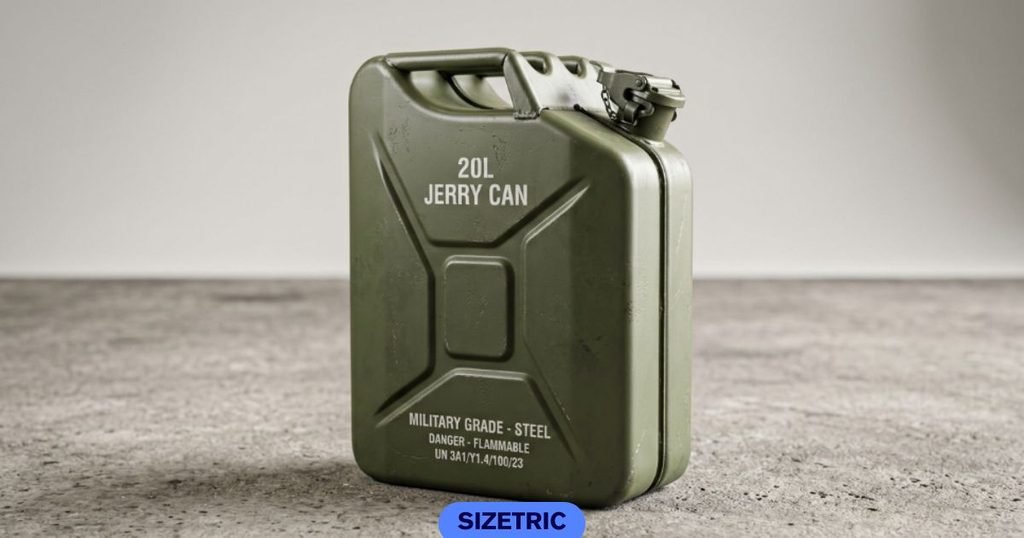
This is the benchmark: 470 × 350 × 165 mm, holding a true 20 litres, built from pressed steel with the signature three-handle top and cam-lever cap. Empty it sits around 4 kg; the three handles let one person carry it or two people pass it hand to hand down a line. It’s the shape every jerry can holder, rack and bracket is engineered around.
Its reliability as a reference comes from that NATO/Wehrmacht heritage — the pattern has barely changed in over 80 years, so a can made today drops into a mount designed decades ago. If you’re measuring clearance on a roof rack or trailer, this is the profile to plan for. Give it about 500 mm of vertical room and a 175 mm-deep slot and you’ll have breathing space.
Read Also: Miles to Steps Calculator: How Many Steps in a Mile?
The 20-Litre Plastic Version
Modern HDPE cans — Scepter’s military fuel can, Wavian’s plastic line and the many copies — hold the same 20 litres but run a touch larger on the outside, roughly 475 × 360 × 175 mm, because the walls are thicker than steel. Empty, they’re the big win: about 2 kg, half the weight of steel, which matters when you’re lifting a full one over your head onto a rack.
The catch is fit. That extra few millimetres in every direction means a plastic can sometimes won’t seat in a bracket sized precisely for a steel one. Plastic also flexes and can bulge slightly in heat, so leave a little more slack than you would for metal. Colour usually signals contents here — red or green for fuel, blue or tan for water.
The 10-Litre Can — Half the Fuel, Easier to Lift
Drop to 10 litres and the numbers get looser, because there’s no single global standard. Metal 10L cans typically stand around 350–400 mm tall, roughly 270–290 mm wide and 130–165 mm deep, holding about 10 litres (2.6 US gal). Treat those as representative rather than exact — brands vary more here than at 20L.
The appeal is weight and reach. A full 10L water can is about 12 kg versus 24 for the big one, so it’s the size people choose for a spare that actually gets lifted regularly, or for tighter storage where a 20L slab won’t fit. It slides into a footwell or a bike pannier frame where the full-size can never would.
The 5-Litre Can — The Boot-Friendly Backup
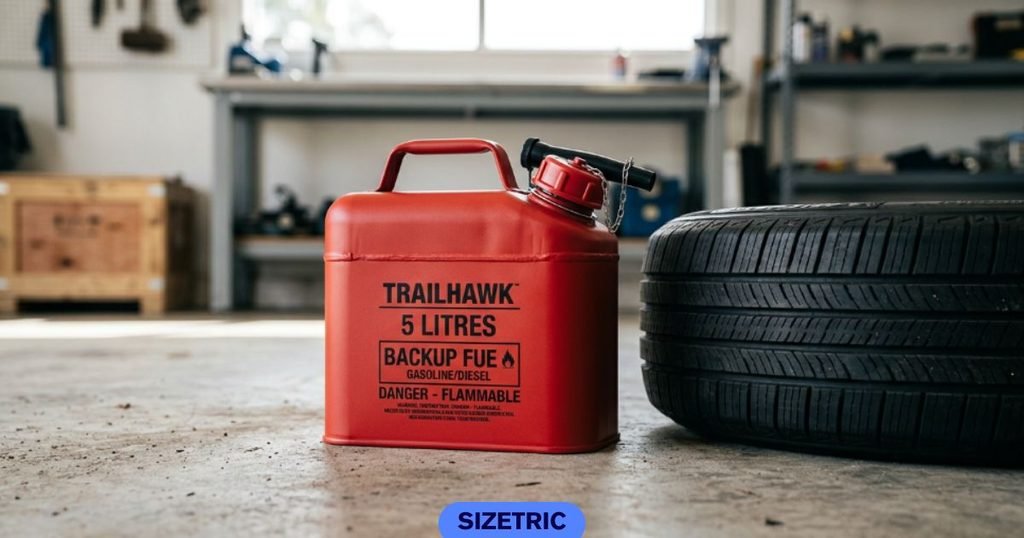
The smallest common size runs roughly 290–345 mm tall, around 230 mm wide and 100 mm deep, carrying 5 litres (1.3 US gal). Again, read these as typical figures — a stubby plastic 5L and a slim metal one can differ by a few centimetres. Full of petrol it’s only about 5 kg, light enough to hang off a handlebar or tuck beside the spare wheel.
This is the “get me to the next station” can — the emergency reserve for a motorbike, a lawnmower run, or a chainsaw’s mix. It rarely gets a dedicated mount; it just lives in a boot corner or a shed shelf, which is exactly why its compact footprint sells.
The Water Jerry Can — Same Shape, Heavier When Full
A 20L water can shares the fuel can’s external footprint almost exactly — near enough 470 × 350 × 165 mm — so it fits the same holders. What changes is what’s inside and how much it weighs. Water is denser than fuel, so a full one hits about 24 kg (53 lb) against roughly 18.5 kg for petrol.
Two practical tells set it apart: the colour (usually blue or desert tan, never red) and often a wider spout for faster pouring and easier cleaning. If you’re mounting fuel and water side by side, plan for the water can being the heavier load on that bracket, not the bulkier one.
The American “5-Gallon” Gas Can — A Different Animal
Search “jerry can” in the US and you’ll also surface the chunky red plastic 5-US-gallon gas can, which is 18.9 litres, not 20. Its shape breaks the mould entirely — squarer and blockier, commonly 380–430 mm tall on a footprint near 300 × 300 mm, with a spout-and-vent design instead of the cam cap. Dimensions swing widely by brand.
It’s worth flagging because the naming trips people up when ordering. If a holder or spec sheet says “jerry can,” it almost always means the flat 20L NATO profile — not this. Confusing the two is how a rack ends up with a can that won’t strap down.
Sizes, Capacities and Weights Side by Side
| Variant | Height | Width × Depth | Capacity | Full weight* |
| 20L steel (NATO) | 470 mm / 18.5 in | 350 × 165 mm | 20 L / 5.3 US gal | ~18.5 kg fuel |
| 20L plastic | ~475 mm / 18.7 in | ~360 × 175 mm | 20 L / 5.3 US gal | ~17 kg fuel |
| 10L | ~350–400 mm | ~275 × 130–165 mm | 10 L / 2.6 US gal | ~9 kg fuel |
| 5L | ~290–345 mm | ~230 × 100 mm | 5 L / 1.3 US gal | ~5 kg fuel |
| 20L water | 470 mm / 18.5 in | 350 × 165 mm | 20 L / 5.3 US gal | ~24 kg |
| US 5-gallon | ~380–430 mm | ~300 × 300 mm | 18.9 L / 5 US gal | ~16 kg fuel |
*Full weight includes the empty can. Fuel figures assume petrol (~0.74 kg/L); diesel adds roughly 2–3 kg per 20 litres.
Why Two “20-Litre” Cans Aren’t Always the Same Size
If you’ve measured two nominally identical cans and got different numbers, you’re not imagining it. A few real factors move the figures.
Material. Steel walls are thin, so a steel can holds 20L inside a compact 470 × 350 × 165 mm shell. Plastic needs thicker walls for the same strength, pushing external dimensions up by 5–10 mm on each axis even though the liquid capacity is unchanged.
Standard versus copy. True NATO-spec cans (Wavian, genuine military surplus) hold their tolerances tightly; the broad face lands around 340–350 mm depending on the maker. Budget copies drift, which is why one can slides into a holder and its “identical” twin sticks.
Region and rating. A metric 20-litre can and an American 5-gallon (18.9 L) can are close but not equal — a full litre apart — and the US format usually wears a different, blockier body. Model year and brand tooling add small variations on top.
Contents. Water and fuel cans can be built to the same external mould yet feel worlds apart full, because density — not size — drives the weight. Always size your mount for the footprint and your rack rating for the heaviest liquid you’ll carry.
What a Jerry Can Is Roughly the Size Of
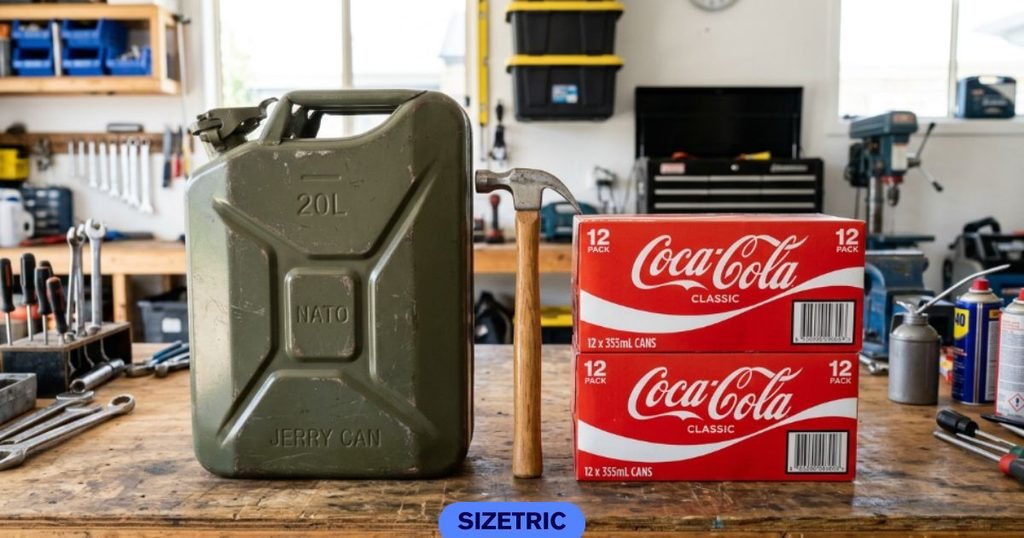
Numbers are exact but hard to picture, so anchor them to things you already know. These are eyeball estimates, not precise matches.
At 470 mm tall, a 20L can stands about the height of two basketballs stacked (each is roughly 24 cm), and reaches to around knee height on an average adult. Its broad 470 × 350 mm face is close to the front of a small carry-on suitcase. The slim 165 mm depth is a shade over the length of a US dollar bill (about 156 mm) — narrow enough to see why these cans pack so tightly in a row.
That mental model is the useful part when you’re guessing whether one fits a gap. If a space swallows a carry-on standing upright with a hand’s width to spare, it’ll take a 20L jerry can.
Read Also: Celsius Can Dimensions: Exact Size, Height & Diameter
Fitting, Mounting and Storing Them Without Surprises
Most fit problems come from planning around capacity when you should be planning around footprint and weight. A few checks save the hassle.
Measure your slot for the 475 mm × 175 mm plastic figure, not the tighter steel one, if there’s any chance you’ll run plastic cans — the larger number gives you margin either way. Leave roughly 500 mm of vertical clearance so the cap and handles clear the mount above.
Mind the direction. Slid in with the narrow 165 mm side facing out, cans eat far less rack width, letting you line up two or three across a swing-out or roof bar. Turned broadside they double their footprint for no benefit.
Finally, rate for weight, not just size. A single full water can is ~24 kg, and three of them push past 70 kg before you’ve added the rack itself — check your roof or bracket’s load limit against the full figure, and drop to 10L or 5L cans for spare fuel you’ll be lifting by hand often. Confusing a metric 20L order for a US 5-gallon, or a steel-spec holder for a plastic can, are the two mistakes that cost people a return shipment — worth a second look before you buy.
Fast Answers
What are the dimensions of a jerry can?
A jerry can’s size depends on its capacity, but the common 20-litre model measures about 470 × 350 × 165 mm (18.5 × 13.8 × 6.5 in). Smaller 10L and 5L versions run proportionally shorter and narrower.
What are the dimensions of a 20 litre jerry can?
A standard 20-litre jerry can measures roughly 470 × 350 × 165 mm (47 × 35 × 16.5 cm). That equals about 18.5 × 13.8 × 6.5 inches, holding 5.3 US gallons.
What is the standard size of a jerry can?
The standard jerry can is the 20-litre NATO pattern at 470 × 350 × 165 mm. It holds 20 litres (5.3 US gallons) and weighs about 4 kg empty.
What are the dimensions of a 10 liter jerry can?
A 10-litre jerry can typically stands about 350–400 mm tall, 270–290 mm wide and 130–165 mm deep. Sizes vary by brand, so treat these as representative figures.
What are the dimensions of a 10 litre container?
A 10-litre container usually measures around 350–400 mm in height with a footprint near 270–290 mm wide. Exact shape shifts by design, but capacity stays at 10 litres (2.6 US gallons).
Lock It In: The Number Worth Remembering
Now you know all the main Jerry Can Dimensions. The standard 20-litre can stands about 470 mm tall, 350 mm wide, and 165 mm deep. That equals 18.5 by 13.8 by 6.5 inches. It holds 20 litres of fuel or water. Empty, a steel can weighs around 4 kg. Full of petrol, it weighs close to 18 kg. Full of water, it weighs about 24 kg. These numbers stay the same across most brands.
Smaller cans hold 10 litres or 5 litres, so they weigh less and lift more easily. Plastic cans measure a little bigger than steel ones. Always measure your rack space first, and check the full weight before you mount a can. These simple steps keep every job safe and easy.
Related Guides:
1: 300 Grams: 12 Everyday Things That Weigh This Much
2: How Much Is 20 Grams? Weight, Conversions & Examples
3: How Much Is 1 Gram? Weight, Examples & Conversions
4: 100 Grams: How Heavy It Is + What Weighs That Much
5: How Much Is 10 Grams? A Weight You Can Hold in Two Coins






2 Comments