
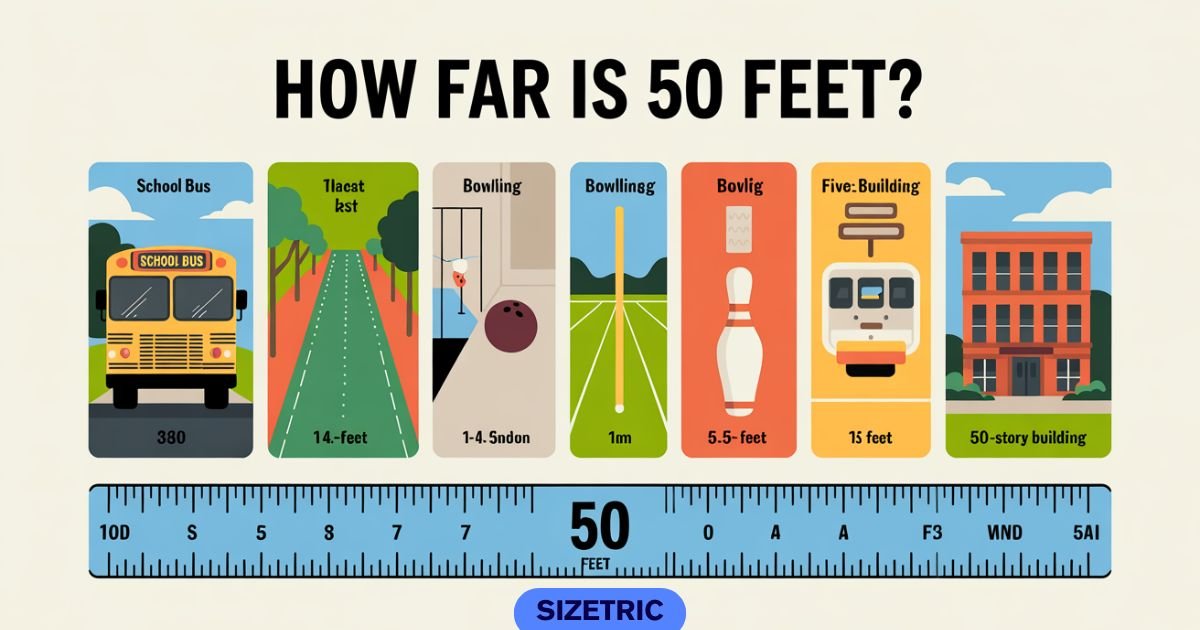
How Far Is 50 Feet? 7 Everyday Comparisons + Chart
Fifty feet is a length equal to 15.24 meters. It is the same as 600 inches or 1,524 centimeters. In simple words, it is the width of a basketball court.
Ever tried to picture 50 feet without a ruler? It sounds simple, but most people guess it wrong. Once you see it in real objects, you will never forget it.
Fifty feet is also about the length of a semi-trailer. You can walk it in around 20 normal steps. That takes just 10 to 11 seconds at a steady pace.
The Short Answer: How Far Is 50 Feet?
Fifty feet is 15.24 meters — about the length of a full semi-trailer and exactly as wide as an NBA basketball court. It equals 600 inches, 1,524 cm, or roughly 16.7 yards. Picture three mid-size cars parked bumper to bumper, or about 20 normal walking steps, and you’re looking at 50 feet.
That’s the fast version. Below, every conversion and a set of objects you can actually visualize.
50 Feet in Inches, Meters, and More (Conversion Chart)
Here’s 50 feet across every common unit — imperial and metric — so you never have to run the numbers yourself.
| Unit | 50 feet equals |
| Inches | 600 in |
| Feet | 50 ft |
| Yards | 16.67 yd (16 yd 2 ft) |
| Millimeters | 15,240 mm |
| Centimeters | 1,524 cm |
| Meters | 15.24 m |
The clean conversions worth memorizing: 50 ft = 600 in = 15.24 m. Everything else fans out from there.
What Does 50 Feet Actually Look Like?
Fifty feet is well past anything your body can gauge directly — no hand span or forearm gets you there. It’s a spatial distance, the kind you walk rather than reach across.
Stand at one baseline of a basketball court and look at the far sideline: that gap is 50 feet. Or watch a big-rig trailer roll past — nose to tail, that’s roughly your distance. It’s tall, too. Laid upright, 50 feet reaches about as high as a five-story building. Once you anchor it to one of those, the number stops being abstract.
Read Also: How Long Is 10 Meters? Feet, Steps & Real Examples
6 Everyday Things That Measure About 50 Feet
These references range from spot-on to close-enough. I’ve flagged which are exact and which are approximate, so you’re never guessing at the guess.
An NBA Basketball Court, Sideline to Sideline (50 ft, exact)
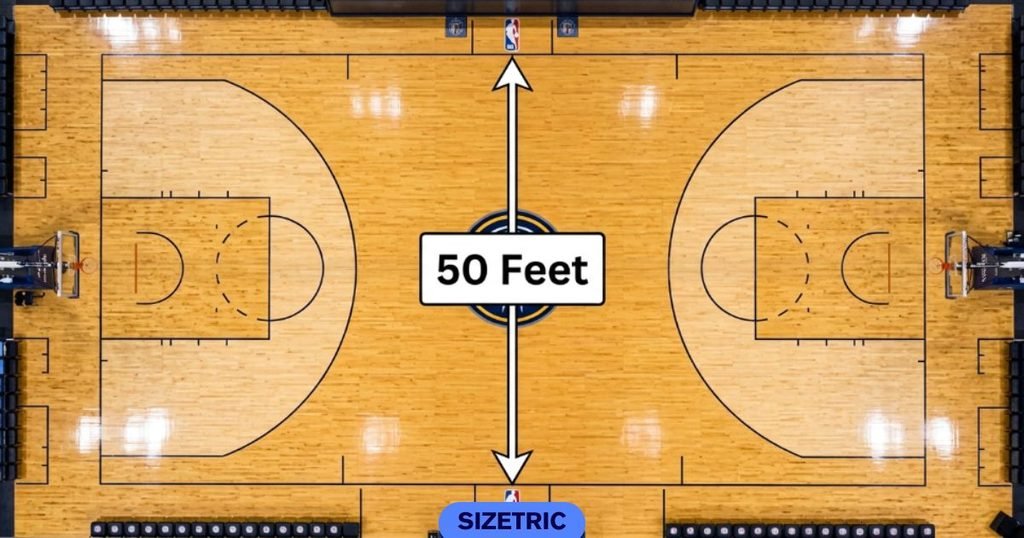
A regulation NBA and NCAA basketball court is 94 feet long and exactly 50 feet wide. That width is the single most reliable 50-foot reference most people have already seen in person. Next time a game’s on, note the sideline-to-sideline span — that’s your benchmark, locked.
A Fully Stretched 50-Foot Garden Hose (50 ft, exact)
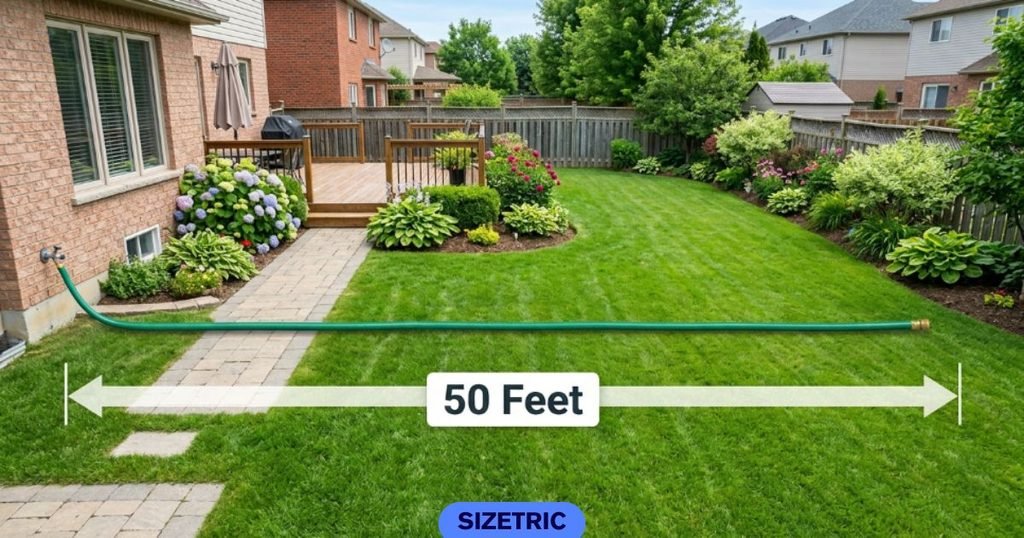
Garden hoses are sold in fixed lengths — 25, 50, and 100 feet are the standards. Roll out a 50-foot hose flat across the lawn and you’ve measured exactly 50 feet with zero tools. It’s the cheapest tape measure you already own, and unlike a court or a truck, you can walk beside it end to end.
Three Mid-Size Cars Parked Bumper to Bumper (~48 ft)
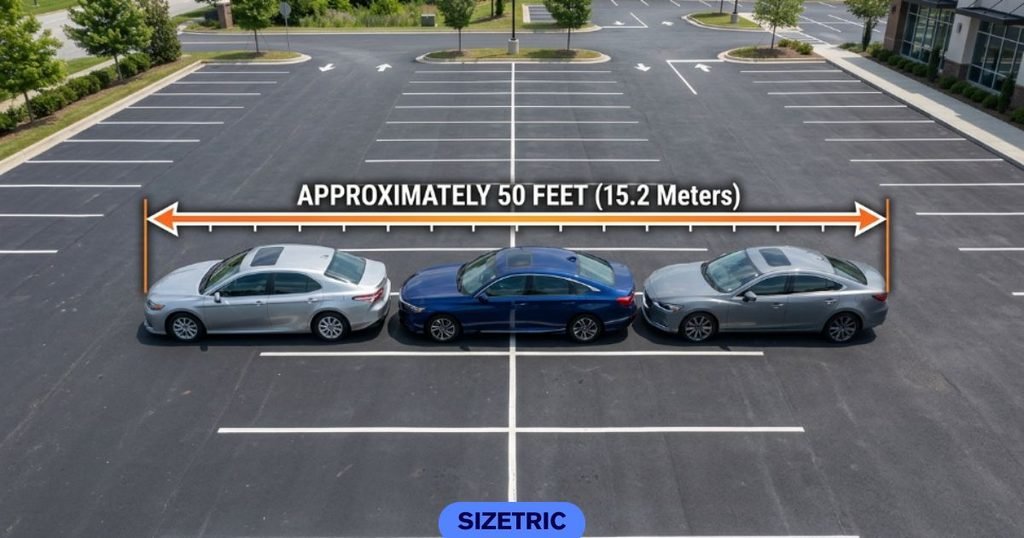
A mid-size sedan runs about 15 to 16 feet long. Line up three of them nose to tail and you land around 45–48 feet — just shy of 50, and dead-on once you leave normal gaps between bumpers. Handy in a parking lot: three cars in a row is your instant 50-foot ruler.
A Full Semi-Trailer (48–53 ft)
The trailer on a big rig is typically 48 or 53 feet long, so 50 feet sits right in the middle of the two standard sizes. A 48-footer is a hair under; a 53-footer, a hair over. Either way, one full trailer ≈ 50 feet is a solid roadside estimate.
A Four- to Five-Story Building (45–50 ft)
Floors run roughly 10 feet each in homes and low-rises, a bit more in commercial buildings. That puts five residential stories at about 50 feet tall. Look up at a five-floor apartment block and you’re looking at 50 feet of height — a useful trick when the distance is vertical, not flat.
About Two and a Half Parking Spaces (~50 ft)
A standard parking space is about 18 to 20 feet long. Two and a half of them laid end to end gets you to roughly 50 feet. It’s a quieter reference than a basketball court, but parking lots are everywhere, so it’s almost always available when you need to size something up on the spot.
Quick Comparison Table: What’s 50 Feet?
| Reference object | Real measurement | How it maps to 50 ft |
| NBA basketball court width | 50 ft | Exact |
| 50-foot garden hose | 50 ft | Exact |
| Three mid-size cars, end to end | ~45–48 ft | Just under |
| Full semi-trailer | 48–53 ft | Brackets 50 ft |
| Five-story building (height) | ~45–50 ft | Close |
| Two and a half parking spaces | ~45–50 ft | Close |
How to Pace Out 50 Feet Without a Tape Measure
No court or hose handy? Your own stride is the backup ruler. An average adult walking step covers about 2.5 feet, which makes 50 feet roughly 20 steps. Here’s the reliable way to do it:
- Calibrate one step. Walk normally and note that a relaxed adult step is about 2.5 feet — heel to heel.
- Count to twenty. Walk 20 natural steps in a straight line. Don’t stretch or shuffle; use your everyday gait.
- Sanity-check the time. At a normal walking pace you cover 50 feet in about 10 to 11 seconds — if it took way more or less, recount.
- Adjust for your height. Taller walkers hit 50 feet in 18–19 steps; shorter strides need 21–22. Pace off a known 50-foot mark once (like a basketball court width) and you’ll have your personal step count for life.
Twenty steps, ten seconds. That’s 50 feet, no equipment required.
Just Below and Just Above: 40 ft vs. 60 ft
Knowing the neighbors helps you place 50 feet fast.
40 feet is a full shipping container or a standard city school bus — noticeably shorter, about four cars end to end. A typical wooden utility pole (roughly 40 feet above ground) also lands here, which is why a pole reads as close to but under 50 feet.
60 feet is where a bowling lane actually sits — foul line to head pin — and it’s also the length of a semi cab plus its trailer combined. The jump from 50 to 60 feet is one extra car length, so if your object clearly beats three cars in a row, you’ve crossed into 60-foot territory.
Where the 50-Foot Mark Actually Comes Up
Fifty feet isn’t a random number — it shows up in real decisions:
- Property and DIY. Fence runs, driveway lengths, and lot setbacks are often measured in 50-foot spans; it’s also a common garden-hose reach from an outdoor tap.
- Sports. Beyond the basketball court width, it’s a useful yardstick for laying out drills, cones, and small-field spacing.
- Safe distances. Many outdoor-safety guides cite roughly 50 feet as a minimum stand-back for spectators watching aerial consumer fireworks — though the exact figure varies by product and local rule, so always check the packaging.
Match the reference to the job and the estimate gets easier: a hose for the yard, cars for the driveway, steps for everything else.
Read Also: How Far Is 20 Feet Visually? 10 Real-Life Examples
Two Myths About 50 Feet, Cleared Up
A bowling lane is not 50 feet. It’s a common mix-up, but a regulation lane measures 60 feet from the foul line to the head pin (about 62 feet to the end of the pin deck). Use it as a 60-foot reference, not 50.
Fifty feet is not the fire-hydrant “no-parking” distance. That rule is usually 10 to 15 feet in most US jurisdictions, not 50. If you’ve been eyeballing hydrant clearance as 50 feet, you’ve been giving up three car lengths of legal curb.
Fast Answers: 50 Feet Questions People Actually Ask
How long is 50 feet visually?
Visually, 50 feet is the full width of an NBA basketball court, sideline to sideline. It also matches the length of a semi-trailer.
How big is 50 feet compared to a human?
Fifty feet is about 8 to 9 times the height of an average adult. Stack nine people head to toe and you reach 50 feet.
What is 50 ft compared to?
50 feet compares to three mid-size cars parked bumper to bumper. It also equals roughly two and a half parking spaces.
How far is 50 feet to walk?
Fifty feet takes only about 10 to 11 seconds to walk at a normal pace. It is a very short, easy distance.
How many steps is 50 feet?
Fifty feet is about 19 to 20 normal adult steps. Taller people need a step or two fewer.
The Takeaway in One Line
So now you know how far is 50 feet. It is 15.24 meters, or 600 inches. That is the same as the width of a basketball court. It is also close to the length of a big truck trailer. You can picture three cars parked in a line. Each of these things helps you see the size in your mind. These simple examples make the number easy to hold onto.
You can also measure 50 feet with your own body. Just walk 20 normal steps in a straight line. This takes about 10 to 11 seconds at a steady pace. You do not need a ruler or a tape measure to do it. Keep these easy tricks in mind. Next time, you will spot 50 feet right away.
Related Guides:
1: How Much Is 15kg? What It Actually Weighs, in Plain Terms
2: How Many Pounds Is 10 Tons? (20,000 lb Answer)
3: 80 Feet: How Long It Really Is, With Real Comparisons
4: Dollar Bill Dimensions: Exact Size, Thickness & Weight
5: Jerry Can Dimensions: Every Size, Weight and Variant Explained




2 Comments