
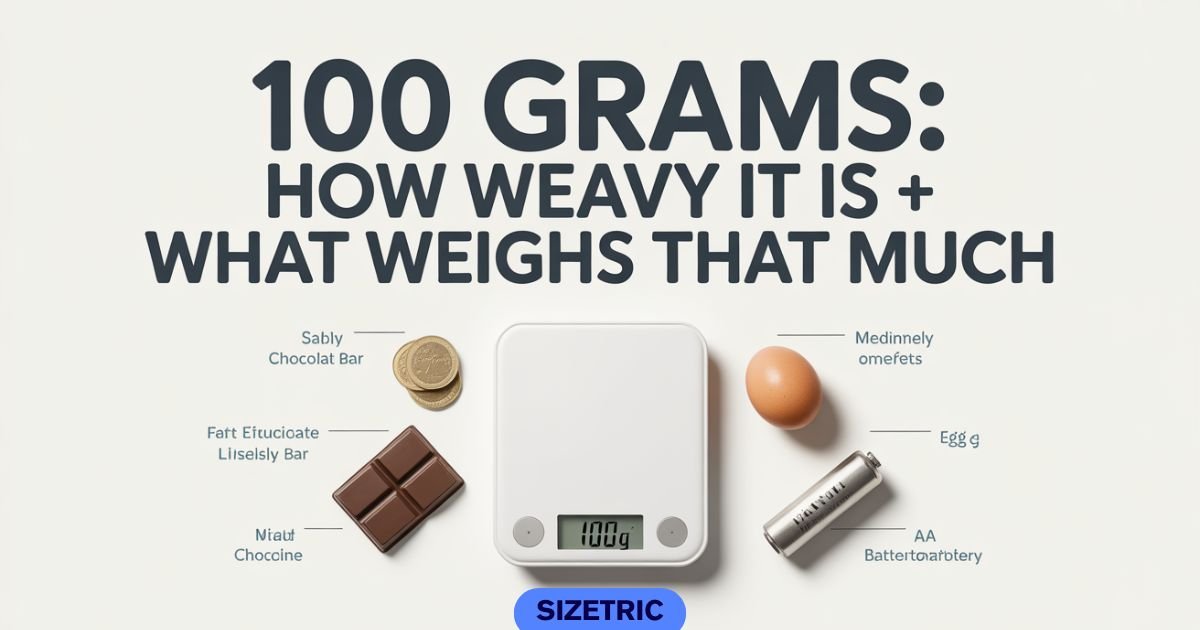
100 Grams: How Heavy It Is + What Weighs That Much
Grams are easy to read off a label and weirdly hard to picture. 100 grams sits right in that blind spot — too heavy to feel like nothing, too light to feel like “a lot.” By the end of this page you’ll be able to feel 100 g in your hand, name a dozen things that weigh it, and even measure it without a scale using pocket change. Let’s pin the number down.
(Quick note on scope: this is a mass, not a length, so the conversions here run grams ↔ ounces ↔ pounds ↔ kilograms rather than inches and centimeters.)
The Short Answer: How Heavy 100 Grams Really Is
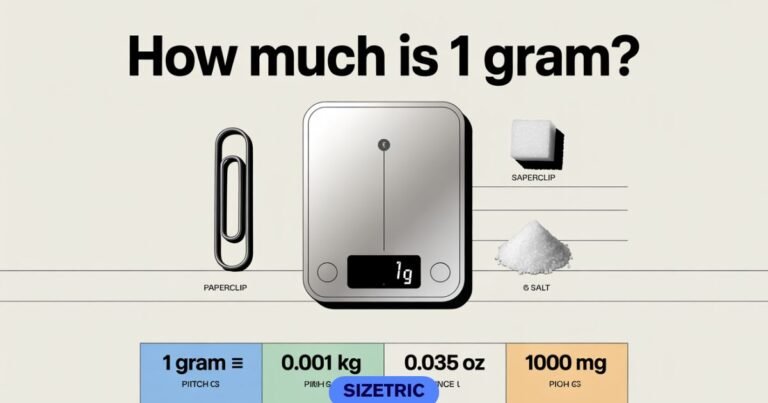
100 grams is about 3.53 ounces, or just under a quarter of a pound (0.22 lb). In everyday terms, it’s roughly a full-size chocolate bar, two large eggs, or a small handful of coins — light enough to rest on your palm without any strain, heavy enough that you’d notice it in an empty envelope. It’s also exactly one-tenth of a kilogram, which makes it the reference weight food labels use for nutrition facts.
100 Grams in Every Unit You’ll Need
Here’s the same weight expressed across the units people actually convert between.
| Unit | Value |
| Grams | 100 g |
| Kilograms | 0.1 kg |
| Milligrams | 100,000 mg |
| Ounces (avoirdupois) | 3.53 oz |
| Pounds | 0.22 lb |
| Troy ounces (precious metals) | 3.22 oz t |
A couple of these are worth flagging. 100 g is not 100 mg — that’s a thousandfold gap, and mixing them up is a genuine hazard when reading supplement or medication doses. And if you ever weigh gold or silver, note that jewelers use troy ounces, so 100 g reads as ~3.22 oz t rather than 3.53.
Read Also: How Much Is 10 Grams? A Weight You Can Hold in Two Coins
What 100 Grams Actually Feels Like in Your Hand
Pick up a lemon, a deck of cards, or a bar of soap and you’re holding almost exactly this much. The heft is modest — your wrist barely registers it. It’s the weight of something you’d toss in a jacket pocket and forget about, not something that pulls the pocket down.
Because weight can’t be judged by eye the way length can, the trick with grams is always about lifting, not looking. A wad of paper the size of a grapefruit and a lemon half its size can weigh the same 100 g — volume tells you nothing here. That’s why the reference objects below matter so much: once your hand knows the heft of a chocolate bar, it knows 100 g.
Everyday Things That Weigh Right Around 100 Grams
Six reliable anchors, from dead-exact to close-enough. I’ve labeled which is which.
Twenty US Nickels — Dead-On 100 g
A single US nickel is minted to weigh exactly 5.00 grams, so twenty of them come to a precise 100 g. This is the single most useful trick on the list: nickels are standardized by the Mint, they don’t vary between coins the way produce does, and almost everyone has a jar of them. Stack twenty and you’ve built yourself a calibration weight for the price of a dollar.
A Full-Size Chocolate Bar
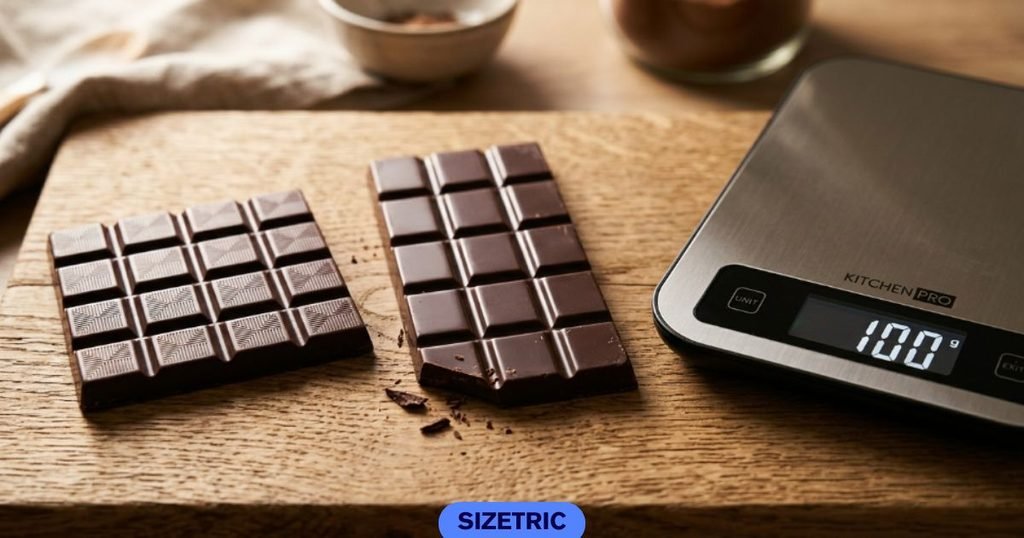
Many standard European chocolate bars — a Ritter Sport square, a classic Milka bar — are made to a 100 g net weight by design. Check the wrapper and you’ll usually see “100 g” printed right there. It’s one of the few grocery items engineered to hit this number exactly, which makes it a mental yardstick you can carry around.
Two Large Eggs
A large chicken egg (in the shell) runs about 50 g, so a pair lands you right at ~100 g. Eggs vary a little by grade and hen, so treat this as a close approximation rather than a precise figure — but for eyeballing a recipe portion or picturing the weight, two large eggs is a dependable anchor.
100 Millilitres of Water
Water is the reason grams and millilitres get confused: 100 mL of water weighs almost exactly 100 g (about 99.8 g at room temperature). Fill a small glass to the 100 mL line and you’re holding the definitional version of this weight. Just remember the equivalence only holds for water — 100 mL of oil, honey, or flour each weigh something different.
A Standard Deck of Playing Cards
The 52 cards in a typical deck weigh roughly 94–95 g, and once you add the tuck box you’re brushing right up against 100 g. It sits a hair under, so call it approximate — but a deck of cards is small, familiar, and always about this heavy, which makes it a great pocket reference.
A Bar of Bath Soap
A full-size bar of soap typically lands near 100 g (most fall in the 85–125 g band). Brands vary, so it’s an estimate, not a spec — but if you’ve ever held a fresh bar, you’ve held roughly 100 g.
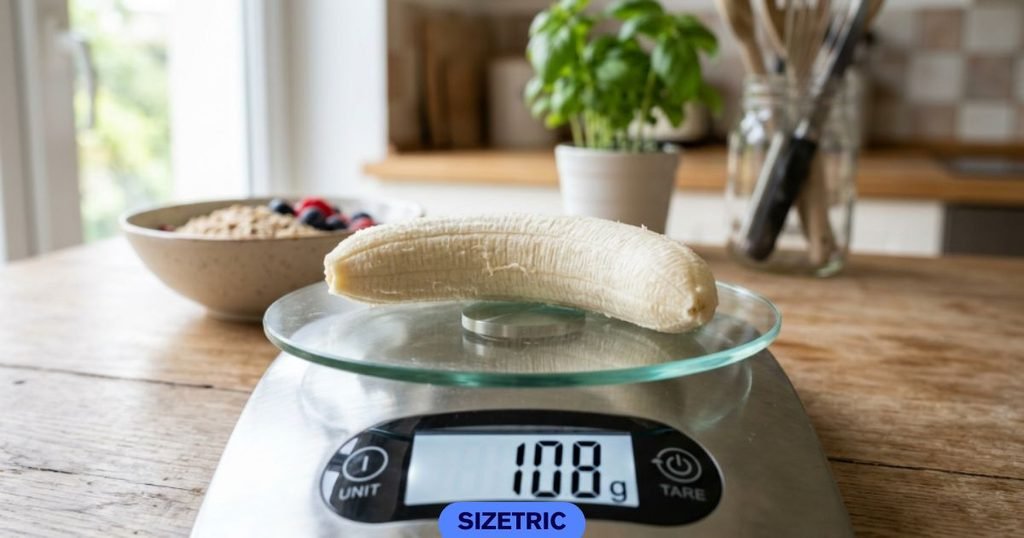
A few more quick anchors: a small peeled banana (~100–118 g), a US stick of butter (113 g — a touch over), roughly four AA batteries (~92 g at ~23 g each, so between four and five to reach 100), or two golf balls (~92 g combined, at ~46 g each).
The 100-Gram Reference List at a Glance
| Object | Typical weight | How close to 100 g |
| 20 US nickels | 100 g | Exact |
| European chocolate bar | 100 g | Exact by design |
| 100 mL of water | ~100 g | Near-exact |
| 40 post-1982 US pennies | 100 g | Exact (2.5 g each) |
| Two large eggs | ~100 g | Close |
| Bar of bath soap | ~100 g | Close, varies |
| Deck of cards + box | ~95–100 g | Just under |
| Small peeled banana | ~100–118 g | Close |
| Stick of butter (US) | 113 g | Slightly over |
| Four AA batteries | ~92 g | Just under |
Gauging 100 Grams Without a Scale
No kitchen scale handy? You have two solid options.
The first is counting coins, which turns pocket change into a precise weight. Twenty nickels give you exactly 100 g; so do forty post-1982 pennies (2.5 g each) or roughly forty-four dimes (2.27 g each). Coins are the closest thing to a certified weight most people own.
The second is hefting against a known object. Hold a deck of cards or a chocolate bar in one hand and your mystery item in the other, and your palms will tell you which is heavier. Human weight discrimination is decent but not fine — most people can feel the difference between 100 g and 120 g, but not between 100 g and 105 g. So this method gets you in the ballpark, not to the decimal. For anything where precision matters — postage, baking, dosing — reach for a scale or the coin trick instead.
50 g, 100 g, 200 g: Telling the Neighbors Apart
Knowing what sits on either side of 100 g helps you avoid over- or under-guessing.
Just below (~50 g): one large egg, a golf ball (46 g), or a tennis ball (~57 g). Held alone, 50 g feels almost weightless — noticeably lighter than a deck of cards.
Your target (100 g): the chocolate-bar, lemon, soap-bar zone.
Just above (~150 g): a baseball (~145 g), a medium apple, or a small smartphone. At 150 g you start to feel real heft settle into your palm.
By hand, the honest reality is that you can reliably tell 50 g from 100 g from 200 g, but not 100 g from 110 g. The gaps between these anchors are wide enough to feel; the fine distinctions inside them aren’t. Trust your hand for the big steps and a scale for the small ones.
Where 100 Grams Actually Comes Up
This particular weight turns up more often than you’d think.
In cooking and baking, gram-based recipes lean on it constantly — 100 g of flour, sugar, or butter is a common building block, and because it’s a round number, scaling a recipe up or down from it is painless. On nutrition labels, “per 100 g” is the standard basis for listing calories and nutrients, which is exactly why it’s worth being able to picture: it lets you gauge whether a serving is one-tenth or triple that reference amount. For postage and shipping, 100 g is a frequent price break — many letter and small-parcel tiers hinge on whether you’re over or under it, so a few grams can change what you pay. And for anyone who owns a small jewelry or kitchen scale, 100 g is the classic calibration point; a dedicated 100 g calibration weight (or that stack of twenty nickels) is what you’d use to check the scale is honest.
Read Also: 500 Grams: How Heavy It Is & What Weighs That Much
Myths People Get Wrong About 100 Grams
“The heavier-looking pile weighs more.” Not necessarily. 100 g of feathers and 100 g of lead weigh the same — the feathers just take up vastly more space. Weight and volume are independent, which is precisely why you can’t eyeball grams.
“100 grams equals 100 millilitres.” Only for water. Denser liquids like honey weigh more per millilitre; lighter ones like oil weigh less. The moment you leave water behind, the tidy 1:1 rule breaks.
“100 g and 100 mg are basically the same ballpark.” They differ by a factor of 1,000. This one genuinely matters with vitamins, medications, and lab measurements — reading milligrams as grams (or vice versa) is a real and dangerous mistake.
“100 grams is a tiny amount of food.” It depends entirely on what it is. 100 g of leafy greens is a big bowl; 100 g of nuts is a calorie-dense small handful. Same weight, wildly different portion.
Quick-Fire Answers
Are 100 grams equal to a cup?
No — grams measure weight and cups measure volume, so it depends on the ingredient (100 g of water is ~0.42 cup, but 100 g of flour is ~0.8 cup).
How much does 100 grams look like?
Picture a chocolate bar, two large eggs, or a small banana — roughly a palm-sized, pocket-friendly amount.
Is 100 grams equal to 1 kg?
No — 100 grams is only one-tenth of a kilogram (1 kg = 1,000 g).
How much is 100 grams equal to?
About 3.53 ounces, or just under a quarter-pound (0.22 lb) — the same as 0.1 kg.
Is 100g the same as 1 cup?
No — only for water does 100 g come close to half a cup; a full cup of most ingredients weighs more than 100 g.
The One-Line Takeaway
So now you know exactly what 100 grams feels like. It is about the same as a chocolate bar, two large eggs, or twenty small nickels resting in your hand. It weighs one-tenth of a kilogram, or roughly 3.5 ounces. You can hold it, lift it, and picture it with ease. The best part is that you do not always need a scale. A stack of coins or a small glass of water gives you a close match.
Keep these simple pictures in your mind. The next time you read a food label or measure something in the kitchen, you will spot 100 grams right away. Practice with the objects you have at home, and this weight will soon feel natural and clear.
Related Guides:
1: Coke Can Dimensions: Height, Diameter & Every Size
2: Pokémon Card Dimensions: Exact Size in Inches, mm & cm
3: Gatorade Bottle Dimensions: Every Size, Measured
4: Red Bull Can Dimensions: All Sizes, Height & Diameter
5: How Tall Is a Monster Can? Exact Height, Diameter, and Size Guide

One Comment