
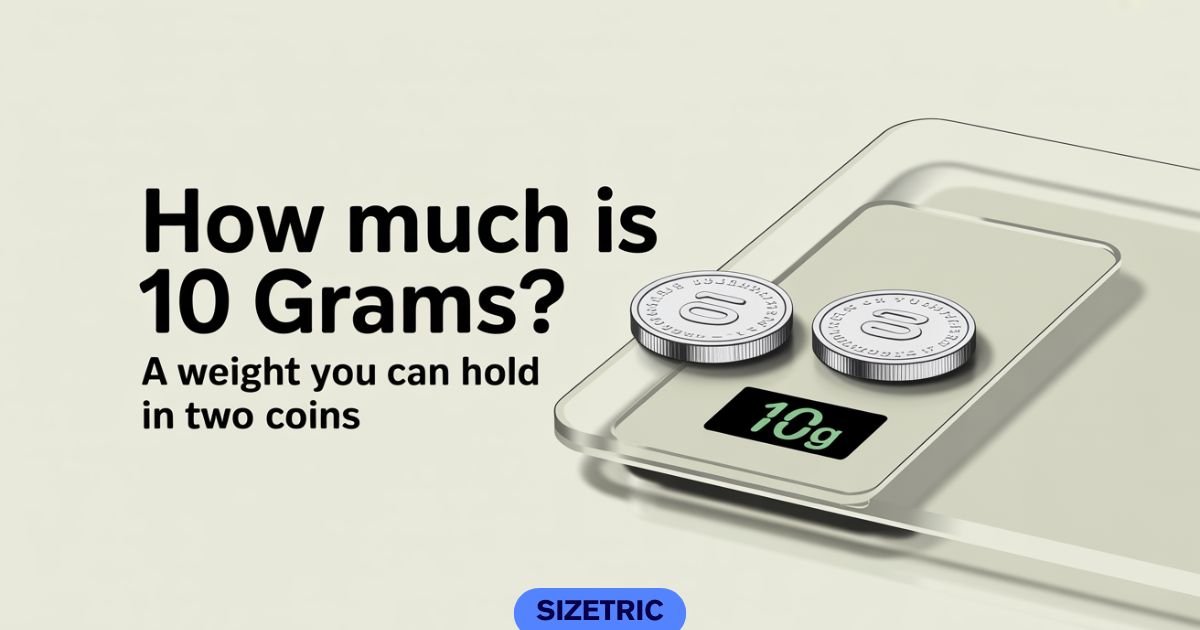
How Much Is 10 Grams? A Weight You Can Hold in Two Coins
Ask most people to picture ten grams and they stall — grams feel abstract in a way inches never do. But you’re almost certainly carrying a perfect 10-gram reference in your pocket right now. This page turns that vague number into something you can feel: exact conversions, everyday objects that hit the mark, kitchen-spoon equivalents, and the one reason 10 grams can look like a fingernail-sized nugget or a fluffy handful. By the end you’ll gauge it without a scale.
The Short Answer: What 10 Grams Weighs
Ten grams is a light, palm-sized weight — the same as two US nickels stacked together, or about two teaspoons of water. It’s roughly one-third of an ounce, a hundredth of a kilogram, and 10,000 milligrams. Drop it in your hand and it barely registers: enough to notice, not enough to feel like a burden.
If you only remember one thing, remember the coins. Two US nickels weigh exactly 10 grams, because each nickel is minted to a precise 5.00 grams. That gives you a reference that’s not “about” or “roughly” — it’s dead on.
10 Grams in Every Unit (Quick Conversion Table)
Grams are the base unit of the metric system for small weights, so 10 g converts cleanly into everything from milligrams to troy ounces. Here’s the full picture in one place.
| Unit | 10 grams equals | Exact / Rounded |
| Milligrams (mg) | 10,000 mg | Exact |
| Kilograms (kg) | 0.01 kg | Exact |
| Ounces (oz, avoirdupois) | 0.353 oz | Rounded |
| Pounds (lb) | 0.022 lb | Rounded |
| Carats (ct) | 50 carats | Exact |
| Grains (gr) | 154.3 grains | Rounded |
| Troy ounces (ozt) | 0.322 ozt | Rounded |
A few of these matter in daily life. The ounce figure (0.353 oz) is the one you’ll meet on kitchen scales and shipping labels. Carats show up at the jeweler — 10 grams is exactly 50 carats of gemstone weight. Troy ounces are how gold and silver are priced, which is why a 10-gram gold bar is a recognizable size that isn’t quite a third of a troy ounce.
What 10 Grams Actually Feels Like in Your Hand
Set two nickels on your open palm and pay attention. There’s a faint, definite pressure — you know something is there, but it wouldn’t tip a leaf-thin sheet of paper off your hand in a breeze. It’s the weight of a folded paper receipt with a coin tucked inside, or a single AAA-sized nudge of pressure.
Ten grams sits right at the edge of “barely there.” A sheet of paper (about 5 g) feels like almost nothing; double it and you cross into a weight your fingers can actually track. That’s the useful mental anchor: 10 grams is the lightest weight you can still confidently feel and compare by hand.
Everyday Objects That Weigh About 10 Grams
These are the references I reach for when I want to picture ten grams fast. Some are exact to the decimal; others are close approximations, and I’ve flagged which is which.
Two US Nickels
This is the cleanest reference there is. A US nickel is struck to a standard 5.00 grams, so two of them land on exactly 10 grams with no rounding. Keep two in a coin pouch and you’ve got a calibrated weight that never drifts. It’s the trick coin collectors and hobbyists use to sanity-check a cheap scale.
Four US Pennies
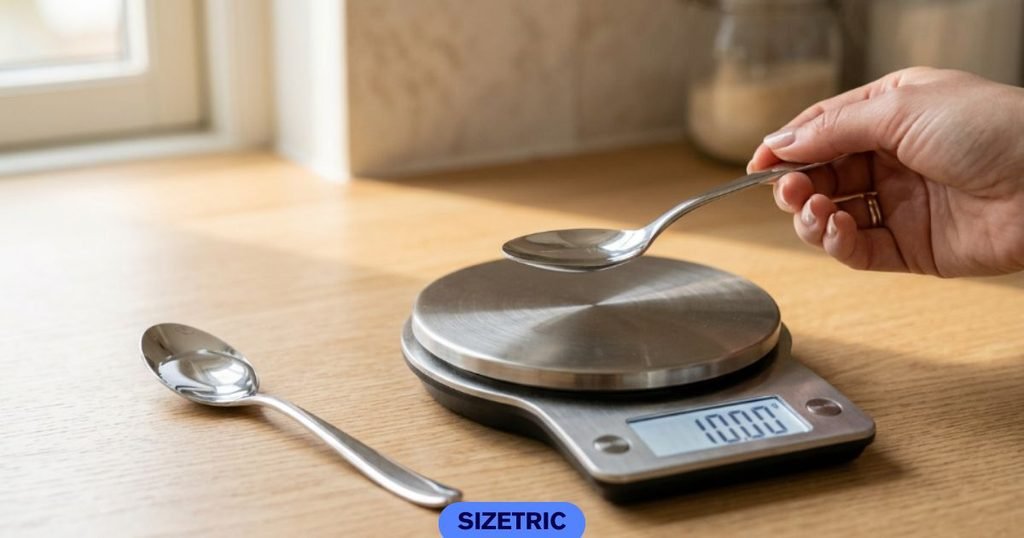
Every US penny minted since 1982 weighs 2.50 grams (they switched to a zinc core that year). Four of them stack to a precise 10.00 grams. Older copper cents from before 1982 weigh 3.11 g each, so this only works with modern pennies — worth knowing if you’re pulling coins from an old jar.
Two Teaspoons of Water
Water is the one substance where grams and milliliters line up, since 1 milliliter weighs 1 gram. Two teaspoons hold close to 10 grams (about 10 ml). It’s an approximate reference — a level teaspoon varies with how you fill it — but it’s the fastest way to weigh ten grams in a kitchen with no scale.
Read Also: 500 Grams: How Heavy It Is & What Weighs That Much
Ten Standard Paperclips
A regular (No. 1, 33 mm) steel paperclip weighs roughly 1 gram, so a little cluster of ten paperclips comes in around 10 grams. They’re rarely identical, so treat this as a ballpark, but it’s handy when the only thing on your desk is a box of clips.
A Short Stack of Banknotes
A US banknote weighs about 1 gram regardless of denomination, so ten bills — ten singles or ten hundreds, it makes no difference — weigh roughly 10 grams. It’s a fun one to demonstrate: a small folded stack of cash is lighter than most people guess.
Two Sheets of A4 Printer Paper
A single sheet of standard 80 gsm A4 paper weighs almost exactly 5 grams, which means two sheets land near 10 grams. US Letter at 20 lb weight is a touch lighter per sheet, so nudge to two-and-a-bit sheets there. Either way, printer paper is a surprisingly reliable everyday scale.
Two UK 20p Coins
The metric world has its own 5-gram coin: the UK 20p piece is struck to 5.00 grams, so two of them also total exactly 10 grams. If you’re outside the US, this is your pocket equivalent of the two-nickel trick.
A Small Handful of Almonds
A shelled almond weighs about 1.1 to 1.2 grams, so roughly eight or nine almonds add up to 10 grams. Nuts vary in size, so this is an estimate — but it’s a good one for picturing 10 grams of food, which is a common nutrition-label serving fraction.
Weight Comparison Table
Here’s every reference above at a glance, sorted by how exact it is.
| Object | Quantity for 10 g | Weight each | Exact or approx. |
| US nickel | 2 coins | 5.00 g | Exact |
| US penny (1982+) | 4 coins | 2.50 g | Exact |
| UK 20p coin | 2 coins | 5.00 g | Exact |
| Water | 2 teaspoons | ~5 g / tsp | Approx. |
| A4 paper (80 gsm) | 2 sheets | ~5 g | Approx. |
| Paperclip (No. 1) | 10 clips | ~1 g | Approx. |
| US banknote | 10 bills | ~1 g | Approx. |
| Almond | 8–9 nuts | ~1.1 g | Approx. |
No Scale? Weigh It With Your Palm
You can gauge 10 grams surprisingly well using the balance method your hands already know. Put two nickels in one palm and the item you’re checking in the other, then bounce your hands gently like a pair of scales. Your arms are far better at comparing two weights than at judging one in isolation, so calibrating against a known 10-gram reference gets you close.
For an even simpler check, keep a small “reference set” in a drawer: two nickels for 10 grams, one for 5, four for 20. Heft the mystery object, then heft the coins, and match the feel. It won’t replace a kitchen scale for baking, but for “is this letter under the postage limit?” or “is this roughly a 10-gram portion?” it’s genuinely useful.
Why 10 Grams Can Look Tiny or Look Huge
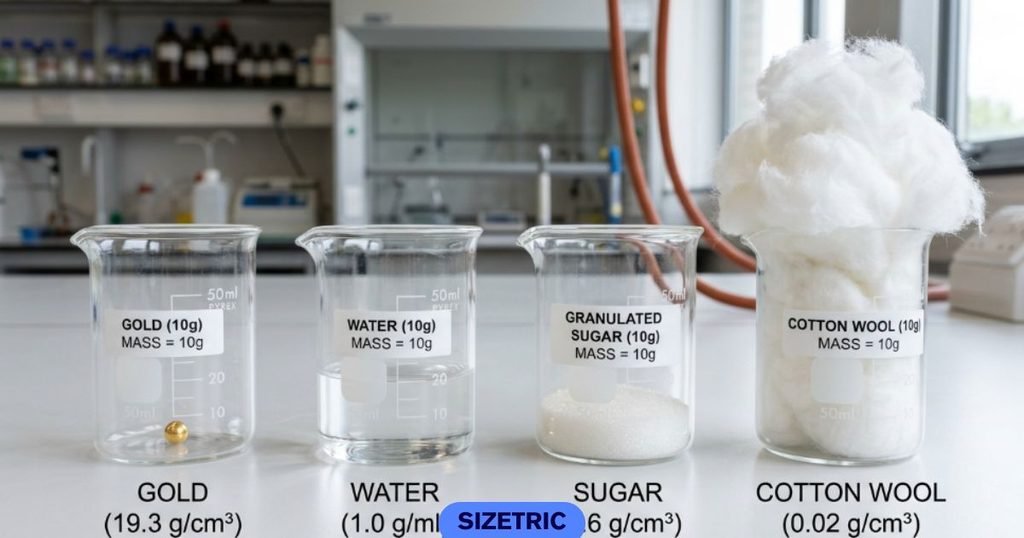
Here’s the part most explainers skip: 10 grams is a weight, not a size. Two objects that both weigh 10 grams can look nothing alike, because weight (mass) and volume are different things, tied together by density.
Watch what 10 grams looks like across a few materials:
- Gold — a dense metal, so 10 grams is a solid cube barely 8 mm on a side. It vanishes in your palm.
- Water — 10 grams is 10 ml, about two teaspoons. A modest puddle.
- Table sugar — around 12 ml, roughly two-and-a-half teaspoons of loose crystals.
- All-purpose flour — near 19 ml, a rounded, dusty tablespoon.
- Down or cotton wool — so airy that 10 grams is a generous loose handful you could barely close your fingers around.
Same number on the scale, wildly different footprints. This is why you can’t eyeball weight the way you eyeball length — a fluffy pile and a metal nugget can register identically. It’s also why “10 grams of gold” sounds like a lot and “10 grams of feathers” sounds like a little, when they’re the exact same weight.
[IMAGE: side-by-side of 10 g of gold, water, sugar, and cotton wool showing different volumes]
10 Grams in the Kitchen: Spoons and Cups
Recipes that use grams are precise, but you can still hit 10 grams with measuring spoons when the scale is buried in a drawer. The catch is that every ingredient has its own density, so 10 grams of one thing fills a different spoon than 10 grams of another.
| Ingredient | 10 grams is about |
| Water | 2 teaspoons |
| Granulated sugar | 2½ teaspoons |
| Table salt | 1¾ teaspoons |
| All-purpose flour | 1 rounded tablespoon |
| Butter (soft) | 2 teaspoons |
| Honey | ½ tablespoon |
Notice salt weighs the most per spoon and flour the least — that’s density again. Treat these as close estimates for cooking, not for baking that lives or dies on precision. When a recipe says 10 grams of yeast or gelatin, a small scale is worth the counter space.
The Weights Just Above and Below 10 Grams
Knowing the neighbors makes 10 grams easier to place. Here’s the ladder around it, using the nickel as a running yardstick.
| Weight | Easy reference |
| 1 gram | One paperclip, or one banknote |
| 5 grams | One nickel, one teaspoon of water |
| 10 grams | Two nickels, two teaspoons of water |
| 15 grams | Three nickels, a tablespoon of water |
| 20 grams | Four nickels, a AA battery (~23 g, close) |
The jump from 5 to 10 grams is the first one your hand can clearly feel — a single sheet of paper versus two. From 10 to 20 grams, the difference becomes obvious even to an untrained palm. If you can’t tell whether something is 10 or 20 grams by feel, it’s almost certainly under 10.
Read Also: Coke Can Dimensions: Height, Diameter & Every Size
Where 10 Grams Actually Comes Up
This isn’t a trivia weight — it shows up in a handful of real situations.
Postage. In many countries a standard letter tips over into a higher postage band around 20 grams, so a couple of folded sheets in an envelope (well under 10 grams) sails through at the base rate. Knowing 10 grams by feel saves a trip to the post office scale.
Precious metals. A 10-gram gold bar is one of the most popular small-investment sizes, and 10-gram silver or gold jewelry pieces are common. Because gold is so dense, that 10 grams is physically tiny — which is exactly the point for something you want to store or wear.
Nutrition. Food labels deal in 10-gram-ish quantities constantly: about 10 grams of added sugar is two-and-a-half teaspoons, a figure worth picturing when you read a drink label. Ten grams of protein, fiber, or fat is a common serving benchmark too.
Hobbies and small projects. Model builders, jewelers, and anyone mixing small batches of resin or spice blends works in single-digit and low-double-digit grams, where a 10-gram reference is the difference between “close enough” and “ruined.”
Fast Answers
Is 10 grams equal to 1 tablespoon?
Not exactly — it depends on the ingredient. One tablespoon is about 10 g of water but only ~8 g of flour or ~12 g of sugar.
Is 1 teaspoon equal to 10 grams?
No. A teaspoon holds roughly 5 g of water or 4 g of sugar, so 10 grams is closer to two teaspoons.
How much does 10 grams look like?
Two US nickels stacked together, or about two teaspoons of water — a light, palm-sized amount.
How to measure 10 grams at home?
Use two US nickels as an exact 10 g reference, or measure two level teaspoons of water for a close kitchen estimate.
How many spoons is 10 grams?
About 2 teaspoons or ⅔ of a tablespoon of water, though denser items like sugar need fewer spoons and flour needs more.
Locking 10 Grams Into Memory
Ten grams stops being abstract the moment you tie it to two coins in your pocket. Two nickels, two teaspoons of water, a rounded tablespoon of flour, a fingernail cube of gold — same weight, four completely different looks, and now you can call up whichever one fits the moment. Next time a label or recipe says ten grams, you won’t reach for a scale to picture it. You’ll already know the feel.
Related Guides:
1: Pokémon Card Dimensions: Exact Size in Inches, mm & cm
2: Gatorade Bottle Dimensions: Every Size, Measured
3: Red Bull Can Dimensions: All Sizes, Height & Diameter
4: How Tall Is a Monster Can? Exact Height, Diameter, and Size Guide

2 Comments