
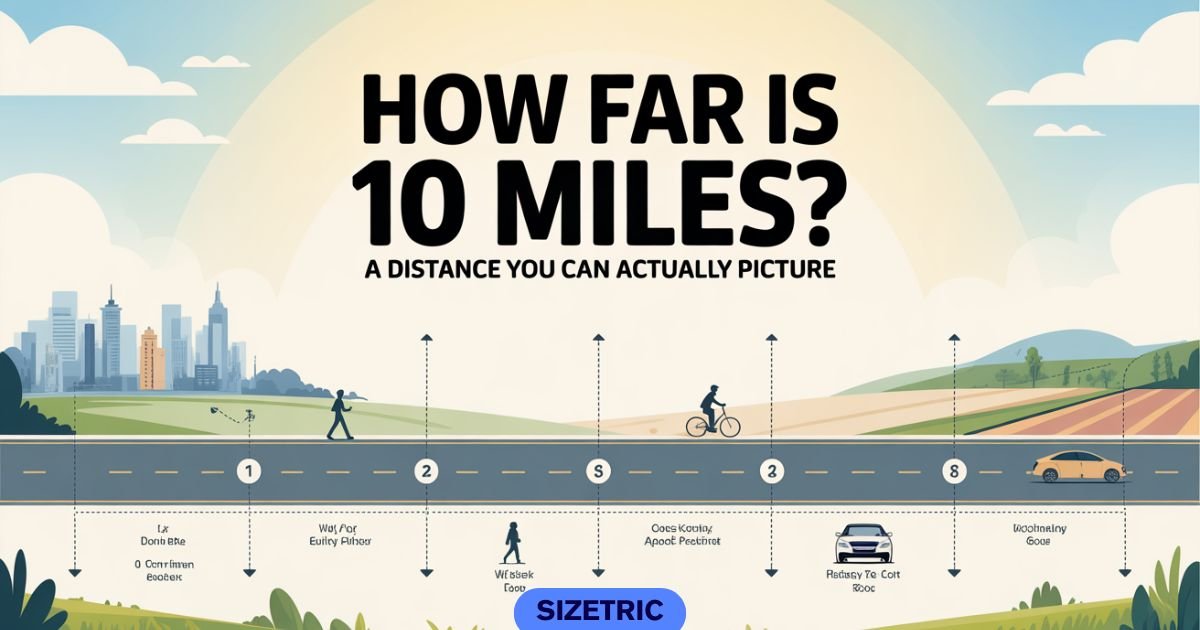
How Far Is 10 Miles? A Distance You Can Actually Picture
Ten miles is one of those numbers that sounds tidy but feels slippery. It’s short enough to drive without thinking and long enough to wreck an unprepared walker’s afternoon. The reason it’s so hard to picture is that it lives on a threshold — the exact point where a distance stops being effortless and starts asking something of you. Move it in a car and it barely registers. Move it on foot and it eats half your day.
This guide pins the number down from every angle. You’ll get the exact conversions in imperial and metric, honest travel times for walking, running, cycling, and driving, and a stack of real landmarks — from Central Park to the Golden Gate Bridge — that snap 10 miles into focus. By the end you’ll be able to gauge the distance in your head, with no map app required.
The Short Answer, Before You Scroll
Ten miles equals 16.09 kilometers, or 52,800 feet. Drive it on an open highway and it’s gone in about 10 minutes; walk it at a normal pace and you’re looking at roughly 3 hours 20 minutes. Picture Central Park’s length walked four times over, and you’ve got it.
That’s the headline. The rest of this page is about making the number stick.
10 Miles in Every Unit You’ll Actually Use
Distance gets messy the moment you cross between imperial and metric, so here’s the full conversion set in one place. Every figure below traces back to a single fixed fact: one mile is exactly 1.609344 kilometers.
| Unit | 10 miles equals |
| Kilometers | 16.09 km |
| Meters | 16,093 m |
| Feet | 52,800 ft |
| Yards | 17,600 yd |
| Nautical miles | 8.69 nmi |
| Centimeters | 1,609,344 cm |
Notice the gap between a statute mile and a nautical mile. Sailors and pilots measure in nautical miles, so their “10 miles” is a longer stretch of ground than yours — a detail that trips up plenty of people the first time they read a marine chart.
What 16 Kilometers Feels Like on the Ground
Numbers on a screen don’t build intuition. Motion does.
Ten miles is a distance your body registers differently depending on how you cover it. On foot it’s a genuine commitment — a half-day outing with a snack break somewhere in the middle. On a bike it’s a pleasant loop you’d barely mention. Behind the wheel it barely counts as a trip at all.
Here’s the useful mental anchor: 10 miles is the far edge of “casually walkable.” Five miles most fit people will stroll without much planning. Double it, and you’ve entered training-plan territory — the kind of distance runners circle on a calendar and hikers pack water for. That threshold is exactly why the number feels ambiguous. It sits right on the line between effortless and effortful.
How Long It Takes to Cover 10 Miles
The single most common question about this distance is “how long will it take me?” — and the only honest answer is it depends entirely on how you’re moving. Below are realistic paces, not idealized ones.
| How you’re moving | Typical pace | Time for 10 miles |
| Casual walk | 3 mph | ~3 h 20 min |
| Brisk walk | 4 mph | ~2 h 30 min |
| Easy jog | 6 mph (10 min/mile) | ~1 h 40 min |
| Steady cycling | 15 mph | ~40 min |
| City driving | 30 mph | ~20 min |
| Highway driving | 60 mph | ~10 min |
Two things jump out. First, walking and driving sit worlds apart — the same 10 miles is a 20-fold difference in time between a stroll and a freeway. Second, that famous “10 miles in 10 minutes” shorthand only holds at a clean 60 mph. Drop into stop-and-go city traffic averaging 30 mph and it doubles. Real commutes, with lights and merges, often stretch it further still.
Real Places and Landmarks That Map to 10 Miles
The fastest way to own a distance is to tie it to somewhere you already know. Each reference below is a fixed, verifiable stretch, and I’ve flagged where a comparison is exact versus rounded.
Central Park, Walked Four Times Over

Manhattan’s Central Park runs 2.5 miles along its long axis, from 59th Street up to 110th. Loop that length four times and you land at almost exactly 10 miles — one of the cleanest whole-number matches you’ll find, and close enough to treat as exact.
Millions of people have walked at least part of that park, which makes it a reference that travels well in conversation. If you’re mapping a running route through a city and want a “roughly 10-mile” loop, thinking in Central-Park lengths gives you a gut-level sense of the effort before you ever open a route planner.
Read Also: 8 Inches Long? 11 Everyday Objects for Instant Scale
Three-Quarters of the Way Up Manhattan
The island of Manhattan measures about 13.4 miles from its southern tip at Battery Park to its northern edge. Ten miles carries you roughly three-quarters of that span — from the harbor up to around the Washington Heights neighborhood. Call it an approximate match, since the island’s exact endpoints are fuzzy at the top.
Because the island is a fixed, well-mapped shape, it’s a reliable yardstick for anyone who’s ridden its subways or sat in its taxis. Next time you gauge a cross-town-and-uptown trip, remember that covering most of Manhattan’s length is your 10-mile benchmark.
Just Under Half the English Channel
At its narrowest, the Strait of Dover separates England and France by about 20.7 miles. Ten miles gets a Channel swimmer just shy of the halfway mark — right around the point where the crossing stops being a swim and starts being a test of nerve.
The Channel swim is a globally recognized feat, which makes it a vivid stand-in for open distance. When you want to feel the weight of 10 miles rather than the ease of driving it, imagine treading water halfway between two countries. That reframes the number completely.
Roughly Six Golden Gate Bridges, End to End

San Francisco’s Golden Gate Bridge stretches about 1.7 miles including its approaches. Line up six of them nose to tail and you’ve laid down almost exactly 10 miles — a close approximation, off by only a fraction of one bridge.
The bridge’s silhouette is instantly familiar even to people who’ve never visited, so it’s a strong visual unit. Picturing six of those iconic spans strung along a coastline gives the distance a scale that a bare “16 kilometers” never could.
One Loop of a Classic Ten-Mile Race
Ten miles is a formal race distance with its own following. The Army Ten-Miler in Washington, D.C., the Cherry Blossom Ten Mile Run, and the UK’s Great South Run all measure precisely 10 miles on certified courses. This is as exact as a comparison gets — the distance is the whole point of the event.
Certified race courses are measured to tight tolerances, so these events are a trustworthy anchor. For a runner, “one Army Ten-Miler” is a ready-made training target that already carries a feel for the required fitness and pacing.
Nearly Two Mount Everests, Stacked
Turn the distance vertical and it gets dramatic. Mount Everest rises about 5.5 miles from sea level to summit. Stack two Everests and you’d reach 11 miles, so 10 miles is a little under two of the world’s tallest peaks piled up — an approximate but jaw-dropping comparison.
Everest’s height is common knowledge, which makes it a powerful reference for grasping vertical scale. It also drives home a quiet point: 10 miles reads as trivial across flat ground and enormous straight up. Same number, wildly different meaning.
Higher Than a Cruising Airliner
A commercial jet typically cruises around 35,000 feet — about 6.6 miles above the ground. Ten miles up would put you well above that, in thinner air than almost any passenger flight ever reaches. Treat this as an approximate ceiling comparison, since cruising altitude varies by aircraft and route.
Nearly everyone has glanced out a plane window at that altitude, so it’s an intuitive touchstone. Realizing that 10 vertical miles overshoots your last flight reframes the distance as something genuinely large once you point it skyward.
About Two and a Half Las Vegas Strips

The Las Vegas Strip — the resort corridor from Sahara Avenue down past the famous welcome sign — runs roughly 4.2 miles. Ten miles works out to about two and a half full Strips, a rounded but handy match for anyone who’s tackled it on foot.
Tourists routinely underestimate that walk and regret it by casino number four, which is exactly what makes it a useful gut-check. If a single Strip already feels long on tired legs, two and a half of them tells you why 10 miles deserves respect on foot.
10 Miles Compared, at a Glance
Here’s the full set of references condensed into one scannable table.
| Reference | Its own size | 10 miles works out to |
| Central Park (length) | 2.5 mi | 4 lengths |
| Golden Gate Bridge | 1.7 mi | ~6 bridges |
| Las Vegas Strip | 4.2 mi | ~2.4 Strips |
| Mount Everest (height) | 5.5 mi | ~1.8 stacked |
| Manhattan (tip to tip) | 13.4 mi | ~75% of it |
| Strait of Dover | 20.7 mi | ~48% across |
| Marathon | 26.2 mi | ~38% of one |
Gauging 10 Miles Without a Map App
Phones die, signal drops, and sometimes you just want a rough read. A few field methods hold up well.
Count it in familiar chunks. If you know a local landmark that sits a mile or two from home, mentally stack those hops. Five two-mile segments is your 10.
Use time as a proxy. This is the most reliable trick on foot. A comfortable walking pace is close to 3 miles per hour, so if you’ve been walking steadily for a little over three hours on flat ground, you’ve likely covered around 10 miles. Add time for hills or heavy packs.
Lean on your odometer, then remember the feel. Drive a known 10-mile stretch once while watching the trip meter, and pay attention to how long it lasts and what it passes. That sensory memory beats any estimate the next time you need one.
Think in laps. A standard outdoor running track is a quarter-mile per lap, so 40 laps is 10 miles. It’s a mind-numbing way to run it, but a foolproof way to measure it.
Where People Get 10 Miles Wrong
A handful of mix-ups come up again and again.
The biggest is confusing 10 miles with 10 kilometers. A 10K is only 6.2 miles — so the two are far from interchangeable, and treating them as equal will throw your pacing, fuel, and timing way off. Ten miles is roughly 60% longer than a 10K.
Another is assuming the drive always takes 10 minutes. That’s the best-case highway figure. Surface streets, school zones, and rush hour can easily push the same trip past 25 minutes.
People also badly underestimate the walk. “It’s only 10 miles” sounds breezy until hour three sets in. Unless you walk regularly, plan for it like the half-day effort it is — water, snacks, decent shoes.
Finally, watch the nautical-versus-statute trap in any aviation or marine context. Ten nautical miles is about 11.5 statute miles, so the wrong assumption quietly stretches your distance by more than a mile.
10 Miles Next to Its Neighbors
Placing the number against the distances around it sharpens the picture.
Its close cousins on the running calendar are the 15K (9.3 miles) just below and the half marathon (13.1 miles) just above. Ten miles slots neatly between them, which is why it’s a natural stepping-stone distance in half-marathon training.
Round it into metric and you get essentially 16 kilometers — a clean figure that European route planners and gym treadmills often default to. And against the big one, the full marathon at 26.2 miles, 10 miles is about 38% of the way there: a solid chunk, but a reminder of how much marathon runners are really asking of themselves.
Read Also: How Far Is 50 Miles? Travel Time, Distance & Real Examples
When 10 Miles Actually Matters
This distance shows up in more decisions than you’d expect.
Commuting and delivery. A 10-mile radius defines a lot of real-world zones — the reach of many food-delivery services, the catchment area of a suburban gym, or a one-way commute that’s short by car but a serious daily ask by bike.
Fitness goals. For runners, the first 10-mile long run is a genuine milestone and a psychological gateway to the half marathon. For cyclists, it’s barely a warm-up.
Electric-vehicle range anxiety. When an EV dash reads “10 miles remaining,” that’s the difference between reaching the next charger and calling for help — a context where the number suddenly feels very precise and very personal.
Real estate and everyday logistics. “Ten miles from downtown” is shorthand for a whole lifestyle trade-off: cheaper space against a longer trip. It’s a distance that shapes where people choose to live.
Fast Answers to Common 10-Mile Questions
What is 10 miles in kilometers?
Ten miles equals 16.09 kilometers (16,093 meters). A quick rule of thumb: multiply miles by 1.6.
How many hours is 10 miles?
It depends on how you move — about 10 minutes driving at 60 mph, roughly 40 minutes cycling, and a little over 3 hours walking. There’s no single time; the mode decides it.
How long does it take to do 10 miles?
Walking takes around 3 hours 20 minutes at 3 mph, an easy run about 1 hour 40 minutes, and city driving roughly 20 minutes. Faster paces trim each of those.
How many kilometers are there in a 10-mile run?
A 10-mile run covers exactly 16.09 kilometers. That places it between a 15K (9.3 miles) and a half marathon (13.1 miles).
Can I run 10 miles in 1 hour?
Yes, but it’s fast — you’d need to hold a 6-minute-mile pace (10 mph) the whole way, which is a trained-runner effort. Most recreational runners finish nearer 1 hour 40 minutes.
Can I walk 10 miles in 2 hours?
Not at a normal pace — that would require 5 mph, closer to a slow jog than a walk. A brisk 4 mph walk gets you there in about 2 hours 30 minutes.
Locking 10 Miles Into Your Mental Map
Ten miles is a chameleon: nothing in a car, a milestone on foot, a mountain-and-a-half straight up. That’s why a bare “16 kilometers” never quite lands — the number only means something once you attach it to how you’re actually moving and to a place you already know. The conversions give you precision; the landmarks give you feel. Together they turn an abstract figure into a distance you can sense.
The trick to keeping it is picking the one anchor that fits your life — four laps of Central Park, a certified ten-mile race, or 16 clean kilometers on the treadmill — and letting everything else fall into place around it. Do that once and the number stops being a guess. Next time you see “10 miles,” whether it’s a race entry, a delivery radius, or the range left on a dashboard, you’ll know exactly what you’re looking at.
Related Guides:
1: How Far Is 500 Feet? Clear Comparisons You Can Picture
2: How Much Is 10 oz? Weight, Grams, Cups & Examples
3: What Is 20 kg? Weight, Conversions & 6 Real Examples
4: How Long Is 25 Feet Visually? 6 Ways to Picture It
5: How Long Is 30 Meters? Feet, Yards & Real Examples




2 Comments