
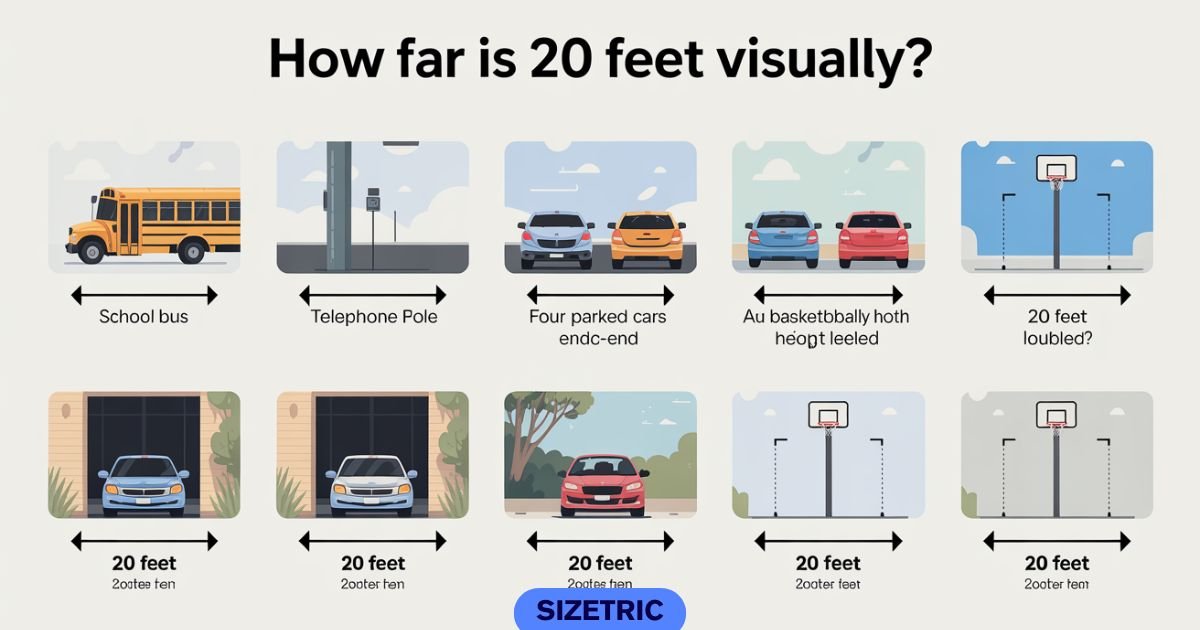
How Far Is 20 Feet Visually? 10 Real-Life Examples
Twenty feet is one of those measurements that sounds obvious right up until you’re standing in a room trying to picture it. It’s longer than a car, roughly two stories tall, and just about the length of a shipping container. The problem is that a number on its own doesn’t help you see anything.
This guide fixes that. Below, I turn 20 feet into things you already know on sight — vehicles, doors, parking spaces, and the number of steps it takes to walk the distance — so you can gauge it at a glance without reaching for a tape measure. You’ll also get clean conversions to meters, inches, and centimeters, and a few tricks for eyeballing the distance outdoors versus indoors.
The short answer
20 feet is about 6.1 meters. Picture roughly three-and-a-half average adults lying head to toe, a full-size crew-cab pickup truck, or three standard interior doors stacked on top of one another. If you’d rather pace it, that’s about eight normal walking steps.
Fast conversions: 20 ft = 240 inches = 6.096 meters = 609.6 cm = 6.667 yards.
20 feet in every unit
Here’s the same distance expressed across the imperial and metric systems, so you can drop it straight into whatever you’re measuring.
| Measurement | Value |
| Feet | 20 ft |
| Inches | 240 in |
| Yards | 6.667 yd (6 yd 2 ft) |
| Centimeters | 609.6 cm |
| Millimeters | 6,096 mm |
| Meters | 6.096 m (≈ 6.1 m) |
A couple of shortcuts worth memorizing: half of 20 feet is 10 ft (3.05 m), a quarter is 5 ft (1.52 m), and if you think in meters, just round 20 feet to a shade over 6 m and you’ll never be far off.
What 20 feet actually looks like
Twenty feet is well past arm’s reach and past the “grab zone” your eye handles instinctively — you can’t reach it, and you can’t quite judge it the way you’d judge something on your desk. It’s the far wall of a generously sized bedroom, the length of a short driveway apron, or the gap those old “stay 20 feet back” road signs wanted between you and the truck ahead.
The distance behaves differently depending on direction. Laid flat on the ground, 20 feet reads as long — a good-sized rug runner, a modest hallway, a car and a bit. Stood up vertically, the same 20 feet reads as tall — about two full stories, or roughly the height of a basketball hoop plus another hoop stacked on top. Same number, very different feel, which is exactly why people misjudge it.
Everyday objects that measure close to 20 feet
These are the reference points I actually reach for. A few are near-exact; the rest are close enough to trust when you just need a visual anchor.
A 20-foot shipping container — the namesake

The most literal comparison there is. A standard 20-foot shipping container (the “TEU” that ports count in) is named for this exact length. Its outer length is a whisker under the round number — about 19.9 ft (6.06 m) — but for eyeballing purposes it is 20 feet. If you’ve seen one on a truck bed or stacked at a port, you already have 20 feet burned into memory.
Read Also: How Much Is 15kg? What It Actually Weighs, in Plain Terms
A full-size crew-cab pickup truck
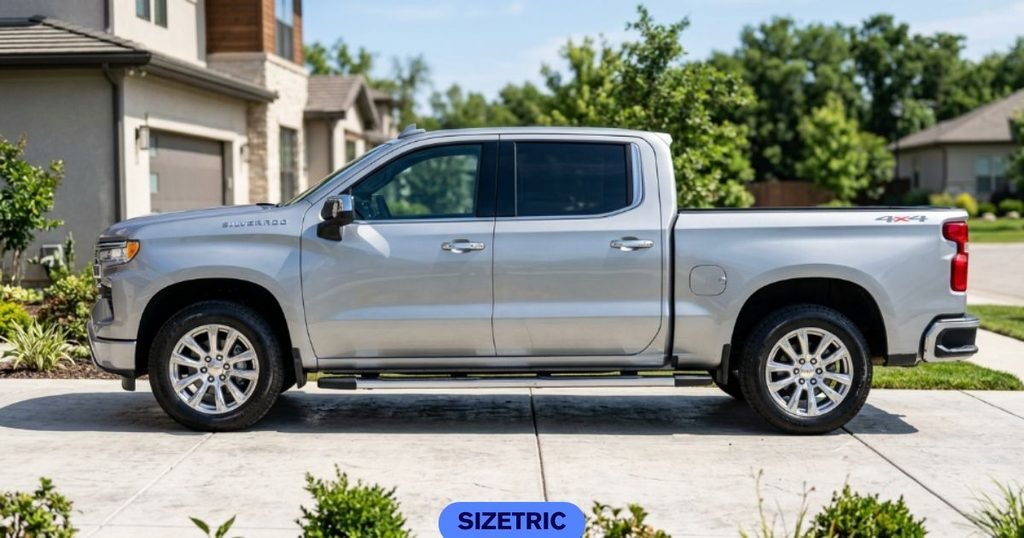
Park a full-size crew-cab pickup — think a Ford F-150 SuperCrew or a Chevy Silverado Crew Cab — and you’re looking at roughly 19.5 to 21 feet bumper to bumper, depending on the bed length. Stand one on end in your imagination and you’ve got a near-perfect 20-foot yardstick that’s sitting in half the driveways in the country.
A standard parking space, plus a couple of feet
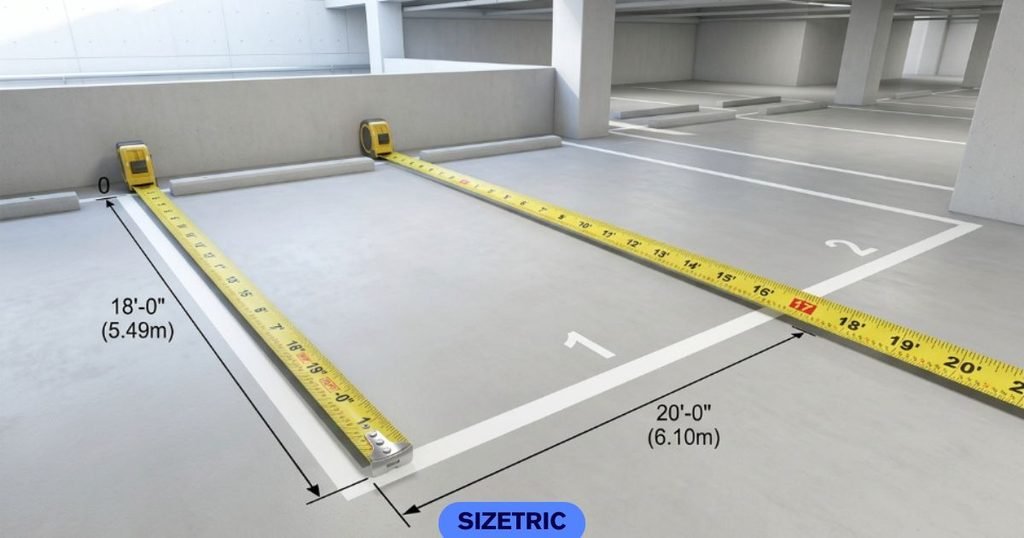
Most marked parking stalls in the US run about 18 feet long. So 20 feet is one full parking space with a little spilling over the line — the length of the car in front of you plus the front bumper of the one behind. Handy the next time you’re judging whether a gap at the curb is long enough to squeeze into.
Three interior doors stacked
This one is exact and it sticks. A standard interior door is 6 feet 8 inches tall (80 inches). Stack three of them: 3 × 80 in = 240 inches = exactly 20 feet. Picture three doorways floating one above the other and you’ve nailed the distance to the inch.
An adult giraffe — almost
A full-grown giraffe stands roughly 16 to 18 feet tall, with tall bulls pushing toward 18–19. So 20 feet is a touch taller than even a big one — a useful mental image for vertical distances like ceiling heights or how high a second-floor window sits.
Half a school bus
A full-size yellow school bus runs about 35 to 40 feet long, so cut one in half and you land right around 18 to 20 feet. Not precise, but if a bus is nearby, splitting it down the middle gives you a fast field estimate.
A long cargo van
A long-wheelbase cargo van — a Ford Transit or Mercedes Sprinter in its extended trim — measures about 19.5 to 22 feet nose to tail. That puts a big work van right in the 20-foot zone, and these are common enough on any street to serve as a quick moving yardstick.
Two basketball hoops stacked
A regulation basketball rim sits exactly 10 feet off the floor. Imagine one hoop set on top of another and you reach exactly 20 feet. This is my favorite anchor for vertical distances, since almost everyone knows how tall a hoop stands.
A residential flagpole
A common residential flagpole — the kind planted in front yards and small offices — stands about 20 feet tall. Picture the pole rising past a two-story window line and you’ve got the height fixed in your mind.
Three-and-a-half adults, head to toe
An average adult stands about 5 feet 9 inches (5.75 ft). Lay people out in a line, head to toe, and it takes roughly three-and-a-half of them to cover 20 feet. It’s a rough measure, but a handy one when a few friends are standing nearby.
Quick size comparison
| Reference object | Approx. length/height | vs. 20 ft |
| 20-foot shipping container | 19.9 ft (6.06 m) | Exact namesake |
| Full-size crew-cab pickup | 19.5–21 ft (~6 m) | ~Spot on |
| Three interior doors stacked | 20 ft (6.10 m) | Exact |
| Two basketball hoops stacked | 20 ft (6.10 m) | Exact |
| Long cargo van | 19.5–22 ft (~6.3 m) | ~Spot on |
| Residential flagpole | 20 ft (6.10 m) | ~Spot on |
| Half a school bus | 18–20 ft (5.5–6.1 m) | ~Spot on |
| Standard parking space | 18 ft (5.49 m) | Slightly shorter |
| Three-and-a-half adults, head to toe | ~20 ft (6.1 m) | ~Spot on |
| Adult giraffe | 16–18 ft (4.9–5.5 m) | A bit shorter |
Exact = matches to the inch; the rest are close visual approximations.
Pace it out: estimating 20 feet without a tape
Because 20 feet is too big for the hand-and-forearm tricks that work on small objects, the body-based method here is your stride.
An average adult walking step — heel of one foot to heel of the next — covers about 2.5 feet (30 inches). Count eight relaxed steps and you’ve walked almost exactly 20 feet. If you think in full strides (two steps, left-to-left), one stride is roughly 5 feet, so four strides gets you there.
Prefer to stand still? An adult’s arm span is close to their height — about 5.5 to 6 feet for most people. Lay down three-and-a-half arm spans, tip to tip, and you’ve marked out 20 feet. Both methods are rough, but for judging a driveway, a room, or a safe following distance, they’re more than close enough.
Room and yard references at 20-foot scale
Once you leave flat measuring behind, 20 feet starts showing up as the size of everyday spaces.
Vertically, it’s about the height of a two-story house measured to the eaves — roughly two floors of living space plus the gap between them. A single-car garage is often about 20 feet deep, which is why a full-size car fits inside with room to open the tailgate. And a large primary bedroom frequently spans close to 20 feet wall to wall. If you can call any of those to mind, you can size up 20 feet in the real world instantly.
15, 20, or 25 feet — telling the neighbors apart
Distances near 20 feet blur together fast, so here’s how to separate them.
15 feet (4.57 m) is about one mid-size sedan length (a Camry or Accord is roughly 16 ft) — a single car, nose to tail. It’s also the exact distance from the free-throw line to the backboard on a basketball court, if that’s an image you carry.
20 feet (6.10 m) adds roughly a fifth on top of that — think one car plus a crew-cab pickup’s front end, or a car and a quarter.
25 feet (7.62 m) stretches to about a car-and-a-half, the ballpark length of a small motorhome or a big boat on its trailer. The jump from 20 to 25 is the difference between “long pickup” and “short RV.”
Where 20 feet actually matters
This distance quietly runs through daily life. When parking or backing a trailer, 20 feet is roughly the room you need to swing a full-size vehicle in and out. In real estate, garage depths, driveway aprons, and room dimensions cluster right around it. On the road, older safety and clearance signs used 20 feet as the “keep back” buffer, and many building codes set fire-lane and hydrant clearances in the same neighborhood. Even in photography, 20 feet is a common working distance for group shots with a standard lens. Knowing the distance by sight means you’re not guessing in any of those moments.
Read Also: How Many Pounds Is 10 Tons? (20,000 lb Answer)
Where people misjudge 20 feet
The classic error is foreshortening: a distance stretching straight away from you looks shorter than the same distance laid sideways across your view, so people routinely underestimate 20 feet down a hallway or driveway.
The second trap is mixing units — 20 feet is not 20 yards. Twenty yards is three times as far (60 feet), a mistake that turns a parking space into most of a basketball court.
Finally, indoors compresses distance. Walls, furniture, and a low ceiling make 20 feet feel cozy; the identical span across an open yard feels noticeably longer. When precision matters, pace it out rather than trusting the eye.
Fast answers
How many footsteps is 20 feet?
About eight normal adult steps, since one relaxed step covers roughly 2.5 feet. Count four full strides if you measure in left-to-left paces.
How much is 20 feet away?
It equals 6.1 meters, or 240 inches — a little more than one full-size pickup truck length. That places the spot just past a car parked in front of you.
What does 20 feet look like?
Picture a crew-cab pickup truck, three interior doors stacked in a line, or the depth of a single-car garage. Each one marks the distance almost exactly.
How far is 20 feet in comparison?
It runs about one car length plus a quarter, or a touch taller than a full-grown giraffe. Stood upright, it reaches roughly two stories high.
How big is 20 feet visually?
It spans a wide bedroom wall to wall or a short driveway apron. That makes 20 feet easy to spot once you fix one clear picture in mind.
The takeaway in one line
By now you know how far is 20 feet visually, and you can picture it fast. Think of one big pickup truck parked in a driveway. Think of three tall doors stacked one on top of the other. You can also count eight normal steps as you walk across a room. Each of these tricks gives you a clear picture in your mind. You no longer need a tape measure to make a good guess.
Twenty feet is about 6.1 meters, or 240 inches. Keep one simple picture ready, like the pickup truck or the stacked doors. Then you will spot this distance right away. With a little practice, you will judge 20 feet with ease and full confidence.
Related Guides:
1: 80 Feet: How Long It Really Is, With Real Comparisons
2: Dollar Bill Dimensions: Exact Size, Thickness & Weight
3: Jerry Can Dimensions: Every Size, Weight and Variant Explained
4: Miles to Steps Calculator: How Many Steps in a Mile?
5: Celsius Can Dimensions: Exact Size, Height & Diameter




2 Comments