
Pokémon Card Dimensions: Exact Size in Inches, mm & cm
Pull any card out of any pack — a common Energy, a Charizard, a Japanese promo — and it will be the same size. That consistency is the whole point, and it’s why one measurement unlocks every sleeve, binder, and toploader you’ll ever buy. This guide gives you the exact Pokémon card dimensions in inches, millimeters, and centimeters, then goes further than the spec sheet: jumbo formats, real thickness, what a card is roughly the size of, and the sleeve numbers that actually matter at the checkout page.
Pokémon Card Size at a Glance
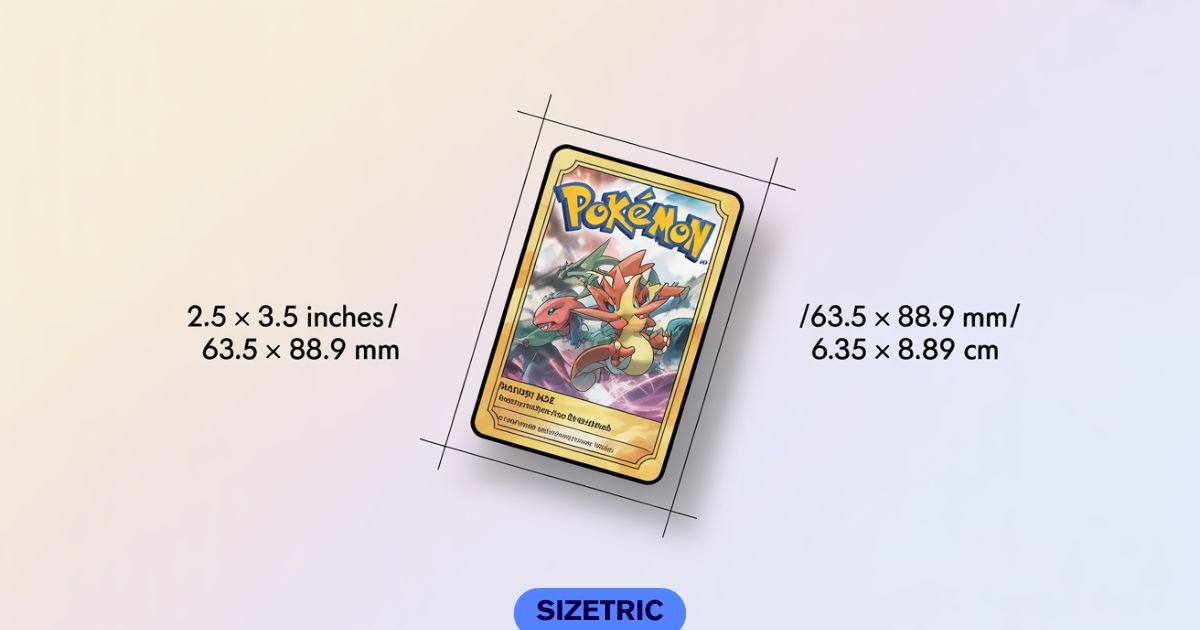
A standard Pokémon card measures 2.5 × 3.5 inches, which is 63.5 × 88.9 mm or 6.35 × 8.89 cm. The hobby usually rounds that to 63 × 88 mm, and both figures describe the same card — the rounding is just shorthand. Height is the long edge (3.5 in / 88.9 mm) when you hold the card upright; width is the short edge (2.5 in / 63.5 mm).
That footprint hasn’t changed since the game launched in 1996, and it’s shared with Magic: The Gathering, so “standard size” accessories fit the whole shelf. A single card is about 0.3 mm thick and weighs roughly 1.8 grams — light enough that a full booster’s worth barely registers in your hand.
Every Measurement in One Table
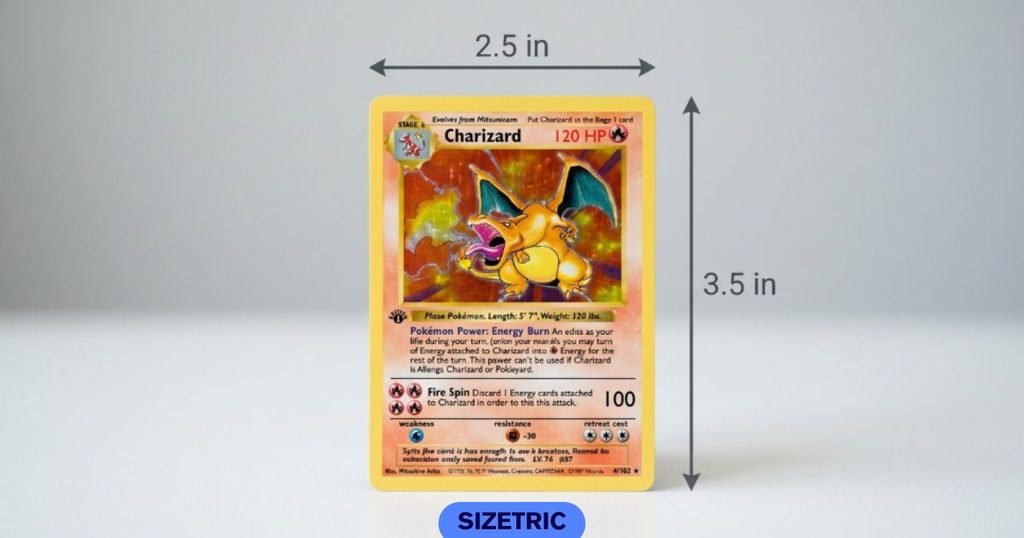
Here’s the complete spec for a standard card, with the conversions collectors actually reach for. Thickness and weight aren’t officially published by The Pokémon Company, so treat those as measured working figures rather than exact specs.
| Dimension | Inches | Millimeters | Centimeters |
| Width (short edge) | 2.5 in | 63.5 mm | 6.35 cm |
| Height (long edge) | 3.5 in | 88.9 mm | 8.89 cm |
| Diagonal | ~4.3 in | ~109 mm | ~10.9 cm |
| Thickness (plain card) | ~0.012 in | ~0.30 mm | ~0.03 cm |
| Corner radius | ~0.125 in | ~3.18 mm | ~0.32 cm |
| Weight | — | — | ~1.8 g |
| Aspect ratio | 5 : 7 | 5 : 7 | 5 : 7 |
| Print size at 300 DPI | — | — | 750 × 1050 px |
That 5:7 ratio is worth remembering — it’s the same proportion as a classic 5×7 photo print, which is exactly why cards scan and frame so cleanly.
Standard Sizes and Variants Explained
The Card in Every Booster Pack
The everyday card — commons, trainers, holos, full-arts, and the pricey chase cards alike — is 2.5 × 3.5 inches (63.5 × 88.9 mm). Rarity and value change nothing about the footprint. A bulk Energy and a five-figure alt-art occupy the exact same rectangle, which is precisely why a graded slab crushes both to the same dimensions when they go for grading.
The number to internalize is the metric pair, because sleeves, binders, and toploaders are sold by it worldwide. If you buy protection for one card, you’ve bought it for all of them. Regional prints don’t break this rule either: an English, French, or Japanese card share the identical size, a point I’ll come back to because a lot of pages online get it wrong.
Read Also: Gatorade Bottle Dimensions: Every Size, Measured
Jumbo and Oversized Promo Cards
Jumbo cards are the oversized promos that ship in special tins, magazines, and box sets — the ones that don’t fit any normal sleeve. There’s no single jumbo size; there are a few. The everyday shorthand is “about 5 × 7 inches,” but the modern format most collectors run into (often called Jumbo L) is closer to 133 × 185 mm (≈5.2 × 7.3 in), while older or larger XL-style promos reach 145 × 200 mm (≈5.7 × 7.9 in). Treat any single jumbo figure as approximate — the format genuinely varies by release.
These cards are display pieces, not deck pieces: none are legal for tournament play. Because the sizes drift release to release, jumbo owners usually protect them with oversized top loaders or rigid sleeves sold specifically for promo cards, not the standard supplies. If you’re storing one, measure your exact card before buying, rather than trusting a blanket “5×7” label.
How Thick a Card Really Is
A plain Pokémon card lands around 0.30 mm, which matches the ~12-point cardstock the trading-card industry standardized on. You can sanity-check that at home: stack 100 cards and you’ll get a column close to 3 cm tall, which works out to 0.3 mm each. That tri-layer build — cardboard, an opaque black core, cardboard — is also why holding a card up to light shows no bleed-through.
Thickness is the one dimension that genuinely varies. Holographic, textured, and full-art cards carry an extra foil layer and measure a hair thicker, nudging toward 0.33 mm and above. Japanese prints tend to feel marginally thinner than Western ones. None of this changes the width or height — a foil Charizard sleeves exactly like a common — but it’s why a deck of all-holos feels chunkier in the box than a deck of commons.
Standard vs Jumbo vs Neighboring Card Games
| Card | Inches (W × H) | Millimeters | Notes |
| Standard Pokémon | 2.5 × 3.5 | 63.5 × 88.9 | Same worldwide, all rarities |
| Magic: The Gathering | 2.5 × 3.5 | 63.5 × 88.9 | Identical footprint to Pokémon |
| Yu-Gi-Oh! | 2.32 × 3.39 | 59 × 86 | Noticeably smaller |
| Jumbo (modern) | ~5.2 × 7.3 | ~133 × 185 | Promo/display, not tournament-legal |
| Jumbo (older XL) | ~5.7 × 7.9 | ~145 × 200 | Larger vintage promos |
The takeaway: Pokémon and Magic share sleeves freely, Yu-Gi-Oh does not, and jumbos live in their own world.
Why You’ll See Slightly Different Numbers Online
Search “Pokémon card size” and you’ll hit 63 × 88, 63.5 × 88.9, and 6.35 × 8.89 cm on different pages, sometimes on the same one. They’re not contradictions — 2.5 inches converts exactly to 63.5 mm and 3.5 inches to 88.9 mm, and the community simply rounds those to 63 × 88 for convenience. That one-millimeter gap is also deliberately why sleeves aren’t cut to 63 × 88.
Small real-world variation comes from a few honest sources: foil layers add thickness, cardstock density shifts weight between sets and eras, and cutting has a tiny manufacturing tolerance. Counterfeits are where the size actually goes wrong — fakes often run too thin (like glossy photo paper) or too thick (0.4 mm and up on cheap board), and the layered edge won’t show that clean cardboard-core-cardboard sandwich when you bend the card slightly.
What a Pokémon Card Is Roughly the Size Of
Numbers stick better with something in your hand. Here are dependable references, from nearly identical to clearly bigger.
- A standard playing card (poker/bridge stock) is essentially the same: 2.5 × 3.5 in. If you’ve held a deck, you’ve held a Pokémon card’s exact footprint — only the thickness and feel differ.
- A credit card (about 85.6 × 54 mm) is a touch smaller in both directions. Lay a card over one and it overhangs slightly all around — handy for picturing the size when no card is nearby.
- A US business card (about 89 × 51 mm) has a long edge that matches a Pokémon card’s height almost exactly. Stand one on its long side next to a card and the tops line up.
- A 3 × 5 index card (76 × 127 mm) is comfortably bigger — useful for the opposite check, confirming a card is smaller than you might assume.
For a no-ruler estimate: a card covers most of an adult palm, and its corner-to-corner diagonal (~4.3 in / 109 mm) is close to the length of an average adult thumb plus a knuckle. Three cards laid short-edge to short-edge span about 7.5 inches — a quick way to gauge binder-row width without measuring.
Matching Sleeves, Binders, and Toploaders to the Size
This is where the exact dimensions earn their keep. A card is 63.5 × 88.9 mm, so protection is cut a little larger so the card slides rather than jams.
- Standard sleeves run about 66 × 91 mm (2.6 × 3.6 in) — the “standard size” label on Ultra Pro, Dragon Shield, and similar brands. They fit Pokémon and Magic interchangeably.
- Perfect-fit / inner sleeves sit around 64 × 89 mm, snug on purpose. Collectors use them for double-sleeving: an inner perfect-fit inside an outer standard sleeve.
- Toploaders are typically 3 × 4 inches, giving a single card firm, rigid protection with room to spare. The common 35-point rating refers to the toploader’s capacity, not the card.
- 9-pocket binder pages are built around the standard footprint, so any standard card drops straight in; jumbos never will.
Two practical notes. If you’re building a tournament deck, roomier standard sleeves shuffle and re-sleeve faster than tight ones — the extra millimeter matters over a long day. And graded slabs are far larger than the raw card (roughly 3.3 × 5.3 in), so they need their own sleeves or storage boxes; don’t expect them near a normal binder.
Read Also: Red Bull Can Dimensions: All Sizes, Height & Diameter
Size Myths Collectors Still Repeat
“Japanese cards are smaller.” They aren’t. Authentic Japanese Pokémon cards measure the same 63.5 × 88.9 mm as English prints. This myth is almost certainly a mix-up with Yu-Gi-Oh! cards, which genuinely are smaller at 59 × 86 mm. Japanese and Western Pokémon share sleeves without issue.
“Pokémon cards are 35pt.” The card stock itself is roughly 12pt (~0.3 mm). The 35-point figure is the standard toploader size that fits a card comfortably — two different measurements that pages routinely blur together.
“Expensive cards are a different size.” Value comes from rarity, condition, and grading, never dimensions. A million-dollar Pikachu Illustrator is the same 2.5 × 3.5 inches as the cheapest common in the set.
Quick-Fire Q&A
What is the size of a Pokémon card in millimeters?
A standard Pokémon card is 63.5 × 88.9 mm (commonly rounded to 63 × 88 mm). That’s the same for every card, regardless of rarity or region.
Are Pokémon cards 3×4 size?
No — the card is 2.5 × 3.5 inches; “3×4” refers to the toploader that holds it. A 3 × 4 in toploader fits a card with room to spare.
What is the height and width of a card?
Height (long edge) is 3.5 in / 88.9 mm and width (short edge) is 2.5 in / 63.5 mm. Hold it upright and the taller side is the height.
What are the proportions of a Pokémon card?
The aspect ratio is 5:7 — the same proportion as a classic 5×7 photo print. It’s always taller than it is wide.
How big is Pokemon card size?
About 2.5 × 3.5 inches (63.5 × 88.9 mm), roughly the size of a standard playing card. It covers most of an adult palm and is around 0.3 mm thick.
Lock the Size In: 2.5 × 3.5 and You’re Set
Every standard Pokémon card is 2.5 × 3.5 inches — 63.5 × 88.9 mm — about 0.3 mm thick, and that’s held true for nearly three decades across every region and rarity. Memorize the one pair of numbers and you’ve solved sleeves, binders, toploaders, and custom prints in a single move. Jumbos are the only cards that break the rule, and they announce it the moment they won’t fit your binder.
Related Guides:
1: How Tall Is a Monster Can? Exact Height, Diameter, and Size Guide


One Comment