
What Is 20 kg? Weight, Conversions & 6 Real Examples
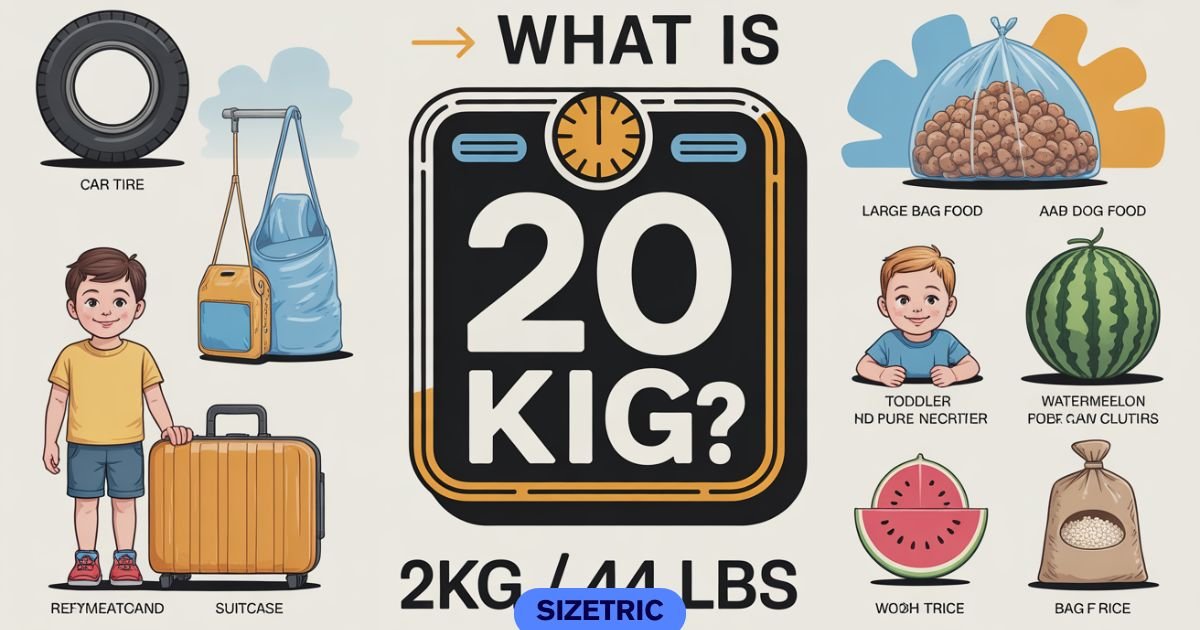
20 kg is a unit of weight. It equals about 44 pounds, or 3 stone 2 pounds. In simple terms, 20 kg is the same as 20 litres of water.
Ever lifted a heavy suitcase and wondered how much it weighs? That heavy pull is often close to 20 kg. It is a load you can lift, but not carry far.
You meet 20 kg more often than you think. A packed bag, a gym plate, or a six-year-old child all weigh about this. It feels heavy, so lift it with care.
The Quick Answer
20 kg (kilograms) is a metric unit of mass equal to about 44 pounds, or 3 stone 2 pounds. To picture it: 20 kg is roughly an average 6-year-old child, 20 litres of water, or a fully packed checked suitcase. Most adults can lift it, but it becomes genuinely heavy once you have to carry it any real distance.
How Heavy Is 20 kg in Pounds and Stone?
Here’s every common conversion for 20 kilograms in one place. The pound and stone figures are the ones most English-speaking searchers are really after.
| Unit | 20 kg equals | Rounded |
| Pounds (lb) | 44.09 lb | ≈ 44 lb |
| Stone (st) | 3.15 st | ≈ 3 st 2 lb |
| Grams (g) | 20,000 g | exact |
| Ounces (oz) | 705.48 oz | ≈ 705 oz |
| Metric tonnes (t) | 0.02 t | exact |
| Litres of water (L) | ≈ 20 L | near-exact |
Two quick things worth locking in. 20 kg is almost exactly 44 lb — not 20 lb, which is a mix-up people make constantly. And because water weighs about 1 kg per litre, 20 litres of water weighs 20 kg, which makes a full 20 L jerry can the most precise everyday reference you can find.
What 20 kg Actually Feels Like
Think of the heaviest single grocery run you can carry from car to kitchen without stopping — a couple of full bags in each hand. That’s the neighbourhood of 20 kg. It’s a “two-handed, brace-your-back, don’t-do-it-twice” weight rather than a casual one.
The catch is distance. Twenty kilos sitting in your arms for ten seconds feels manageable. The same 20 kg carried 200 metres, or lifted up two flights of stairs, feels like a completely different number. Weight you can hold and weight you can transport are not the same experience — a distinction most weight-comparison pages skip entirely.
Read Also: How Long Is 25 Feet Visually? 6 Ways to Picture It
6 Everyday Things That Weigh About 20 kg
These are the references I reach for when I want to gauge 20 kg without a scale. I’ve flagged which are near-exact and which are ballpark.
A full 20-litre container of water

Fill a 20 L water container to the brim and you’re holding almost exactly 20 kg — water density does the maths for you. This is the single most reliable 20 kg reference on the list because it doesn’t depend on brand, model, or guesswork. If you’ve ever swapped the bottle on an office water cooler, you’ve handled roughly this.
A standard 20 kg gym plate
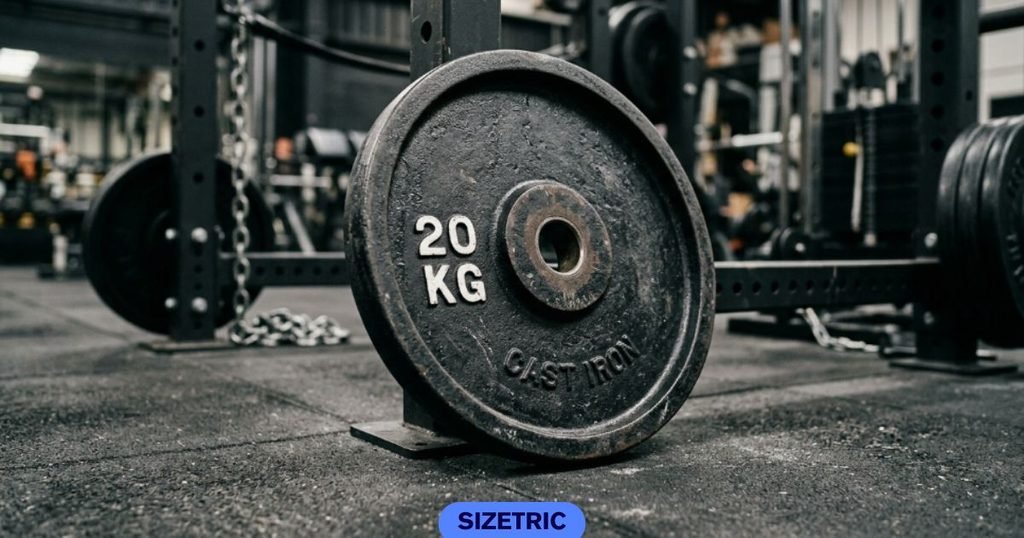
Metric gyms stock a 20 kg cast-iron or bumper plate as a core size, and it’s an exact, calibrated 20 kg. (Its imperial cousin, the 45 lb plate, is slightly heavier at about 20.4 kg — close, but not identical.) One plate loaded on each side of a barbell is a genuinely useful mental anchor if you lift.
An average 5-to-6-year-old child

A typical six-year-old weighs around 20–22 kg, and a five-year-old sits nearer 18–20 kg, so 20 kg is close to an average early-primary-age kid. Any parent who’s carried a sleeping child up to bed knows the feeling — and knows why you don’t want to do it for long.
A packed checked suitcase
Most airline economy fares cap a single checked bag at 20 or 23 kg, and budget carriers frequently set the limit at exactly 20 kg. A large hard-shell case stuffed for a two-week trip lands right around this figure — which is precisely why baggage scales at check-in matter so much.
A 20 kg sack of potatoes or pet food
Bulk sacks of potatoes, rice, or large-breed dog food are commonly sold in 20 kg (and 25 kg) sizes. Hoist one onto your shoulder and you’ve got a good working sense of the load. This is the reference DIY and garden-centre shoppers meet most often.
A mounted car wheel (tyre + rim)
A complete wheel — tyre fitted to an alloy rim — on a mid-size car weighs roughly 18–22 kg, so about 20 kg (approximate; the tyre alone is closer to 10 kg). If you’ve changed a flat, that awkward, low-slung heft is your 20 kg benchmark.
20 kg at a Glance
| Reference object | Approx. weight | Exact or estimate |
| 20 L container of water | 20 kg | near-exact |
| Standard gym plate | 20 kg | exact |
| Average 6-year-old child | 20–22 kg | estimate |
| Packed checked suitcase | 20–23 kg | varies by airline |
| Sack of potatoes / dog food | 20 kg | standard size |
| Mounted car wheel (mid-size) | 18–22 kg | estimate |
How to Gauge 20 kg Without a Scale
No scale handy? You can get within a couple of kilos using things you already own. (These steps are written to double as HowTo schema.)
- Grab a known 1 L or 2 L reference. A 2-litre bottle of water is ~2 kg. Ten of them, or the mental image of ten, is 20 kg.
- Use a filled bucket. A standard 10 L bucket brimmed with water is ~10 kg — two of those is your target.
- Compare against a checked bag you’ve weighed before. If you know your suitcase hit 19 kg at the airport last trip, that’s a calibrated reference in your memory.
- Do the “one-arm test.” Try lifting the object with one hand. If you can but it’s clearly a strain and you’d want two hands to carry it, you’re in the 18–25 kg zone.
Is 20 kg Safe to Lift?
For a healthy adult, 20 kg is lift-able — but it sits in a range worth respecting. UK Health and Safety Executive guideline figures for manual handling suggest a maximum of around 25 kg for men and 16 kg for women when lifting close to the body at waist height, with those limits dropping sharply if the load is held away from you, above shoulder height, or below the knees.
So 20 kg lifted close to your body, with a straight back and bent knees is reasonable for many people; the same 20 kg at arm’s length or twisted is where backs get hurt. Treat it as a “use good technique” weight, not a “grab and go” one.
15 kg vs 20 kg vs 25 kg — Telling Them Apart
The neighbours on either side of 20 kg are easy to confuse by feel, so here’s the quick separation:
| Weight | Everyday match | How it differs |
| 15 kg (≈ 33 lb) | A 3-to-4-year-old; a mid-size checked bag | Noticeably easier to carry any distance |
| 20 kg (≈ 44 lb) | A 6-year-old; 20 L of water | The “two hands, mind your back” load |
| 25 kg (≈ 55 lb) | A large bag of building sand or cement | Near the upper safe single-lift limit |
If you can walk comfortably across a room with it in two hands, you’re nearer 15 kg. If you’re setting it down every few steps, you’ve crossed into 25 kg territory.
Weight vs. Bulk: Why 20 kg Can Fool Your Eyes
Here’s the trap. Twenty kilograms of feathers and twenty kilograms of steel weigh the same — the feathers just fill a room while the steel fits in your fist. Weight tells you nothing about size on its own.
That’s why a compact 20 kg dumbbell feels “heavier” than a big, fluffy 20 kg duvet in a bag — the dense object concentrates the load into a smaller grip, so your hand works harder even though the scale reads identically. When you’re estimating, judge by the number on the scale, not by how big the thing looks.
Read Also: How Long Is 30 Meters? Feet, Yards & Real Examples
Common Misconceptions
- “20 kg is the same as 20 lb.” No — 20 kg is about 44 lb, more than double.
- “Heavier means bigger.” Density decides size; a small dense object can outweigh a large light one.
- “20 kg is a trivial lift.” For many people it’s fine with good form, but it’s close enough to safe-handling guideline limits that technique genuinely matters.
Fast Answers
What is an example of 20 kg?
A full 20-litre container of water is a perfect example of 20 kg. A standard gym plate or a large packed suitcase also weighs about this.
What does 20 kg look like?
20 kg looks like an average six-year-old child or a big checked suitcase. It can be small and dense, like a gym plate, or large and light, like a full duffel bag.
What is something that weighs 20 kg?
A 20 kg bag of dog food, a sack of potatoes, or a mounted car wheel each weighs about 20 kg. A 20-litre water container is the most exact match.
How much is 20 kg of weight?
20 kg is about 44 pounds, or 3 stone 2 pounds. In grams, that is 20,000 g, and it equals roughly 20 litres of water.
How big is 20 kg?
20 kg has no fixed size, because weight and size are different things. A dense gym plate fits in one hand, while a light duvet of the same weight fills a whole bag.
Is 20 kg heavy to carry?
20 kg is a moderate-to-heavy load that most adults can lift with good form. It feels fine for a few seconds but grows heavy when you carry it far or up stairs.
The One-Line Takeaway
So now you know what is 20 kg. It weighs about 44 pounds, or 3 stone 2 pounds. That is the same as 20 litres of water or a large packed suitcase. You can picture it as an average six-year-old child. Most adults can lift this weight with care. The trick is to keep the load close to your body. You should bend your knees and hold your back straight. This simple habit protects you from harm.
Remember that 20 kg feels light for a moment but heavy over time. You can hold it for a few seconds without trouble. Carrying it far or up the stairs takes real effort. Now you can spot this weight with ease and handle it safely.
Related Guides:
1: How Long Is 30 Feet? Visualize It With Real Objects
2: How Far Is 500 Meters? 6 Real-World Ways to Picture It
3: How Far Is 50 Feet? 7 Everyday Comparisons + Chart
4: How Long Is 10 Meters? Feet, Steps & Real Examples
5: How Far Is 20 Feet Visually? 10 Real-Life Examples




2 Comments